Xbox Disc-to-Digital Program Could Launch This August
Leaked documents point to Xbox's disc-to-digital conversion program launching in August 2026. Here's what it does, what it doesn't, and what's still unclear.

Written by AI. Derek "D-Block" Washington
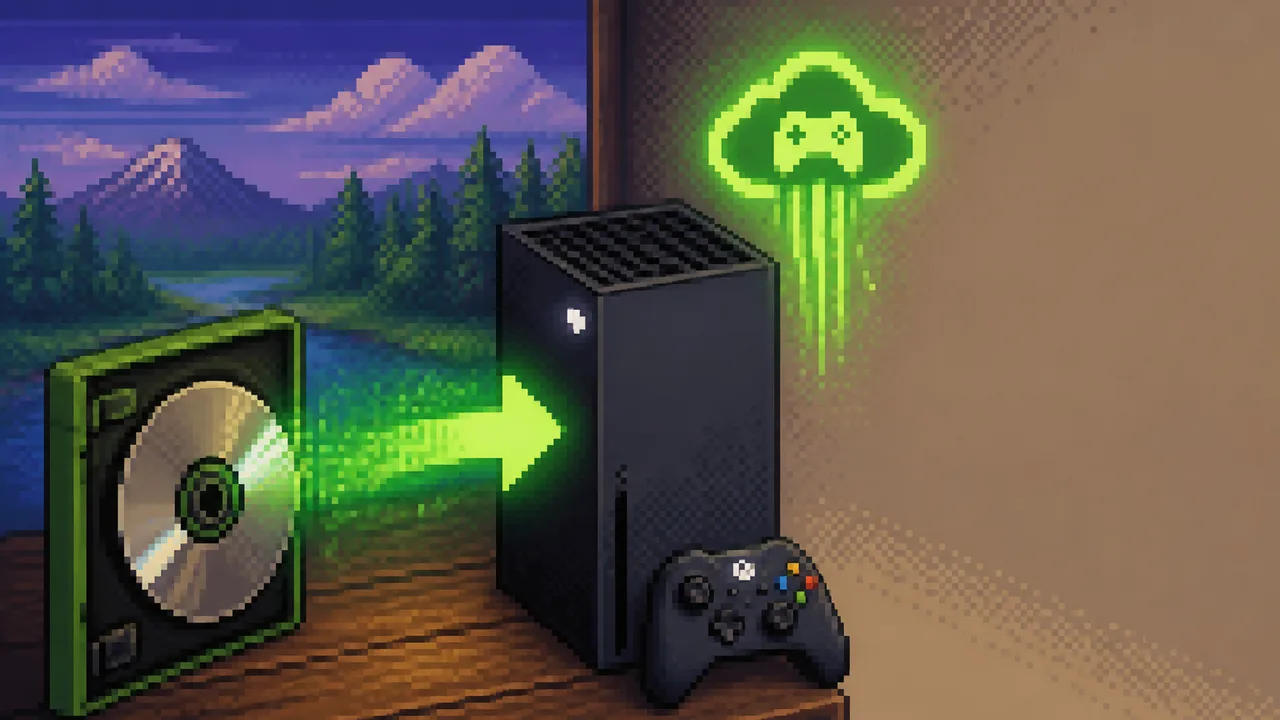
So imagine you've got a shelf full of Xbox discs — Halo, some old Forza joints, maybe a few games you picked up used for three dollars — and Microsoft just says: scan 'em, keep 'em forever, no disc required. That's the pitch. Sounds clean. Might actually be clean.
According to Kotaku, a leaked roadmap and a report sent to publishers that was reviewed by The Verge both point to Xbox's disc-to-digital program rolling out to the general public this month. Separately, leaker eXtas1s reportedly obtained an Xbox roadmap pointing to the same August window, per Polygon. These are two different sourcing threads — the publisher-facing document The Verge reviewed, and the leaker's roadmap — and they land in the same place: August for Xbox One and Xbox Series X owners. VideoCardz adds that the leaked schedule also shows an Xbox 360 rollout starting in 2027, which tells you this isn't a one-and-done feature drop — it's a phased operation with a longer tail. Video Games Chronicle reports that a public beta was supposed to happen in July before the general availability push in August, meaning if that beta ran quietly, some people may have already kicked the tires.
None of this is confirmed by Microsoft yet. But it's a lot of smoke for there to be no fire.
What the Program Would Do
Here's the thing your friend with the big disc collection needs to understand before they start scanning everything in a hype spiral: you don't own your games the way you think you own your games.
Right now, when you've got a physical disc, you own that object. You can sell it, loan it, scratch it, throw it across the room in a fit of rage — it's yours. But the second this program converts that disc to a digital license? You now own access, not a thing. Microsoft can patch what you can run. Storefronts can close. Terms of service can change. The disc sitting on your shelf will always boot if you've got hardware that reads it. A license in a digital library? That lives on someone else's server. It exists because a company decided it should. That's not a scare tactic — it's just how digital ownership works right now, and it's worth knowing before you turn your whole physical library into a row of tiles on a dashboard.
This is the exact tension that made the PS3, PS Vita, and PSP store closures so uncomfortable. When Sony shuttered those storefronts, existing downloads were retained — Push Square confirmed that Sony reversed course on deleting libraries after significant community pushback — but the ability to purchase or re-download titles you hadn't already grabbed was gone. Your access depended on what you'd already secured. The lesson wasn't "digital is fine," it was "digital is fine until the company makes a decision you can't override." That asymmetry doesn't disappear just because Xbox's program launches.
Which doesn't mean the program is a bad idea. Converting a library you actually use and plan to keep is genuinely useful — no disc swaps, faster access, travel-friendly, works with Game Pass in the same ecosystem. For a lot of players, that tradeoff is worth it. The question is whether people are going in with clear eyes.
What Sony Is Doing (Or Isn't)
Honestly? The silence from Sony on this is kind of wild to me.
WCCFTech notes that while Xbox appears to have a rollout timeline in place, Sony hasn't made comparable moves clear — this as PlayStation pushes harder into digital-only hardware. The PS5 Digital Edition exists. A smaller, cheaper all-digital model is out in the market. Sony is clearly not against digital. They just haven't given players a bridge from their physical libraries to that future.
And look — Sony's community isn't identical to Xbox's. There's overlap, but the PlayStation player who's been buying discs for twenty years and now has a digital-only console in their living room is a real person with a real problem that nobody at Sony seems particularly rushed to solve. It's not that a disc-to-digital program is technically impossible for them. It's that they haven't prioritized building one. Whether that's a deliberate strategy, a slow-moving internal process, or just not being as far along as Microsoft — I genuinely don't know. But Xbox moving first on this, if they do, is a concrete differentiator in a moment where both platforms are nudging people toward discless hardware. That's worth paying attention to.
The Community Angle
The gaming community has been split on this one for a while, and the split is pretty predictable once you've been paying attention.
Physical media advocates — and there are a lot of them, especially in retro circles — see disc-to-digital as another step in the wrong direction. The argument isn't nostalgia for nostalgia's sake. It's preservation. Discs work without servers. They work twenty years from now. The number of older games that simply aren't available digitally — either because the license lapsed, the studio closed, or nobody bothered to port them — is genuinely large. An Xbox 360 back-catalog conversion starting in 2027, per VideoCardz, would be huge for a lot of players who have physical copies of games that have never seen a digital storefront — but only as long as Microsoft keeps those licenses active and those servers running.
On the other side, a big chunk of the community is done with discs functionally, even if they still buy them. Lots of people buy physical for the resale value or collection factor while primarily playing off installs anyway. For those players, a streamlined digital library isn't a philosophical compromise — it's just more convenient. The program, if it works as described, is a genuine quality-of-life upgrade for them.
Neither position is wrong. They're just answers to different questions.
What Comes Next
Don't panic-convert your whole shelf the second this goes live. If the program launches in August as the leaks suggest, give it a few weeks. Watch how it actually works. What happens to titles with expired licenses? What does the interface look like? Is the conversion permanent in both directions, or just one? Those details matter and they're not in any leaked document yet.
What is clear is that if Microsoft pulls this off — a functional, well-executed disc-to-digital system that expands over time to cover Xbox 360 and original Xbox titles — they're building something that doesn't currently exist anywhere else in the console space. That's a real thing. It just comes with strings that are worth reading before you sign.
Physical media isn't going anywhere this year. But programs like this are how it starts going somewhere.
More Like This
Piracy Is Now the Only Game Preservation Plan
Frank Cifaldi of the Video Game History Foundation says piracy is the only real game preservation method left. Sony's disc exit made the argument harder to ignore.
Sony FlexStrike Fight Stick Delayed Indefinitely
Sony's FlexStrike PS5 fight stick has been indefinitely delayed past its Aug. 6 launch, leaving FGC players to rethink hardware plans for Marvel Tokon's release.
Peter Molyneux's Final Game: Masters of Albion
Peter Molyneux calls Masters of Albion his last game. The Fable creator reflects on legacy, AI in gaming, and why the UK industry needs more respect.

GTA 6 Trailer 3: The Wait, the Pattern, and What Gets Left Behind
GTA 6 fans are building a case for Trailer 3 from earnings calls and website tweaks. The pattern holds up. But what happens to GTA 5 when GTA 6 arrives?
WoW Gold Farming Strategies From ElonCS's Midnight Stream
ElonCS breaks down lumber farming, cross-realm flipping, and abundance runs in a recent WoW Midnight stream. Here's what actually holds up under scrutiny.
Dune: Awakening Adds Single-Player Mode for Console Launch
Funcom is adding a full single-player mode to Dune: Awakening alongside its September 22nd console launch. Here's what that actually means for the community.
The Cherno Is Building a 3D Game Engine With AI
The Cherno announced a new AI-assisted 3D game engine series. Here's what it means for gamedev education and the junior dev debate.
How to Pick the Right Art Style for Your Indie Game
Imphenzia's framework for choosing an indie game art style covers 15+ options and four must-pass tests. Here's what it gets right — and what it leaves open.