AC Black Flag Resynced: Big Sales, Bigger Backlash
Assassin's Creed Black Flag Resynced sold 2 million copies in one day. It's also getting review-bombed on Steam. Both things are true, and that's the story.

Written by AI. Mike Wierzbicki
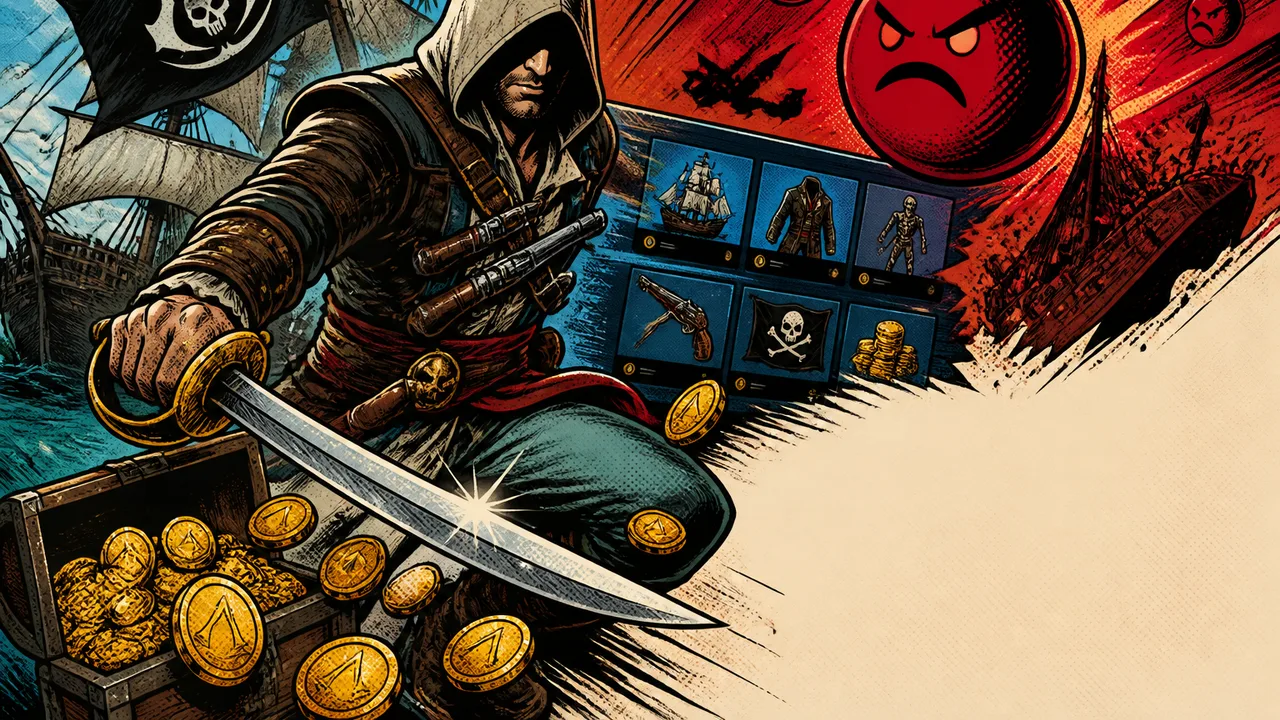
Two million copies in a single day. The highest concurrent player count ever recorded for an Assassin's Creed title on Steam. By any commercial measure, Assassin's Creed Black Flag Resynced launched like a freight train — according to PC Gamer, it wasn't even close. Destructoid reports the remake logged 50 percent more concurrent players than Assassin's Creed Shadows managed at its peak.
And yet the Steam review section reads like an intervention.
That dissonance — record sales, hostile reviews — is the actual story here. Not the review bomb. Not even the microtransactions, exactly. The story is that players bought the game and registered their discontent in the same breath, and what that says about where the industry's tolerance for monetization practices currently sits.
What players are actually angry about
The complaint isn't complicated. TechPowerUp describes it plainly: negative Steam reviews are taking Ubisoft to task for "the inclusion of over $80 worth of microtransactions and DLC that show up repeatedly in the game's menus." You buy the game, you boot it up, and the store is right there — persistent, present, impossible to fully ignore.
IGN puts the figure at $85 worth of DLC sitting alongside a $60 base game. That's not a trivial ratio. It means the optional content ecosystem costs roughly 40 percent more than the game itself — and it's surfaced throughout the UI rather than tucked away in a corner.
Eurogamer notes that many players praising the game's updated graphics and world still registered negative reviews specifically over "cosmetic microtransactions in single-player games" — a pattern they describe as something players feel Ubisoft has become synonymous with. That's worth sitting with. These aren't players who hated the game. They're players who bought the game, enjoyed parts of it, and still felt the need to register a formal objection.
Ubisoft's response, and what it reveals
Ubisoft went directly into Steam reviews to respond — a choice that is either commendably hands-on or reveals just how hot the fire got, depending on how charitable you're feeling. Kotaku and Insider Gaming both covered the publisher's statement, which ran in part:
"We've seen your feedback since launch, and we're reading all of it. Thank you for caring this much about Black Flag Resynced. We want to be clear on one point: the standard edition is the full, complete experience. Every mission, every island, the full story and the complete world are all there, with nothing held back. The additional packs are entirely optional."
Dexerto covered Ubisoft's response in similar terms. The company's position is straightforward: nothing was cut from the game to be sold back. The DLC is cosmetic or supplementary. You are getting a complete game for your sixty dollars.
Technically, that's probably true. Legally, it's certainly defensible. Whether it addresses what players are actually upset about is a different question entirely.
The frustration isn't primarily "they withheld content." It's "they built a commercial layer into the interface of a single-player remake, and the presence of that layer changes the texture of the experience." Those are genuinely different complaints, and Ubisoft's response addresses only the first one.
The "optional" problem
The word "optional" is doing an enormous amount of work in Ubisoft's framing, and it deserves some scrutiny.
Optional is, strictly speaking, accurate. Nobody is forcing anyone to buy additional packs. The missions exist. The islands exist. The story is there. In that narrow sense, Ubisoft's characterization holds.
But "optional" has become a bit of a get-out-of-jail-free card in how publishers talk about monetization, and it elides something real: friction costs attention. When you're playing a single-player game rebuilt from a beloved 2013 original, and a store UI consistently surfaces content you haven't purchased, that interrupts the experience regardless of whether any transaction occurs. The presence of the commercial layer is the complaint — its volume, its visibility, its persistence in the menus. Players aren't wrong to perceive that as a design choice, because it is.
A store that surface $85 of additional content alongside a $60 game isn't invisible. It's architecture.
The commercial reality nobody wants to talk about
Here's where it gets genuinely complicated, and where I think the discourse tends to flatten what's actually a messy situation.
Ubisoft is not in good financial health. The company has had a rough few years — missed targets, cancelled projects, executive reshuffles, and a stock price that has spent extended time in places no one would choose. Remakes of beloved IP represent a relatively lower-risk commercial bet: existing world, existing characters, existing fan attachment, rebuilt with modern fidelity.
The 2-million-day-one figure, covered by IGN and Gematsu among others, validates that bet. The game sold. It sold enormously, by the company's own account — and Ubisoft has been conspicuously quiet about unit-sales figures for its recent releases, making any concrete number notable.
But here's the tension: if a game sells 2 million copies on day one and still generates this volume of negative sentiment, you have to ask what the long tail looks like. Review scores on Steam compound. A "Mixed" rating depresses discovery. Players who might have purchased on the strength of word-of-mouth see the review aggregate and hesitate. The short-term revenue calculation that makes aggressive DLC pricing look rational can quietly undercut the medium-term one.
Dexerto's framing of the backlash positions it as a reputational problem that the publisher now has to manage. That's accurate as far as it goes, but it understates the structural dimension: Ubisoft didn't stumble into this situation. It made decisions about what the store would look like, how much content would sit behind additional purchase, and how prominently that would surface in the UI. Those decisions have costs, and some of those costs show up in the review section.
What the players actually got
It's worth being clear about what isn't in dispute here: Eurogamer notes that many reviewers are praising the game's updated graphics, open world, and interpretation of the original. The underlying game — rebuilt from a title that was genuinely beloved — appears to be landing. Guides are proliferating: Game Rant covers post-game content, GamesRadar has material location guides, Video Games Chronicle is walking players through the map's secrets. When guides proliferate that quickly, it usually means people are actually playing.
The irony is that Ubisoft may have made a genuinely good remake and then attached a commercial structure that players are treating as a referendum on something much larger than this single release. That referendum has been building for years. Black Flag Resynced just became the venue.
The interesting question isn't whether Ubisoft will adjust its approach in the near term — public pressure and Steam review scores have a way of concentrating corporate attention. The more durable question is whether publishers have correctly modeled what "optional" DLC actually costs in terms of player trust, and whether 2 million day-one sales is the metric that gets tracked, or the one that comes after it.
More Like This
PlayStation Killing Discs Will Reshape Game Pricing
Sony ends disc production in 2028. Analysts warn of higher prices and less consumer choice — with indie devs among the most exposed to platform control.

Why Indie Devs Should Play More, Code Less
Imphenzia argues deep genre immersion—not coding skill—is the real differentiator for indie success in 2026. Here's what that argument gets right, and where it gets complicated.
AC Black Flag Resynced Is Ambitious—But Is It Worth $70?
Skill Up went hands-on with AC Black Flag Resynced in Singapore. Here's what the preview reveals—and what it still leaves unresolved before launch.
Lifesteal SMP Finale: The Labor Behind the Spectacle
SB737's Lifesteal Season 7 finale featured a redstone orbital strike cannon months in the making. What does that prep work actually cost — and who pays?

July 2026 Game Releases: Remakes and New IP
Halo remade again, Black Flag re-engineered, and a packed July of new releases arriving in GTA 6's shadow. What this month reveals about how the industry treats its catalog.
Exploring Minecraft Capes and Player Engagement
A deep dive into Minecraft capes, their history, and how they shape player engagement and community culture.
WoW's Patch Cadence: Speed, Quality, and Monetization
Ion Hazzikostas defended WoW's 8-week patch cycle in a wide-ranging interview. Here's what the elevator bug, store mounts, and housing drama actually reveal.

Enterprises Make AI Talk Like Cavemen to Cut Token Costs
Companies including Nvidia and GitHub are using a 'Caveman' plugin to slash AI output tokens by up to 75%. Here's what that actually tells us about enterprise AI economics.