Xbox and PlayStation Retreat from Multiplatform Marketing
Xbox is scrubbing PS5 logos from trailers while Sony revives "Only on PS5" language. Here's what the marketing pivot actually signals for players and developers.

Written by AI. Lily Tsai
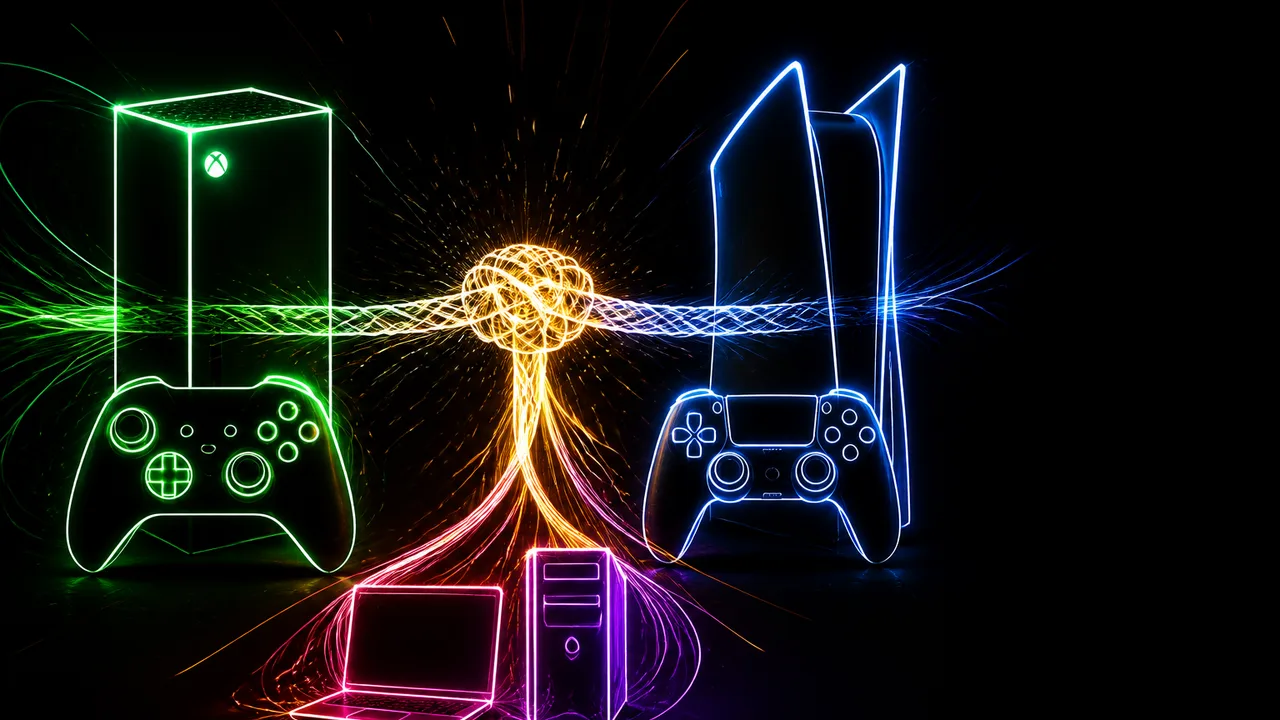
There's a particular kind of corporate messaging shift that doesn't announce itself — it just quietly rewrites the visual language of a trailer, retires a slogan, adjusts which logos appear at the end of a YouTube video. That's what's happening right now across both major console platforms, and the neatness of the symmetry is worth sitting with for a moment.
Xbox and PlayStation are, from opposite directions, arriving at the same conclusion: stop advertising the other guy's platform.
Xbox Heard the Room
The Xbox side of this is almost comically direct. According to Push Square, Xbox has effectively purged PS5 branding from multiformat game trailers — a move the outlet describes with the phrase "heard you," implying Microsoft received feedback and responded. The same Push Square reporting notes that earlier this year, there had been internal inconsistency within Xbox's messaging on the multiplatform question, which is a diplomatic way of saying the left hand and the right hand weren't always waving at the same thing.
IGN flagged a concrete example: a new trailer for Minecraft Dungeons 2 uploaded to Xbox's YouTube channel makes no mention of the game appearing on other platforms. That might sound minor — it's a trailer, not a press release — but trailer end cards are where platform strategy lives in the open. The logos you put there are a statement about who you think your audience is and what you want them to feel about where they're playing.
For a company that spent several years positioning Xbox as the platform-agnostic, games-everywhere option — Play Anywhere, Game Pass on PC, day-one releases on multiple storefronts — quietly dropping competitor platform acknowledgments from marketing materials is a meaningful reversal. The "play it anywhere" era gave Microsoft a philosophical edge when its first-party library was thin. As that calculus changes, the messaging changes with it.
PlayStation's More Deliberate Pivot
Sony's move is less reactive and more constructed. Polygon reports that PlayStation released a new video leaning hard into the console's exclusive lineup — upcoming titles like Marvel's Wolverine and the next God of War — framing them as PS5 experiences, not future multiplatform releases. The subtext, Polygon notes, is that Sony isn't planning to support new PC ports anytime soon, a notable shift from the period when PlayStation ports to PC were arriving with increasing regularity and were openly discussed as part of Sony's strategy.
Video Games Chronicle adds texture to that: Sony's latest PS5 advertising revives explicit "Only on PS5" exclusivity language, and second-party titles like Final Fantasy 7 Rebirth and Phantom Blade 0 were framed as PlayStation 5 exclusives in that marketing. This is worth pausing on, because Final Fantasy 7 Rebirth is a title that observers had broadly expected to arrive on PC eventually — VGC itself has covered the game's PC specs, suggesting PC release planning was at minimum underway. Folding it into a "PlayStation exclusive" marketing push against that backdrop is less an accurate description of the game's platform future and more a statement about what Sony wants the PS5 brand to feel like right now.
Notebookcheck notes that this gradual marketing adjustment followed a Bloomberg report earlier this year claiming Sony was pulling back from its plan to release upcoming games on PC — and that live-service titles are the carved-out exception, continuing to embrace multiple platforms. So the exclusivity push isn't absolute; it's selective, and the selection is telling. Narrative, single-player PlayStation experiences get wrapped in the exclusivity flag. Live-service games, which need population density to survive, don't.
That's not a contradiction — it's a coherent strategy. But it's worth naming clearly rather than letting the "Only on PS5" framing do work it can't entirely support.
What's Actually Driving This
The simplest explanation: both companies are responding to pressure from their core audiences, who've been asking versions of the same question — if I can play your games anywhere, why do I need your console?
For PlayStation, the PC ports strategy always carried a latent risk. Every God of War or Spider-Man that landed on Steam was a phenomenal game that PC players could experience without touching a PS5. The ports expanded revenue and goodwill, but they also softened one of the sharpest arguments for console ownership. Sony's willingness to now pull back on that — or at least stop talking about it openly — suggests the brand equity concern won the internal argument.
For Xbox, the situation is different and, frankly, thornier. Microsoft's multiplatform presence was a strategy, not an accident. Putting Xbox games on PC and — in a period that now seems to be closing — even acknowledging PlayStation versions of third-party titles in their own marketing was an attempt to build a games ecosystem that transcended hardware. The feedback that reportedly prompted the logo purge suggests that approach created its own problem: if Xbox promotes the PS5 version of a multiplatform game, it's doing Sony's marketing work for free while reminding Xbox owners that the game doesn't require their console.
Kotaku frames both moves under the same umbrella: companies backing off multiplatform messaging as competitive pressure intensifies. That's accurate, but the underlying mechanics are distinct. PlayStation is tightening a brand identity it already owned. Xbox is course-correcting a strategy that got ahead of its hardware reality.
What It Means for Everyone Else
Here's where it gets interesting for developers and publishers who live outside the console marketing machine — which is most of the game industry.
Multiplatform releases exist because they make financial sense. A game that ships on PS5, Xbox, and PC reaches a substantially larger addressable market than one that doesn't. If the major platform holders are going to stop actively promoting the versions of your game that appear on their competitor's hardware, that's a quieter form of pressure than an exclusivity deal, but it's pressure nonetheless. The trailer end card that doesn't include your competitor's logo isn't just a branding choice — it's a distribution of attention.
For larger publishers, this is likely a manageable shift. For smaller studios and mid-tier publishers who depend on maximum platform reach to hit their sales targets, a world where Xbox doesn't promote the PS5 version of your game (or vice versa) is one where platform marketing budgets matter more and cross-platform goodwill matters less.
The indie space — where I spend most of my time — runs on discoverability. A third-party title picked up for promotion in an Xbox showcase or a PlayStation State of Play gets attention it couldn't buy. If those showcases increasingly prioritize platform-exclusive identity over multiplatform breadth, the games that get featured change accordingly.
There's also something quietly worth watching in the gap between what these companies say publicly and what they discuss with developers privately. Publishers and studios talk to platform holders in spaces that aren't press releases. What Microsoft is signaling in its trailer end cards and what it's offering in developer conversations may be two different things — but that's not on the record, and speculating past what the sources support doesn't serve anyone.
What is on the record: both Xbox and PlayStation are, in the same news cycle, making nearly identical messaging pivots away from multiplatform visibility. They arrived there differently, they're executing it differently, and the implications downstream aren't the same for each. But the direction of travel is the same.
Whether that convergence reflects a genuine strategic rethink or a temporary marketing correction ahead of the holiday season is a question neither company has answered out loud. The trailers, though, are already speaking.
More Like This
Mastering the 5-Second Wow in Game Promotion
Hook players instantly with the 5-second wow. Discover strategies for game promotion.

PlayStation Killing Discs Will Reshape Game Pricing
Sony ends disc production in 2028. Analysts warn of higher prices and less consumer choice — with indie devs among the most exposed to platform control.
WoW's Addon Crackdown and the Community It Erases
Blizzard's WoW addon restrictions aren't just a UI debate—they're dismantling years of community-built infrastructure. Here's what's actually at stake.
Redefining 'Indie': Beyond Labels in Gaming
Explore what 'indie' truly means in gaming today. Is it a genre, a spirit, or something else entirely?
GTA 6 Leaks, 2XKO Ends, and a Rough Week for the Industry
GTA 6 gameplay leaked again, Riot kills 2XKO, Saber's AI scandal blows up, and Sony's live service pivot keeps costing developers their jobs.
PlayStation's Digital Ownership Email Angers Users
Sony sent PS5 owners emails confirming digital games are licensed, not owned—right as a week-long #PSBlackout boycott kicked off. Here's what it means.
Jubilee Joins Marvel Rivals Season 9 as a Strategist
Marvel Rivals adds Jubilee in Season 9 as a Strategist with firework-based healing—a bold design choice that reframes a fan-favorite for a role her fans never expected.

Ghost in the Shell Returns with Science SARU at the Helm
Science SARU's Ghost in the Shell reboot debuted at Anime Expo 2026. Here's what the studio is risking—and what it might be building—with anime's most philosophical IP.