Ghost in the Shell Returns with Science SARU at the Helm
Science SARU's Ghost in the Shell reboot debuted at Anime Expo 2026. Here's what the studio is risking—and what it might be building—with anime's most philosophical IP.

Written by AI. Lily Tsai
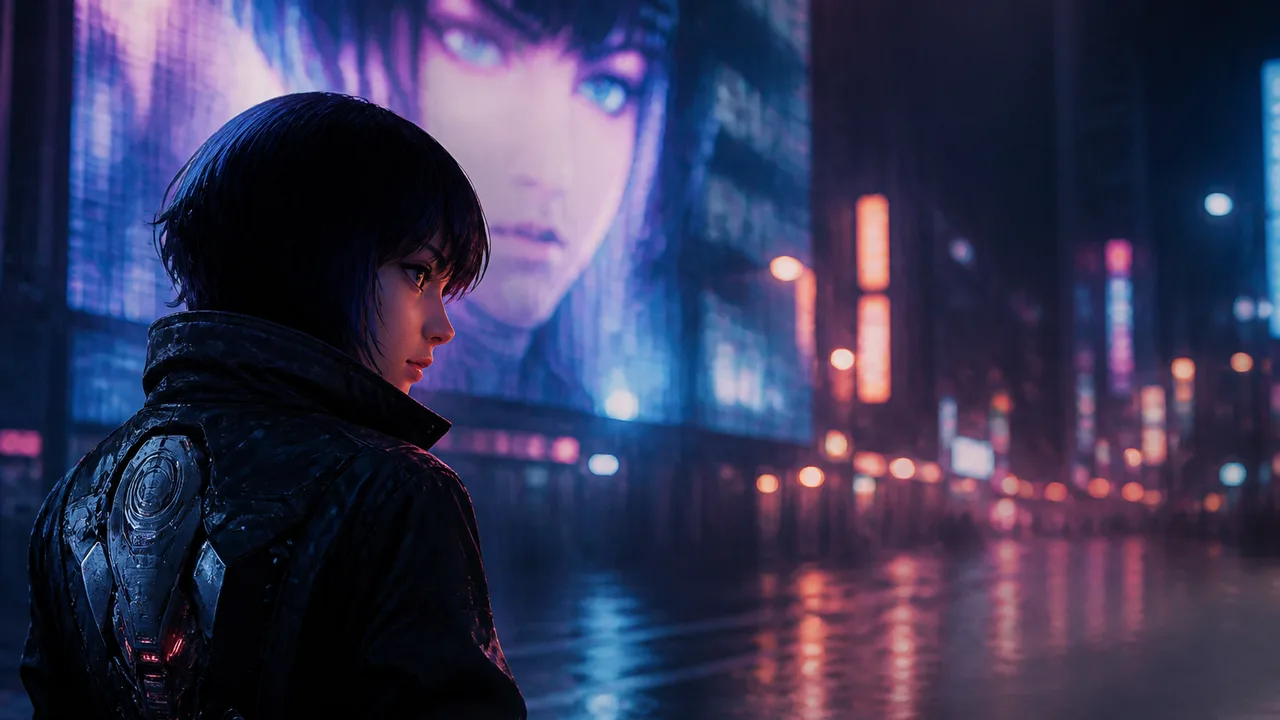
Motoko Kusanagi has been asking the same question for over thirty years: what part of a self survives when the body is replaced, when memory is editable, when identity becomes a file that can be overwritten? For most of the franchise's history, that question felt like philosophy — serious, elegant, the kind of thing you'd encounter in a film studies seminar. It doesn't feel like that anymore. It feels like Tuesday.
The question of where the body ends and technology begins is no longer speculative. It lives in conversations about AI-generated work, about digital permanence, about whose voice is in your earbuds and what "authentic" even means when so much of daily life runs through mediated systems. Ghost in the Shell didn't predict this moment exactly — but it built the conceptual vocabulary for it, and that vocabulary is suddenly everywhere.
Which is part of why the franchise's return, debuted in front of a packed audience at Anime Expo 2026, matters beyond the usual calculus of IP revival and streaming catalogues. Polygon describes the new series as "a true love letter to cyberpunk anime fans," with the first episode offering a fresh take on one of anime's most influential cyberpunk worlds. According to CBR, the new entry recreates the manga's aesthetic with the aim of potentially restoring the cyberpunk anime brand to what it once was. The studio bringing it back is Science SARU — and that's the part I keep returning to.
What Science SARU Is Actually Risking
Science SARU is not a neutral production entity. It was co-founded by Masaaki Yuasa, whose fingerprints are all over its output: Devilman Crybaby, Keep Your Hands Off Eizouken!, Inu-Oh — work that consistently prioritizes emotional texture and formal experimentation over franchise legibility. Even as the studio has evolved with new directors, that auteur DNA hasn't disappeared. It's part of what defines the studio's identity in the industry.
That makes this a genuinely loaded creative bet. Science SARU isn't just adapting a beloved IP — it's an artistically defined studio taking on a franchise that has existed in multiple canonical forms, each beloved by a different subset of fans, each with its own aesthetic logic. Screen Rant notes that Major Motoko Kusanagi's core characterization — quiet, stoic, brooding — persisted through earlier entries including the highly regarded Ghost in the Shell: Stand Alone Complex series. That consistency is part of what made the franchise's identity so durable. It's also a creative cage.
The new series, according to Screen Rant's coverage of the Prime Video release, is more than a visual overhaul — it appears to retell the story from a fresh point of entry, while the visual approach deliberately evokes the disproportionate character styling of '80s and '90s anime. That's a meaningful signal. It says: we are not trying to look contemporary. We are trying to look like the thing that made people fall in love with this franchise in the first place.
The interesting tension for a studio like Science SARU is that this aesthetic callback could read as either deeply considered or commercially cautious. Choosing to echo the manga's visual language rather than modernize aggressively suggests the creative team has opinions — that they believe something was lost in translation across the franchise's many iterations, and that returning to source is a form of argument, not just nostalgia. Studios I've watched closely tend to make choices like that when they have something specific to say, not when they're playing it safe. Whether Science SARU is making a statement or making a product is exactly what one episode can't tell us yet.
CBR's broader coverage points out that the brand carries nostalgia across two generations of international fans, and that the current wave of anime's global popularity has brought renewed attention to the original manga. That context is useful for understanding why this moment makes commercial sense. But it doesn't explain why Science SARU specifically — a studio with a strong creative identity and real things to lose — said yes to it.
What the Community Debate Actually Reveals
There's an r/scifi thread on Ghost in the Shell that's been circulating for a while, asking whether it remains the ultimate cyberpunk and sci-fi anime. The responses are split, and that split is more revealing than the question. Several commenters hold the franchise up as foundational — consistently ranked among top anime by Japanese directors, influential in ways that ripple through every cyberpunk work that followed it. Others argue that something more recent has claimed that throne, with Cyberpunk: Edgerunners — the 2022 Netflix series — cited as having surpassed Ghost in the Shell for at least some fans who grew up on the original.
What I find instructive isn't which title "wins" — that's just fandom. What's instructive is that the community is actively holding both. There's no consensus because the franchise occupies two different functions for two different generations: one group for whom Ghost in the Shell invented a set of ideas, and another for whom those ideas arrived pre-installed in newer work. The reboot is entering a community that is genuinely mid-argument about whether the original source still has authority, or whether it's now one voice among many in a conversation it started.
That's not a hostile audience — it's actually an engaged one. But it does mean Science SARU isn't just competing with the franchise's own legacy. They're competing with every piece of media that absorbed that legacy and became someone's first encounter with these ideas. Studios navigating that kind of layered expectation can't just execute well. They have to give the audience a reason to go back to the origin — not out of obligation, but because the origin still has something to say that the descendants don't.
Whether This Is Worth Rooting For
The Major's questions have migrated out of seminars and into everyday life — that's the strongest argument for why this reboot has real stakes beyond franchise management. Ghost in the Shell was always asking what it means to be a self inside a system that can modify, copy, or delete that self. We are now all inside that system in ways that feel considerably less theoretical than they did even a decade ago.
That's the version of this story I want Science SARU to tell. Not the version that recreates iconic imagery and trusts nostalgia to carry the emotional weight — but the version where a studio with an actual point of view finds something in Motoko Kusanagi's situation that connects to the specific texture of 2026.
Based on one episode, the early signals are cautious optimism at best. The aesthetic choices suggest intention. The Prime Video distribution suggests reach. The Anime Expo premiere suggests confidence. None of that tells me whether Science SARU has a reason to revive this franchise or just the resources to do it.
What I know from watching smaller studios navigate creative inheritance — the moment when a team takes on an IP larger than itself and either gets absorbed by it or finds a way to inhabit it on their own terms — is that the answer rarely shows up in the first episode. It shows up when the story has nowhere to hide: when the worldbuilding is finished, the characters are established, and all that's left is whether the series actually has something to say about being a ghost inside a machine.
Science SARU has built its reputation by having things to say. I'm not counting them out. But I'm not calling it yet.
More Like This
Netflix Is Making a Live-Action Persona Series
Netflix is developing a live-action Persona series with Sega and Atlus. Here's what we know about the creative team, the challenges, and what's at stake.
Star Fox 2026 Review: Great Game, Wrong Ambition
Skill Up reviews the 2026 Star Fox remake: gorgeous, fun, and built exactly like a premium mobile game — which is both its strength and its ceiling.
The Cherno Is Building a 3D Game Engine With AI
The Cherno announced a new AI-assisted 3D game engine series. Here's what it means for gamedev education and the junior dev debate.
How Akira (1988) Rewired Global Animation and Cinema
Katsuhiro Otomo's Akira used 160,000 hand-drawn cels, 327 custom colors, and an inverted production process to permanently change how animated films get made.
Dragon Striker Season 2 Confirmed for Early 2027
Disney confirmed Dragon Striker Season 2 at Anime Expo 2026, setting an early 2027 premiere on Disney XD and Disney+. Here's what the renewal signals.
PlayStation Killing Discs Will Reshape Game Pricing
Sony ends disc production in 2028. Analysts warn of higher prices and less consumer choice — with indie devs among the most exposed to platform control.
Kojima's OD Survives Xbox's Sweeping Reset
Xbox is cutting projects and studios in a major reset, but Kojima's horror game OD stays safe. What does that tell us about where the platform is heading?