Where Pickpockets Thrive in Europe's Busiest Cities
From Barcelona's La Rambla to Lisbon's metro, here's a clear-eyed look at where pickpockets operate in Europe and how tourist crowds make it possible.

Written by AI. Mariel Fontaine
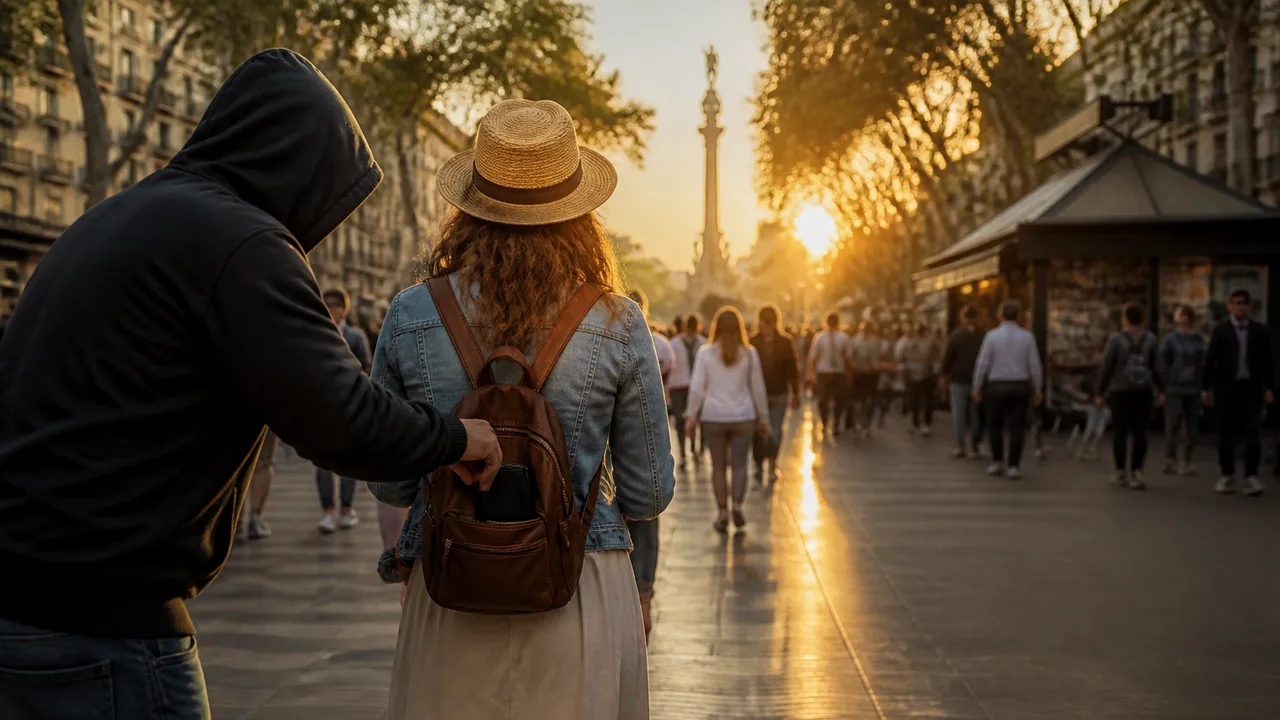
Photo: AI. Asha Kingsley
There is a particular irony in the Vatican posting signs that warn visitors to guard their wallets. The same institution that draws millions of pilgrims and tourists into its famously crowded corridors has, by the logic of its own popularity, created one of the more efficient environments for petty theft in southern Europe. It did not intend to. It doesn't need to. Volume does the work.
That's the core insight buried inside Mark Wolters' recent video for Wolters World, which catalogs nine European cities where pickpocketing is a documented, recurring problem for travelers. The framing is practical and the tone is avuncular — Wolters has spent decades traveling and built a substantial audience on honest, unsentimental advice — but beneath the list format is something worth examining more carefully: the relationship between mass tourism and opportunistic crime is structural, not incidental.
The geography of vulnerability
Wolters opens his list with Barcelona, a ranking that will surprise no one who has walked La Rambla in July. "Pickpockets are a scourge in Barcelona," he says flatly, noting that police presence on the boulevard has not eliminated the problem, only redistributed it somewhat. The Barri Gòtic and the metro fill in the rest of the picture. Barcelona's tourist infrastructure is extraordinary — the city received roughly 12 million overnight visitors annually in recent pre-pandemic years, according to figures from the city's tourism office — and that concentration of distracted, often cash-carrying visitors creates a market that professional thieves treat like any other.
Paris follows, with the Eiffel Tower, the Louvre, and the metro each flagged as high-risk environments. Rome completes an obvious top three, with Wolters pointing specifically to the Colosseum, Vatican City, Trevi Fountain, and tourist buses as concentrated risk points. The pattern across all three is identical: beautiful, unmissable attractions that compress enormous numbers of people into small spaces, slow-moving queues, and moments of deliberate distraction — a coin tossed over a shoulder, a painting on a wall, the view from a platform — that pull attention away from pockets and bags.
Florence and Naples extend what Wolters calls his "Italian trifecta" to a quintet. Florence's concern is structural: the Duomo, the Uffizi, the Ponte Vecchio, and the Accademia funnel tourist traffic through narrow corridors with little room to move. Naples presents a slightly different profile — Wolters singles out the central train station and the Circumvesuviana line toward Pompeii as particular flashpoints. He recounts how his own father was robbed while standing at a ticket machine, a pickpocket working the moment of transaction when attention is split between screen, wallet, and the queue behind.
Prague, Istanbul, Amsterdam, Lisbon, and Venice round out the geography. Each adds texture to the argument. Prague's risk is almost surgically localized: the tourist corridor running from Castle Hill down through Charles Bridge to Old Town Square. "You go two blocks outside of there," Wolters observes, "I'm going to guess the number of pickpocketings drops a lot." Istanbul's Grand Bazaar and Taksim Square, and the ferries crossing the Bosphorus — where the spectacle of two continents meeting tends to absorb all available attention — present comparable dynamics. Amsterdam's risk profile carries a candid additional variable: visitors in the red light district, Wolters notes, "are having a little more fun" and are correspondingly less alert.
Lisbon may be the most instructive case on the list. Wolters describes it as a city he loves deeply, one where he lived for five years, and he links its rising pickpocketing problem directly to its rising tourist volumes. The affordability that drew budget travelers, the tuk-tuks, the summer crowds — all of it has made the city more attractive to petty theft operations. The metro's green line near Intendente and the Bairro Alto district are his specific alerts. The implication is clear even if he doesn't press it hard: Lisbon is not intrinsically dangerous; it became more dangerous as it became more popular. That's a dynamic playing out in a number of European cities simultaneously, and it deserves more scrutiny than most travel coverage gives it.
What "professional" actually means
One thread Wolters returns to throughout is the professionalism of the thieves involved. These are not crimes of opportunity in the amateur sense — someone noticing a wallet sticking out of a pocket. "They're professional thieves all over Europe, all over the world, and they're going to target you," he says, "not just in Paris, in Barcelona, but wherever." The distinction matters because it shapes how travelers should think about risk mitigation.
A professional pickpocket doesn't look like your mental model of a pickpocket. Wolters makes this explicit: the perpetrator "might dress up very, very nicely or they might be a little kid." Organized groups sometimes use children or well-dressed decoys specifically because tourists have absorbed the message to watch for certain archetypes. The craft here is social engineering before it is physical dexterity — manufacturing a moment of confusion, of sympathy, of spectacle — that opens a window. The three-card-monte operators, the fake distressed tourists claiming to need funds for a flight home, the stranger who helpfully points out something on your shoulder: all variations on the same design.
What makes this genuinely useful to understand — rather than simply anxiety-inducing — is that it identifies the mechanism rather than just the location. The mechanism is attention depletion. Any situation that floods your senses with novelty or concern is a situation where your peripheral awareness contracts. That's not a character flaw in tourists; it's a cognitive reality. The Louvre is designed to overwhelm. Trevi Fountain rewards full attention. The Bosphorus ferry offers a view that demands to be stared at. These are features, not bugs, of the experiences in question. Pickpockets have simply learned to work with the architecture of wonder.
The reasonable calibration
Here is where Wolters earns some credit for resisting the genre's worst tendencies. He does not catastrophize. He states clearly, more than once, that most travelers will not be pickpocketed. He has traveled Europe for decades without being victimized himself — "knock on wood," he adds, with the awareness of someone who knows that certainty is not available. His wife had a wallet taken from a diaper bag while changing clothes; his mother lost a bag in Barcelona to the classic "something on your shoulder" ruse. These incidents happen. They are unpleasant. They are rarely dangerous. They are manageable with attention.
The practical mitigation he describes is consistent and unspectacular: keep bags in front of you on public transport, not behind; be particularly alert in ticket-machine queues and bottlenecks; stay anchored when a crowd creates pressure and confusion. None of this is novel advice, but there is something useful in having it attached to specific streets, specific metro lines, specific queues rather than left as a generality.
The deeper question that a video like this raises — and doesn't quite answer, because it's not what the video is for — is what cities, governments, and the tourism industry owe visitors in terms of structural protection. Police on La Rambla haven't solved Barcelona's problem. Signs in Vatican City warning of pickpockets are, at minimum, a form of institutional acknowledgment that feels more like absolution than remedy. As European cities continue absorbing record tourist volumes, the conditions that make petty theft easy to operate are largely conditions those cities have encouraged. The tourists are the product; the attention economy that pickpockets exploit is, in a narrow sense, the same economy that funds the museums and fills the restaurants.
At what point does a warning sign become insufficient?
More Like This
American Tourists in Europe: The Etiquette Gap
From date formats to tipping culture, the everyday customs that trip up American travelers in Europe—and what they reveal about deeper cultural differences.
Small Group Italy Tours Are Reshaping Travel
Small group Italy tours promise authenticity over crowds. But do they deliver — and at what cost to the communities they claim to honor?

World Cup Streaming Scams Fuel a $220M Black Market
Cybercriminals are exploiting World Cup fever with stolen streaming accounts and fake FIFA sites. Here's what the $220M underground economy actually looks like.
Bank Cards Are Built From Cold War Spy Tech
From CIA security passes to a Soviet bug hidden in a wooden seal, the technology inside your bank card has a wilder history than you'd expect.
What Poles Actually Want Tourists to Know
From geography to drinking etiquette, here's what Polish locals wish visitors understood before arriving—and why it matters more than you think.

What Smart Travelers Do Right After Boarding a Plane
From seat checks to jet lag tricks, here's what experienced flyers actually do in the first few minutes after boarding—and why it matters.

Gaiman, Argentina: A Welsh Town Deep in Patagonia
Gaiman in Argentine Patagonia preserves a Welsh settler heritage unlike anywhere else on earth. Here's what the town actually offers curious travelers.
Airport Behavior That Makes Flying Worse for Everyone
From gate lice to baggage claim crowding, Mark Wolters of Wolters World maps the airport habits that slow everyone down—and why they persist.