Gaiman, Argentina: A Welsh Town Deep in Patagonia
Gaiman in Argentine Patagonia preserves a Welsh settler heritage unlike anywhere else on earth. Here's what the town actually offers curious travelers.

Written by AI. Mariel Fontaine
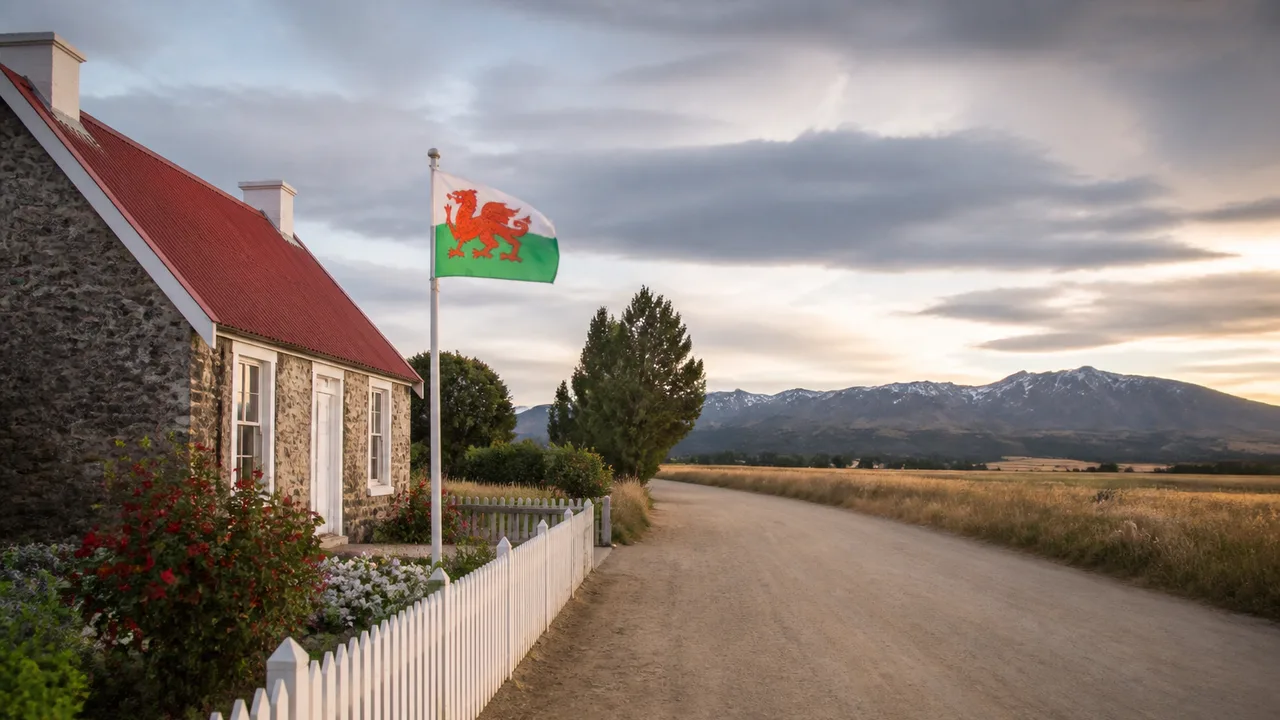
Photo: AI. Hayden Cross
There is a town in the Patagonian steppe, roughly an hour from the Atlantic coast, where the street signs are in Spanish and the cake is Welsh. This is not a theme park recreation. It is Gaiman, a working agricultural community in Chubut Province where the descendants of Welsh settlers who arrived in 1865 have maintained a cultural identity so distinct that the town still hosts an Eisteddfod — the centuries-old Welsh festival of poetry, song, and dance — every year. The cognitive dissonance of eating bara brith beside the Chubut River while Andean wind rattles the windowpanes is, apparently, entirely genuine.
Travel creators Samuel and Audrey documented two back-to-back day trips to Gaiman in a recent video guide, and the portrait that emerges is of a place that rewards exactly the kind of traveler it tends not to attract: the one without a tight itinerary and with a reasonable tolerance for dust.
Getting There, and Why the Route Matters
Gaiman sits about 15 minutes by road from Trelew, or roughly an hour from the coastal city of Puerto Madryn. Renting a car is the most flexible option, but the local bus — operated by company 28 de Julio — is entirely viable and, depending on which route you choose, actively pleasant. There are two options: the highway, which is faster, and Route 7 (Ruta Siete), a parallel country road that adds time but passes through considerably more interesting terrain.
Samuel and Audrey took both on separate trips and recommend asking the bus driver specifically for Ruta Siete when boarding. One practical caveat worth noting: bus schedules are not posted at stops. The advice given to them on the ground was simply to stand at the stop; buses come through roughly every hour. This is either refreshingly analog or mildly stressful, depending on your relationship with uncertainty.
The History Underneath the Tea Cakes
Gaiman's appeal is not separable from its history, and that history is layered in ways that the town's museums take seriously — or try to, within the constraints of limited opening hours.
The Central Chubut Railway tunnel is one of Gaiman's most-visited sites, a 282-meter curved passage built in 1914 after local residents refused to allow the train to run through the town center. The railway itself operated from 1888 to 1961, connecting the Chubut River valley to the port at Puerto Madryn, and was the first in Patagonia. Its closure left the tunnel as one of the few remaining physical traces of that era. Information panels inside are displayed in Spanish, English, and Welsh — a linguistic triptych that neatly summarizes Gaiman's identity. A practical note from the video: the tunnel is not well lit, curved enough that you cannot see from one end to the other, and has only one entrance and exit. Audrey mentions on camera that she would not walk it alone. A phone flashlight and a companion seem like reasonable precautions.
The Tehuelche-Mapuche Museum — formerly the Gaiman Anthropological Museum — occupies one of the town's earliest two-story buildings and addresses the people who inhabited this land before any European contact. Critically, it also examines the relationship that developed between the Tehuelche people and the Welsh settlers: not a romanticized alliance, but a practical one in which the Tehuelches helped the newcomers survive a climate and landscape wholly unlike anything they had known. That story — indigenous people teaching European immigrants how to live on land the Europeans had claimed — sits uncomfortably alongside the more triumphalist narratives of settler history, and the fact that Gaiman's museum engages with it at all is worth noting. Tours and panels are in Spanish only, so prior knowledge of the language helps.
The Regional History Museum, housed in the former train station, displays furniture, crockery, and farming equipment brought over by the original Welsh settlers, along with exhibits on the Eisteddfod tradition. It was, at the time of filming, open only one day per week — a scheduling reality that demands research before arrival.
The first house built in Gaiman — a stone structure erected in 1874 by David D. Roberts and Jemima Jones, the settlement's founding couple — is open for guided tours only. The guide who led Samuel and Audrey through was, they note, trilingual: Spanish, English, and Welsh-in-progress. The house still conveys, even with its original reed-and-mud roof replaced by metal, what the video characterizes plainly as a life that "was not easy."
The Tea Houses: Ritual, Not Novelty
Welsh afternoon tea in Gaiman is the experience most visitors come for, and on this point the travel consensus and the video are aligned: arrive hungry. Samuel and Audrey did not follow this advice on their first visit, having eaten lunch at Gwalia Lân (a pub in the town center that, while proudly Welsh in signage and atmosphere, serves Argentine-Italian fare like pumpkin sorrentinos in leek sauce). They describe the consequence at Ty Gwyn — their first tea house — with some candor.
Ty Gwyn offers what the video describes as a "very cozy feel," more domestic dining room than formal tearoom. The spread includes pre-buttered bread, scones, sandwiches, and multiple cakes, among them a cream pie that functions, in practice, as a deconstructed scone: pastry crust, clotted-cream filling, topped with jam. "You've got it all," as the video puts it.
Ty Te Caerdydd carries the greater fame, largely because Princess Diana took tea there during her 1995 visit to Argentina. The room reads accordingly — more hotel than home, elegant where Ty Gwyn is warm. At the time of the visit, the table held eight varieties of cake, including banana cream pie, lemon and coconut squares, dulce de leche cake, and quince jam with meringue. The menu at both establishments follows similar logic: Welsh staples (bara brith, cream pie, scones) hybridized with Argentine flavors in ways that feel organic rather than calculated.
"Every cake is such a different taste," Samuel observes during the Ty Te Caerdydd visit. "And so you come here and it's like — every bite is different." This is the kind of remark that reads as filler until you consider that afternoon tea in Gaiman is genuinely the town's central cultural export, the one activity that has drawn visitors for decades, and its quality has to be maintained by families running small businesses with no safety net of corporate backing or mass tourism to absorb a bad season.
Quintas Narlú: The Orchard Argument
The video's most affecting stop is also the least expected. Quintas Narlú is a working farm on Gaiman's outskirts that operates a small shop selling homemade jams, honey, loose tea, Welsh cake, fresh berries, and lavender. The owner, having sold Samuel and Audrey some raspberries and cake, invited them to walk the apple orchard and picnic. They did.
"No one's in a rush here," one of them says. "Everyone's just hanging out. They want to chat with people, find out where you're from. This is a place that you have to visit kind of like with no itinerary and with no rush."
The farm is not a tourist attraction in any formal sense. It is a farm that happens to welcome visitors, which is a distinction worth preserving. The raspberries described in the video were fresh, in season, and purchased directly from the people who grew them — the kind of encounter that gets written about in travel pieces with a frequency inversely proportional to how often it actually happens.
What Gaiman Is, and What It Isn't
The Gaiman Panoramic Point — a short hike above the railway tunnel, topped with a sculpture called The Shape of Silence — offers views that the video describes, with admirable honesty, as "not that impressive." You can see the main street in one direction and farmland in the other. Samuel and Audrey climbed it because they were already there.
That kind of calibrated expectation-setting is, in a way, the most useful thing this video does. Gaiman is not a dramatic destination. It is a small town with irregular museum hours, unpublished bus schedules, dusty infrastructure, and cake that has sustained a Welsh identity across 160 years and 11,000 kilometers. Whether that combination constitutes a reason to make the trip from Puerto Madryn is a question only the traveler can answer — but at least the question now has most of its facts.
More Like This

California's Channel Islands Hold 13,000 Years of History
From pygmy mammoths to the Lone Woman of San Nicolas, California's Channel Islands preserve one of North America's deepest human records — if we bother to look.
Casa del Desierto: Barstow's Forgotten Harvey House
Barstow's Casa del Desierto is a stunning 1911 Harvey House in the Mojave Desert—and one of America's least-visited Amtrak stations. Here's why it still matters.
What Living in Antarctica Is Really Like
McMurdo Station houses 900 people, 24/7 pizza, and live music. The field camps have bucket toilets. Antarctica contains multitudes.
Inside Argentina's 7-Generation Working Estancia
Estancia La Tomasa near Buenos Aires has welcomed guests since 2023. Here's what a weekend on this 140-year-old working ranch actually looks like.

Driving Patagonia's Route 40: What Van Life Actually Looks Like
Kara and Nate drove 2,000 miles across Patagonia in 8 days. What they found reveals the gap between van life mythology and Patagonian reality.
Estancia Villa Maria: A Tudor Manor Near Buenos Aires
Estancia Villa Maria blends Argentine cattle-boom history with Tudor architecture and four daily meals—40 minutes from Ezeiza Airport. Here's what to expect.

Where Pickpockets Thrive in Europe's Busiest Cities
From Barcelona's La Rambla to Lisbon's metro, here's a clear-eyed look at where pickpockets operate in Europe and how tourist crowds make it possible.

Airport Behavior That Makes Flying Worse for Everyone
From gate lice to baggage claim crowding, Mark Wolters of Wolters World maps the airport habits that slow everyone down—and why they persist.