Estancia Villa Maria: A Tudor Manor Near Buenos Aires
Estancia Villa Maria blends Argentine cattle-boom history with Tudor architecture and four daily meals—40 minutes from Ezeiza Airport. Here's what to expect.

Written by AI. Mariel Fontaine
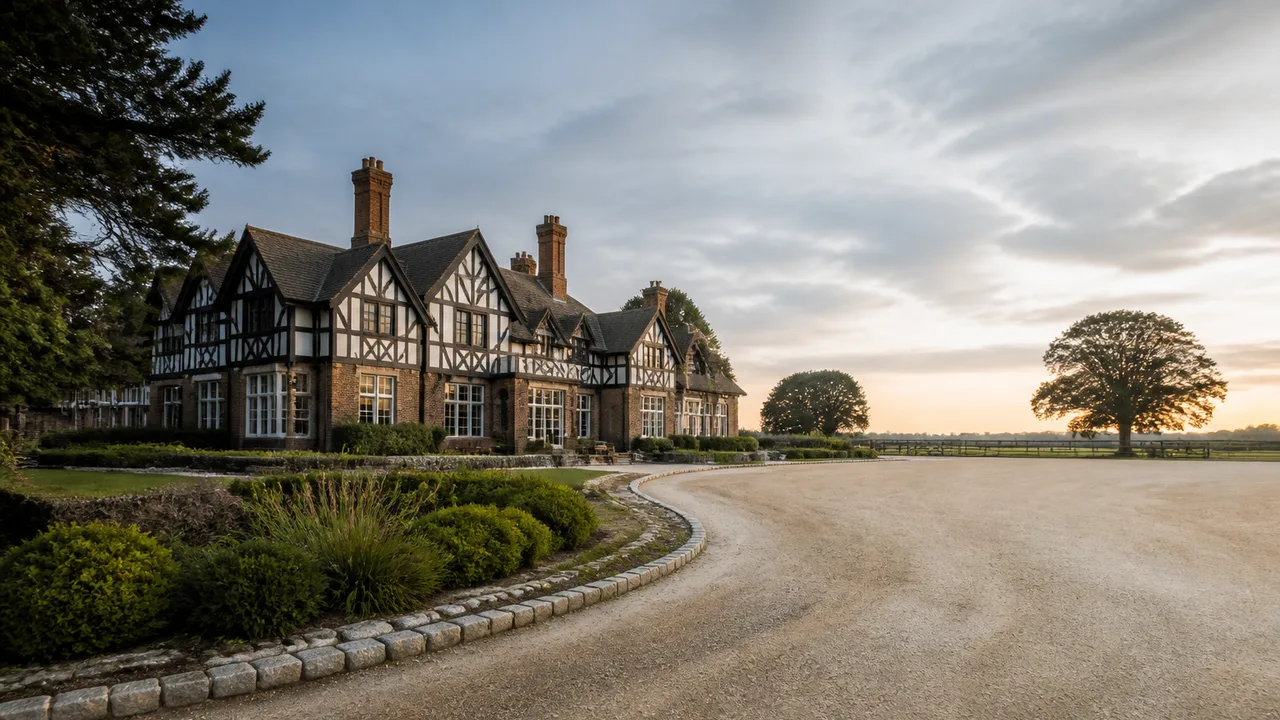
Photo: AI. Hayden Cross
There is a particular kind of travel logic that rarely gets examined: the idea that the hours before a long-haul flight should be spent in an airport lounge, nursing lukewarm coffee and watching departure boards. Estancia Villa Maria, sitting forty minutes from Ezeiza International Airport in the Pampas flatlands, proposes a different arrangement entirely—one involving four-poster beds, four meals a day, and a carriage ride through 74 hectares of gardens designed by a disciple of one of South America's most celebrated landscape architects.
Whether that proposition suits you depends on what you want from travel's closing hours. But it's worth understanding exactly what you're saying yes to.
A House That Outlived Its Purpose—and Found a Better One
The property's origin story is, in miniature, Argentina's origin story. Vicente Pereda founded the cattle ranch in the late 1800s, at the height of the country's beef boom—a period when Argentina was positioning itself as one of the world's dominant meat producers and the landed families of the Pampas were accumulating wealth on a scale that demanded architectural expression. In 1919, Vicente's son Celedonio hired Alejandro Bustillo to design the family's summer villa. Bustillo, who would go on to shape the visual identity of Argentine Patagonia with his work in Bariloche, delivered something unexpected for the South American countryside: a Tudor-Norman manor completed in 1927, all steep rooflines and English country-house gravity, transplanted to the Argentine flatlands.
It is an odd building in the best possible way. Tudor architecture in the Pampas is not a statement that resolves itself neatly, and the estancia doesn't try to make it resolve. The incongruity is part of the texture.
The surrounding gardens carry their own lineage. Benito Carrasco, who designed them, had worked alongside Carlos Thays—the Franco-Argentine landscape architect responsible for Buenos Aires's Jardín Botánico and dozens of the city's public parks. The result, across 74 hectares, is a planted landscape of over 300 species of trees and vegetation. In autumn, which is when Samuel and Audrey visited and documented their stay in a recent video, the property turns golden in ways that are apparently difficult to stop describing once you've started.
The Structure of a Stay
Estancia Villa Maria operates on a rhythm that is essentially pre-industrial in its logic: you arrive at noon, eat lunch, have afternoon tea, eat dinner, sleep, eat breakfast, and leave. Four meals are included in the room rate, and the schedule is not incidental—it is the architecture of the experience.
The sixteen guest rooms are split across two buildings. The main house holds eleven rooms; the Casa Francesa, a few steps away, holds five, operates as an adults-only space, and includes a penthouse. Samuel and Audrey stayed in a suite in the main house, which they describe as opening into a receiving room and office-type space before leading to a bedroom with a four-poster bed and a bathroom with what sounds like considerable square footage.
The meal sequence they document is worth paying attention to, not because every dish is remarkable, but because the pacing reveals something about the estancia's operating philosophy. Afternoon tea—merienda—arrives on a two-tier tray: scones, sandwiches, a brownie, a coconut and dulce de leche square, quince cookie, red velvet cookie with white chocolate chips. Dinner is three courses by firelight: fried mozzarella, broccoli and cheese soup, then mushroom risotto or grilled salmon, then pancakes with dulce de leche and artisanal strawberry ice cream. Breakfast the following morning is a buffet of medialunas, bread, cake, ham, cheese, fruit, cereal, yogurt, juice, coffee—and then, apparently, eggs and bacon for those who wanted more.
Lunch, when they got to it, was empanadas followed by steak with chimichurri and salsa criolla, and dessert. The flan with dulce de leche reportedly held its own.
"You will be very well fed at Estancia Villa Maria," Audrey says in the video. This is not an overstatement.
What the Activities Actually Are
The estancia's activity list reads wide: an 18-hole golf course, clay tennis court, swimming pool, football field, croquet, billiards room, board games, horse riding twice daily (mornings from 10 a.m. to noon, afternoons from 2 to 4 p.m.), carriage rides, walking trails, and polo lessons or demonstrations that can be arranged at additional cost.
In practice, for a one-night stay, you will use some fraction of this. The carriage ride through the property takes twenty to thirty minutes and covers the main gardens. The horse riding operates in the same time windows. The walking trails let you fill in what the carriage doesn't reach. Samuel and Audrey note, without apparent regret, that they "only scratched the surface" with twenty-four hours—which is probably honest and probably fine. The point of the activity list is not to be exhausted by it; it is to ensure that whatever your group needs—a toddler who wants a slide, a golfer, someone who just wants to sit in a garden—there's something available.
One practical note from the video: if you want an Argentine asado from the estancia's grilling station, visit on a Friday, Saturday, or Sunday. On weekdays, the kitchen operates from a standard menu. The exception, as it turned out, was a French couple who had specifically requested barbecue and received it on a Monday—which suggests the estancia is not entirely inflexible, but that the weekend visits are the more reliable path to smoke and fire.
The Framing Worth Questioning
The travel-content framing for a property like this is almost always "perfect pre-flight stop," and Estancia Villa Maria leans into that angle hard—not unreasonably, given the forty-minute drive to Ezeiza. "Do the estancia before you fly out," Audrey says in the video. "This one is close to the airport. And it's just so convenient, such a peaceful way to unwind."
That's fair as far as it goes. But the pre-flight framing subtly reduces what is actually a fairly substantial property to a transit amenity—an airport lounge with better empanadas and a century of history. For travelers spending more than one night, or for those interested in the Pampas as a landscape worth understanding rather than merely relaxing inside, the estancia's depth becomes more legible. Bustillo's architecture, Carrasco's gardens, the cattle-boom economics that made the whole thing possible—these are not footnotes.
The conversion of Argentine estancias from working agricultural estates into hospitality properties is itself a story worth noting. It's a pattern common to landed estates across multiple continents: land that was productive within one economic model becomes experiential within another. The labor and infrastructure required to maintain 74 hectares of curated parkland, sixteen guest rooms, four daily meals, and a stable of horses is not trivial, and it's paid for by guests rather than cattle. That's a different relationship with the land than the one Vicente Pereda established in the 1880s, and it's worth sitting with that difference, even briefly, while you're eating your merienda.
None of this is a reason not to go. It's a reason to go with your eyes open to what you're actually visiting—not just a beautiful property, but a particular moment in the long economic biography of the Argentine countryside.
The golden autumn light, apparently, is its own argument.
More Like This

Air New Zealand's Business Class Dilemma
Air New Zealand's new business class faces criticism for its lack of privacy and direct aisle access, raising questions about its competitive edge.

Spirit Airlines Is Gone. Your Airfare Bill Isn't.
Spirit Airlines shut down in May 2026. For millions of price-sensitive travelers, that yellow plane was the only thing keeping fares honest. Here's what that costs.
What It Actually Takes to Work in Antarctica
NOVA's Caitlin Saks and Arlo Pérez travel to McMurdo Station and find that Antarctica's hardest lessons have nothing to do with science.
Inside Argentina's 7-Generation Working Estancia
Estancia La Tomasa near Buenos Aires has welcomed guests since 2023. Here's what a weekend on this 140-year-old working ranch actually looks like.

Driving Patagonia's Route 40: What Van Life Actually Looks Like
Kara and Nate drove 2,000 miles across Patagonia in 8 days. What they found reveals the gap between van life mythology and Patagonian reality.
Como 1907: Building Football's Most Ambitious Brand
The Hartono brothers didn't just buy a football club—they bought a canvas. How Como 1907's tourism-meets-football model could rewrite sports business.

Airport Behavior That Makes Flying Worse for Everyone
From gate lice to baggage claim crowding, Mark Wolters of Wolters World maps the airport habits that slow everyone down—and why they persist.

Basic French Phrases That Help Tourists in France
A handful of French words can shift how locals treat you in France. Here's what actually matters, and why the effort carries more weight than fluency.