Casa del Desierto: Barstow's Forgotten Harvey House
Barstow's Casa del Desierto is a stunning 1911 Harvey House in the Mojave Desert—and one of America's least-visited Amtrak stations. Here's why it still matters.

Written by AI. Helen Papadopoulos
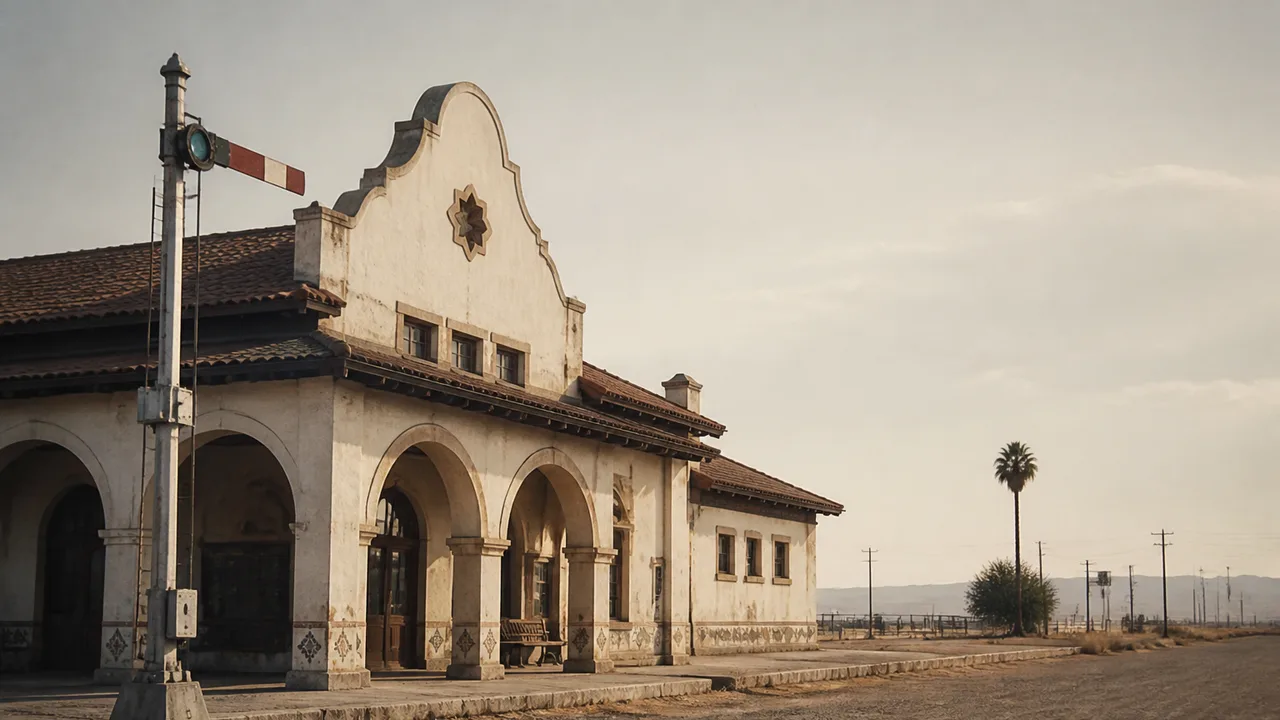
Photo: AI. Marcel Dubois
The ancient Romans had a word for the infrastructure of empire: cursus publicus, the network of roads, relay stations, and rest houses that made long-distance movement possible. Strip away the togas and the Latin and you find something structurally identical in the American Southwest of the 1870s: a transcontinental railroad punching through hostile terrain, and the urgent, unresolved question of what happens to human beings in the hundreds of miles between stations.
The answer, when it came, arrived in the form of a British immigrant named Fred Harvey.
The YouTube channel Fourth Place recently visited Casa del Desierto — "House of the Desert" — the 1911 Harvey House and Santa Fe Railway station in Barstow, California, and the resulting video is a useful primer on a building that most Americans have never heard of and very few have visited. Barstow Station logged just 3,300 passengers in 2025, making it one of the least-trafficked Amtrak stops in California. But passenger counts are a strange metric for measuring a place like this. The more interesting numbers are the ones behind the building's origins: over 80 Harvey Houses at their peak, one new location every hundred miles along the Santa Fe Railway, and a single entrepreneur who — depending on which historian you favor — either civilized the American West or, at minimum, made it considerably more tolerable to cross.
The Problem Fred Harvey Solved
Before Harvey, eating on a long-distance train in America was something between an adventure and a punishment. Stops were short, food was bad, and the traveler's only recourse was to accept the situation or go hungry. The Fourth Place presenter frames it plainly: "Hospitality did not exist on long-distance passenger rail" before Harvey entered the picture.
Harvey's solution was elegant in its simplicity. He approached the Santa Fe Railway with a proposal that required almost nothing from the railway itself: Harvey would fund and operate clean, affordable restaurants and hotels at regular intervals along the route. The railway provided the space and the trains. Harvey provided everything else. The first location opened inside the Topeka, Kansas depot in 1876. By the time the concept had fully matured, the Fred Harvey Company was not just running lunch counters — it was operating full hotels, catering long-haul trains, and functioning as what we might now call a vertically integrated hospitality brand. America's first restaurant chain, predating the golden arches by roughly eight decades.
The Barstow station was designed as a "three-in-one": Santa Fe depot, Harvey House hotel, and restaurant, all under one roof. The current building — the 1911 replacement after the original burned in 1908 — is a Moorish-inflected Spanish Renaissance structure, white stucco arches running in long arcades that shade both upper lodging corridors and lower passenger waiting areas. The Fourth Place presenter notes that its authorship "is still disputed by scholars, either credited to Francis W. Wilson or Mary Colter herself" — a small but telling detail. Mary Colter, the architect most associated with Harvey Houses and with a distinct Southwestern vernacular style, is a figure who has received serious scholarly attention in recent decades precisely because her work was for so long attributed to others or ignored entirely. That the question of who designed Casa del Desierto remains open says something about how unevenly the historical record has been maintained.
What Survives and What Doesn't
The history of Harvey Houses after the mid-twentieth century is mostly a history of loss. When passenger rail ridership collapsed in the 1960s and 70s, the Santa Fe Railway did what any rational corporation would do: it shed the overhead. Stations were abandoned, sold, or demolished. The Fourth Place presenter mentions encountering the Harvey House in Amarillo, Texas, "fenced off and actively fading away as we speak" — a reminder that "historic" and "protected" are not synonyms.
Barstow landed on the luckier end of the spectrum, though not without cost. The city purchased the property in the 1990s. The 1992 Landers earthquake inflicted serious structural damage, and Barstow subsequently invested more than $8 million in restoration. Today the station operates as a multi-use civic building: Amtrak stop, city government offices, the Barstow Area Chamber of Commerce, the Western America Railroad Museum, and the Route 66 Mother Road Museum all share the space. Wedding receptions are held here. There are bridal and groom rooms available for rent. Outside, a collection of vintage rail cars — including a Santa Fe locomotive, a Union Pacific locomotive, and a Pullman business car from the Arizona and California Railroad — sits on display.
This is, depending on your disposition, either a creative adaptive reuse strategy or a melancholy improvisation. The building survives because it has been made useful in ways its designers could not have anticipated. Whether that constitutes preservation or a kind of ambient repurposing is a question worth sitting with.
Meanwhile, in Los Angeles, the Harvey House dining hall inside Union Station — a more prominent property in a more prominent city — sat empty for decades and was restored only as of May 2026, now housing a new restaurant. The contrast is instructive: high-profile buildings in high-traffic cities attract investment. Buildings in Barstow attract wedding parties and hope.
The Water Stop Problem, Revisited
There is something almost too neat about Barstow's current situation. The Fourth Place presenter puts it directly: "The city of Barstow itself sort of functions like a modern-day water stop, an oasis of fast food and gas stations in the desert between the Southern California megalopolis and Las Vegas." The town that Fred Harvey helped build by making it a necessary stopping point on the transcontinental route now exists as a necessary stopping point on the I-15. The mechanism changed; the function didn't.
What did change is the economics of who benefits. Harvey Houses were a genuine population multiplier — the presenter notes that they "single-handedly contributed to massive population growth within the desolate water stop towns they were constructed in." The hospitality infrastructure brought workers, visitors, and eventually residents. The contemporary highway-stop model — chains, gas, a brief exit — extracts money from passing travelers without meaningfully rooting them to place. Barstow's stagnant economic activity and population growth are the predictable result.
The question of whether restored historic rail infrastructure could reverse any of this is not purely sentimental. The presenter notes that Brightline West, the private high-speed rail operator currently building a line between Las Vegas and the greater Los Angeles area, did not include Barstow in its route. Whether that decision reflects Barstow's current population density, its geographic position, or simply the economics of high-speed rail development is not entirely clear. What is clear is that the station — which still receives one Southwest Chief train daily in each direction, Chicago-bound at 8:47 p.m. and Los Angeles-bound at 3:34 a.m. — operates at the margins of a national passenger rail network that itself operates at the margins of American transportation policy.
What the Building Is Actually Doing
I find myself less interested in the nostalgic frame — the Wild West, the glory days of passenger rail — than in the structural question the building poses right now. Casa del Desierto is keeping itself alive through a combination of civic subsidy, event revenue, museum function, and the sheer accident of architectural distinction. It works because it is genuinely beautiful, and because beauty, it turns out, has some practical utility even in Barstow.
Fred Harvey understood this before almost anyone else in the American West. His argument was not simply that passengers deserved decent food. It was that the quality of an experience shapes the demand for the infrastructure that delivers it. Harvey Houses did not just serve the transcontinental railroad — they made people want to take it. "Fred Harvey single-handedly popularized long-distance passenger rail travel," the Fourth Place presenter argues, crediting him with the title "great civilizer of the American West."
That last honorific deserves some scrutiny — the history of who got civilized, and at whose expense, in the nineteenth-century American Southwest is considerably more complicated than a hospitality success story. But the operational insight holds: infrastructure without experience is just inconvenience. Casa del Desierto, at its 1911 peak, was the argument made in stucco and terracotta tile.
Whether anyone in contemporary American transportation policy is listening is a different question entirely.
More Like This
WW1 Trench Life: What the Western Front Was Really Like
From Pals' Battalions to the Vickers gun, a new documentary unpacks the grim machinery of survival on the WW1 Western Front in unflinching detail.
The Transcontinental Railroad's Forgotten Price Tag
The golden spike ceremony hid a messier truth: fraud, erasure, and collapse. Here's the full accounting of what America's railroad actually cost.
Inside Argentina's 7-Generation Working Estancia
Estancia La Tomasa near Buenos Aires has welcomed guests since 2023. Here's what a weekend on this 140-year-old working ranch actually looks like.
California's Ghost Towns Google Maps Can't Find
13 hidden California ghost towns erased by floods, fraud, and water wars—each with a stranger story than anything Bodie ever offered.
Asherah: Was She the Wife of the God of Israel?
Inscriptions, figurines, and Ugaritic myth suggest ancient Israelites worshipped a goddess alongside Yahweh. The evidence is real. The debate is very much alive.
Waco Siege: Ancient Echoes in Modern Tragedy
Explore the 1993 Waco siege through the lens of ancient cult dynamics and modern law enforcement challenges.
Medieval Knights: The Gap Between Code and Conduct
Medieval knights lived by a strict code of chivalry—and routinely broke it. A look at the real training, politics, and moral failures behind the armor.
Searching for London's First Roman Road Under Lambeth
Time Team investigates whether London's first Roman road ran through Lambeth Palace gardens—and why the Romans crossed the Thames there before building Londinium.