When Michigan Buried 30,000 Frozen Pizzas in 1973
In 1973, Ossineke buried 30,000 frozen pizzas after a botulism scare. The public funeral reveals how food safety, customer trust and waste collide at scale.

Written by AI. Sofia Ramirez
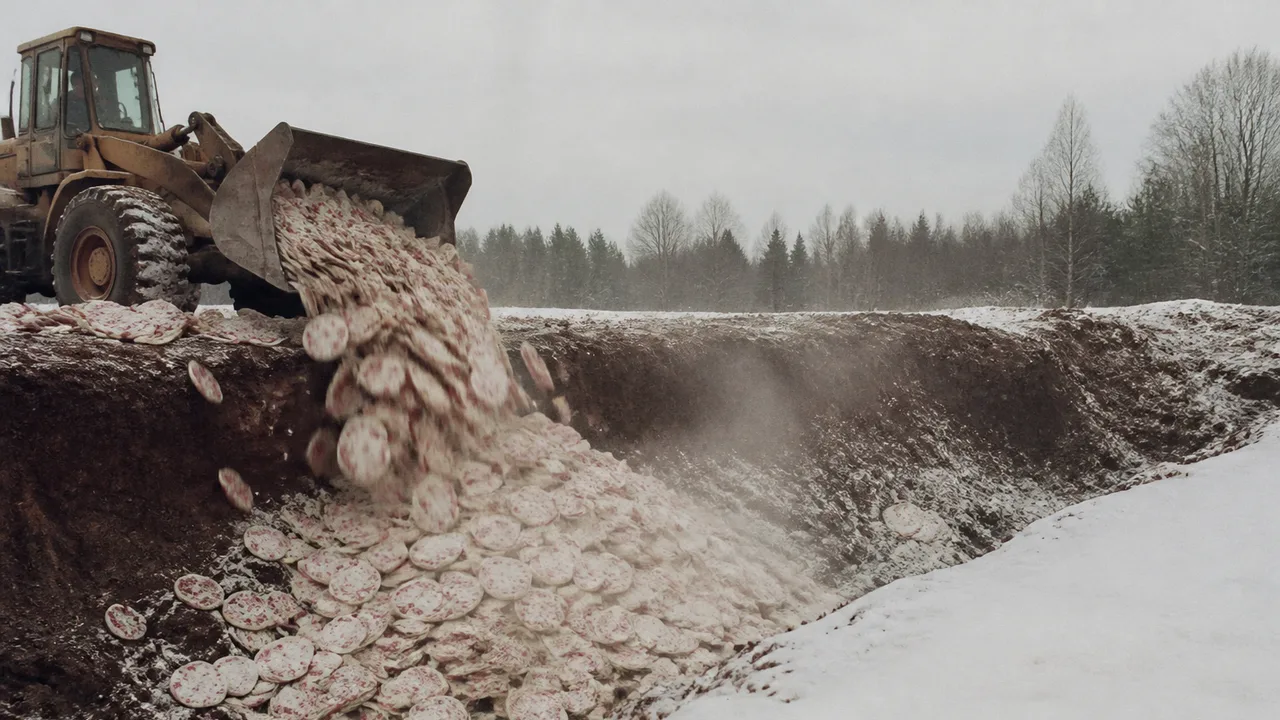
On March 5, 1973, hundreds of people gathered in Ossineke, Michigan, to watch 30,000 frozen pizzas go into the ground. Flower garlands decorated the burial site. Governor William G. Milliken attended. Someone had turned a food disposal job into a funeral, and the crowd showed up to see it.
The pizzas came from Papa Fabbrini Pizzas, a local business caught in a botulism scare. Whether any of the buried pizzas actually contained botulinum toxin remains unclear. The fear was enough to make 30,000 meals unsellable.
That number is the detail that resists being filed away as small-town eccentricity. A household throws out dinner. A frozen-pizza business facing a safety scare has to deal with inventory by the thousands. The funeral gave Ossineke a way to witness that enormous loss, even as it made the story easier to remember than the business problem underneath.
A Safety Scare at Factory Scale
Frozen pizza is built for a journey beyond the place where someone makes it. Production, packaging, cold storage and sales all have to work before a customer can take one home. That reach is the product's advantage: a meal can wait in a freezer until someone wants it. It also expands the consequences when buyers lose confidence. A shop cannot make a worried customer feel safe simply by pointing out that the other boxes look fine.
Botulism is a serious food-safety concern, so a decision to dispose of food under suspicion has an understandable logic. The scale still deserves attention. Thirty thousand pizzas represent ingredients, labor, packaging, freezer space and expected sales. None of those costs vanishes when the food does. Workers may have made the pizzas, but a production count rarely names them. Customers may have counted on an inexpensive meal, but the funeral photographs would have shown a burial rather than anyone's dinner table.
It is tempting to look at a mound of edible-looking food and ask why it could not go to people who needed it. That question assumes appearance could settle a safety concern. It could not. The relevant choice in Ossineke was how to handle pizzas people feared might be unsafe, not how to find enough hungry people to take them. Food waste and food safety can pull in different directions; this episode puts both in the same hole.
The public ceremony introduced a second, stranger calculation. Disposal could have happened without spectators. Holding a funeral made the decision visible, invited the community into it and gave a local business a way to acknowledge a loss that everyone could count. It also offered humor at a moment when customers had reason to worry. Those purposes can coexist. A flower garland does not answer a safety question, but it tells neighbors the company is treating the situation as an event rather than pretending nothing happened.
Milliken's presence enlarged that audience. A governor at a pizza burial makes a memorable headline. It also shows how a local food business and its customers could become a matter of public attention when confidence in a product broke down. What it does tell us is that the loss had become visible well beyond the factory.
What Happens After the Burial
The pizzas went into the ground on one day. The business had to keep facing customers afterward. Mushroom toppings became a problem of trust: Papa Fabbrini lost more money introducing new flavors because customers had lost confidence in mushrooms. The business survived.
That aftermath gives the funeral a longer timeline. A company can remove a batch of food from sale, but it cannot order people to forget why they stopped buying it. New flavors offered customers an alternative and cost the business money to develop. The owner had to make decisions about future pizzas while absorbing a loss on those already made. The ceremony was one expense of a crisis; rebuilding sales was another.
Customers had their own decision to make. A person choosing dinner at a store does not have to prove that a pizza is dangerous before buying something else. That freedom is sensible for a shopper and difficult for a producer whose name appears on every box. Confidence moves through ordinary choices, one purchase withheld at a time. The legal dispute over the business's losses captures something the burial alone cannot: the costs continued after the spectacle ended.
The 1973 event belongs to a larger history of convenience food, though it does not need to carry that history by itself. Frozen meals ask people to trust a chain of work they cannot see. Someone prepares the food, someone packages it, and someone keeps it cold until it reaches a freezer at home. Customers encounter the finished box, not the people and decisions along its route. When something prompts a safety scare, all those unseen steps become part of the customer's question: can I trust this dinner?
Ossineke's answer, on that March day, was unusually public. Hundreds of people watched food they might otherwise have bought disappear under the ground. The garlands made the scene funny enough to survive in local memory. The 30,000 pizzas make it harder to leave the story there. They show the size a familiar meal can reach before anyone opens a box, and how much a community can lose when nobody wants to open one.
More Like This
Douglas MacArthur and the People He Left Behind
MacArthur is remembered as a military legend. But what about the veterans he gassed, the soldiers he abandoned, and the Japanese citizens who built a new democracy?
California's Hidden Underground: Caves, Tunnels, and Buried History
From a buried Gold Rush city to survival tunnels built by Chinese immigrants, California's underground holds layers of geology, history, and forgotten infrastructure.
Medieval England: How Peasants and Guilds Shaped Society
A new documentary traces medieval England's social divide through two real families—one peasant, one guild merchant—and the starkly different worlds they inhabited.
How the Continental Congress Named the United States in 1776
On September 9, 1776, Congress swapped 'United Colonies' for 'United States.' The name left the country's whole structure deliberately unresolved. Here's how.

Hedy Lamarr, Inventor of Frequency-Hopping Technology
Hedy Lamarr wasn't just Hollywood's biggest star — she co-invented frequency-hopping, the technology underpinning Wi-Fi, Bluetooth, and GPS. Her story is overdue.
Daily Life in Ancient Greece: Beyond the Marble Myth
Ancient Greece gave us democracy and philosophy—but also silver mines that killed enslaved workers. A look at who really built the "golden age."