When Disaster Strikes the Same Place Twice
Haiti's earthquakes and Australia's Black Friday and Black Saturday fires reveal how poverty and geography shape who survives when nature repeats itself.

Written by AI. Olivia Meng
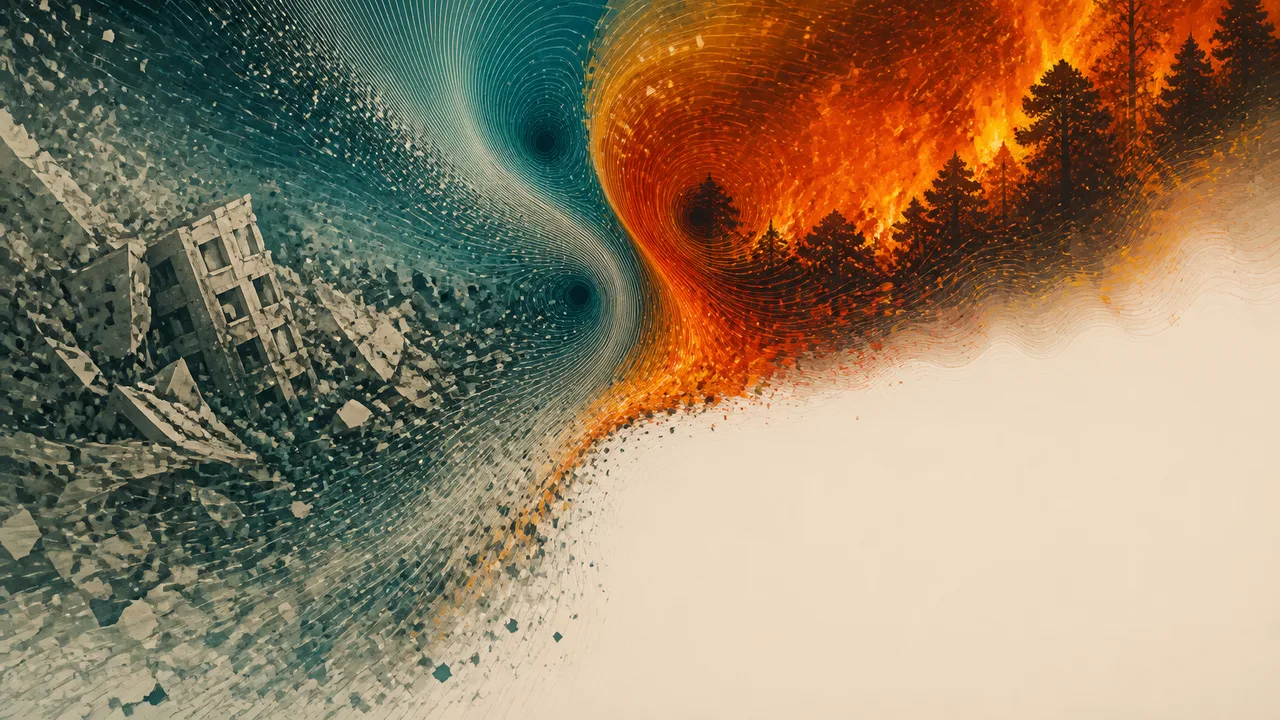
Photo: AI. Dexter Bloomfield
The question that runs through Wonder's documentary Disaster Déjà Vu is deceptively simple: what does it mean when catastrophe finds the same place twice? The answer, across four disasters spanning Haiti and Australia, turns out to be less about geology or meteorology than about what a society has built — and what it hasn't — in the years between.
Haiti: The Architecture of Vulnerability
On May 7th, 1842, at roughly 5:00 p.m., a massive earthquake struck northern Haiti. The epicenter was Cap-Haïtien, then a well-fortified city of over 10,000 people — stone buildings, brick and mortar, civic pride made physical. Modern seismological analysis, working backward from the historical record of damage and ground movement, places the event at approximately magnitude 8.1. It was not, by the measure of its era, a city that should have fallen so completely. It fell anyway. Within minutes, the city was rubble. Then the fires came. Then a tsunami struck Port-de-Paix with a wave nearly five meters high, sweeping hundreds into the sea. Half the population of Cap-Haïtien did not survive.
The eyewitness account of J.D. Delorme, eleven years old on the day of the quake, carries the texture of the moment: "The bell tower of the cathedral that was opposite began to swing in the air. The bells full flight chime a sinister melody and rhythm." A child narrating the sound of a city dying.
168 years later, on January 12th, 2010, the earth moved again. This time the epicenter was west of Port-au-Prince, the capital, home to an estimated three million people. The magnitude was 7.0 — less powerful than 1842 on paper, but the seismology was precise in its cruelty: shallow depth, directly beneath a densely populated urban core with inadequate building codes and decades of underinvestment in infrastructure. Twenty seconds. That is how long the shaking lasted, according to one survivor's account. "There was nothing but rubble. You couldn't see the air. All of a sudden it was dark."
The Haitian government reported more than 315,000 dead, though that figure was never independently confirmed by international observers. More than a quarter-million homes were rendered uninhabitable. Roughly 4,000 schools were damaged or destroyed. The largest medical facility still standing after the quake had patients lying on mattresses in the parking lot, in the open sun, unattended.
What followed illuminated something the documentary articulates with uncomfortable clarity. According to Global News, which examined the post-earthquake reconstruction decade, billions of dollars in international assistance flowed into Haiti after 2010 — yet as recently as 2017, the United Nations estimated that 55,000 people were still living in unsanitary conditions from displacement, and 2.5 million continued to require some form of humanitarian assistance. The money existed. The recovery did not.
The structural explanation comes from one of the documentary's commentators: "Haiti's effort to respond to catastrophes is hindered by its lack of resources, by underinvestment in infrastructure, by suspicion of foreign powers who have too often preyed upon Haiti, and by lack of faith in their own institutions, which means disasters are often occasions of social discord rather than unity." That is not a description of a country that failed to learn from 1842. It is a description of a country that was never given the conditions to build the systems that learning requires.
The earthquake was natural. The death toll was not — or not entirely.
Australia: When the Landscape Is the Fuel
Southeastern Australia's relationship with fire is geological and ecological in ways that make Haiti's seismic exposure look almost comprehensible by comparison. Eucalyptus trees are effectively combustible by design; native vegetation has, in some cases, evolved to depend on fire for regeneration. The Aboriginal peoples who lived on this continent for tens of thousands of years understood this, and managed it through systematic planned burning. That knowledge was largely abandoned when British colonial agriculture reorganized the land along extractive lines that had no use for it.
The result was Black Friday, January 13th, 1939. Months of drought. Melbourne hitting 45.6°C — a record that would hold for seventy years. Gale-force winds from the north. And a landscape so dry it needed almost nothing to ignite. Fires that had been burning for weeks across Victoria combined into something that could not be managed with hand tools and volunteer brigades. Nearly two million hectares burned. Seventy-one people died. Entire townships ceased to exist.
One survivor from the Toolangi State Forest described the pace of it: "I noticed the flames at about quarter past three. They came up like a racehorse."
The disaster triggered a royal commission, led by Judge Leonard E.B. Strahan, whose conclusion shaped Victorian fire management for decades. Planned burns were reintroduced. Detection towers went up. Access roads were cut through public land. Water bombers entered the suppression toolkit. By any reasonable measure, Australia absorbed the lesson and rebuilt its systems around it.
Then February 7th, 2009 arrived.
Black Saturday began with Melbourne reaching 46°C — fractionally higher than that 70-year-old record from Black Friday, as if the landscape were keeping score. Winds exceeded 100 km/h. Fire authorities had issued warnings. Containment lines that existed on maps turned out not to exist in the path of a wind-driven firestorm. Near Kilmore East, 60 km north of Melbourne, a toppled power line ignited what would become the Kinglake fire complex. When the wind shifted from northerly to southwesterly without warning, communities that believed the fire had passed them were suddenly surrounded. Ten people died in Steels Creek, trapped by fire approaching from every direction at once.
The scale was staggering. Over 3,500 homes and structures were lost. Nearly half a million hectares burned. More than 170 people died across the state, according to the Victorian Bushfires Royal Commission. Four hundred more were injured. Over 7,500 were displaced.
What makes Black Saturday distinct from Black Friday is not just the numbers. It is that Black Saturday happened despite a sophisticated, well-resourced, institutionally prepared response — after a royal commission, after seventy years of improved practice. As one expert voice in the documentary puts it: "The new normal of risk is substantially above the older historical pattern. As the climate shifts, it will have to invest in further resiliency both to protect its people from fires that are unpredictable and of course its natural environment and species that will otherwise disappear from the earth."
That is the variable Black Friday's royal commission could not have accounted for: a warming climate that is systematically compressing the gap between catastrophic fire conditions. The drought is longer. The heat is higher. The wind is no different, but it operates now on a landscape that has been drying for longer and harder than the historical models expected.
The Contrast That Isn't a Comparison
Haiti and Australia are not symmetrical cases, and the documentary is honest enough not to treat them as such. Australia is a wealthy country with functioning institutions, a free press, and the capital to invest in suppression technology. Haiti is the poorest nation in the Western Hemisphere, carrying the compounded weight of colonial extraction, political instability, and chronic international underinvestment. When both are struck by the same category of disaster — and then struck again — they do not experience it the same way, and they do not recover the same way.
What connects them is the structure of the problem. Both are caught in geographies they did not choose. Both face the near-certainty of the third event. And both demonstrate, in their different ways, that the distance between a disaster and a catastrophe is rarely the force of the event itself. It is everything a society has or has not done in the intervals between.
The earthquake is coming for Haiti again. The fire season will return to Victoria. The open question is not whether those events will happen. It is what the intervals are being used for.
More Like This
Rethinking Cosmic Acceleration: A Local Illusion?
Exploring the debate on whether the universe's acceleration is a local phenomenon, challenging the concept of dark energy.
How the Asteroid Impact Ended the Dinosaur Era
Explore the catastrophic asteroid impact that ended the dinosaurs, its immediate aftermath, and the long-term environmental changes.

Subcritical Reactors: Nuclear Power's Safety Fix?
A new generation of subcritical reactors promises to make nuclear meltdowns physically impossible. But can they deliver on cost, scale, and timeline?
Venice Is Sinking and Emptying at the Same Time
Venice faces two accelerating crises: rising seas and a vanishing population. Neither MOSE nor a €5 tourist fee comes close to solving either one.
Inside the Ship That Keeps Newfoundland Alive
The Canadian Coast Guard icebreaker Henry Larson doesn't just rescue trapped ships—it's the lifeline holding remote Newfoundland communities together.
Understanding the Real Risk of Brain-Eating Amoebas
Explore the facts and myths surrounding brain-eating amoebas. How real is the threat, and can climate change affect its spread?
Geothermal Energy's Promise and Its Real Barriers
Geothermal delivers 24/7 clean power with near-zero emissions. But drilling costs, financing gaps, and policy inertia stand between the technology and global scale.

How Air Pressure Works, From Barometers to Champagne
Neil deGrasse Tyson explains the physics of air pressure — and why understanding it matters beyond parlor tricks and party science.