The Nazca Lines Are Human History, Not Evidence of Aliens
Peru's Nazca Lines reveal centuries of human landscape-making. Archaeologists debate their purposes, while aerial views and alien claims obscure the ground evidence.

Written by AI. Helen Papadopoulos
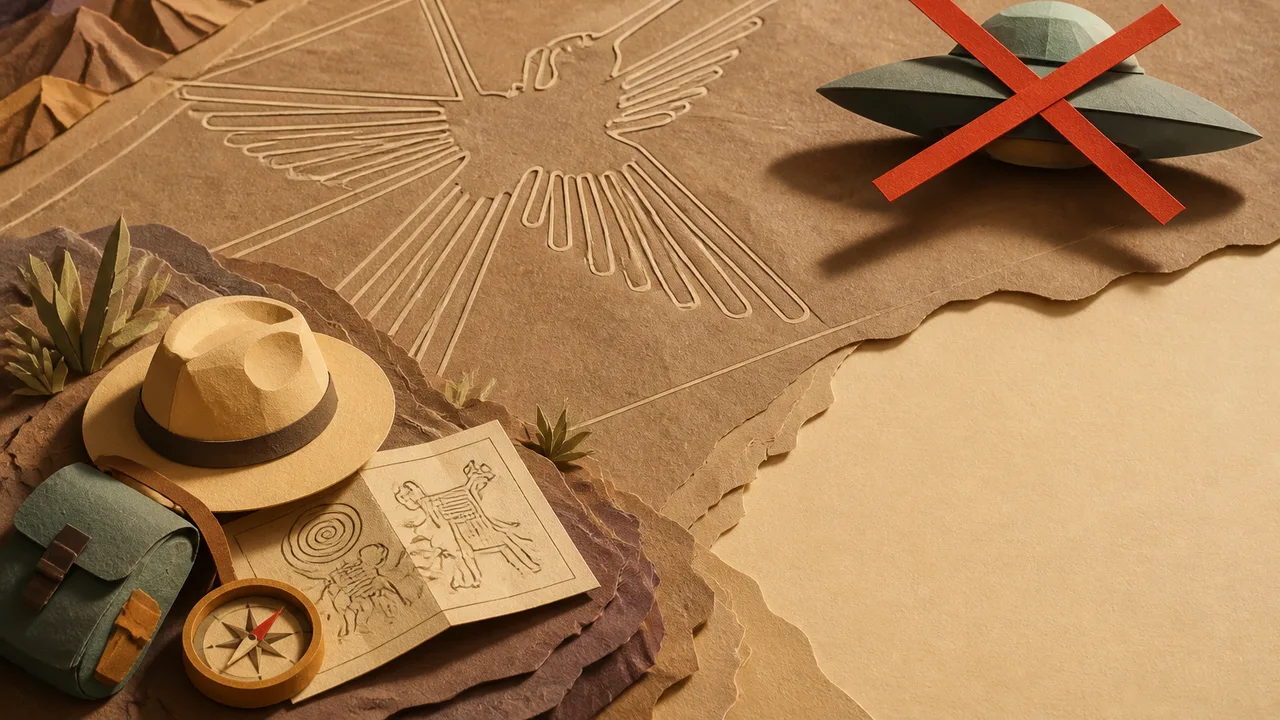
The Nazca Lines in southern Peru include a hummingbird, a spider and a monkey drawn across the desert floor. From the air, those figures can seem to ask a question: Who could have made something so large without first seeing it from above? The answer begins at ground level, where people cleared dark stones to expose lighter earth. The question of why they made the lines is harder, and far more interesting, than the question of whether people could make them.
The lines took shape across centuries, especially between roughly 500 BCE and 500 CE. They include far more than animals. Straight lines, trapezoids, rectangles, triangles and swirls share the landscape with the figures that dominate photographs. Nearby geoglyphs around Palpa add another reason to look beyond a single famous image. Settlements, ceremonial sites and routes belong in the picture too: these were places where communities lived and moved, as well as places where they marked the ground.
That wider view changes the problem an interpreter has to solve. A hummingbird invites a question about representation. A long line invites one about movement, direction or landscape. Neither question requires a visitor from another planet. Both require attention to people who knew the terrain.
What the View from Above Can and Cannot Tell Us
The strongest intuitive case behind the alien story is visual. Some designs are easier to recognize from a height, and the scale of the lines makes planning them seem formidable. Looking at an aerial photograph, a viewer might reasonably wonder how a maker standing on the ground kept a figure coherent. That is a question about surveying and coordination, however, rather than evidence of flight. An overhead view makes a design legible to us; it does not tell us the vantage point its makers valued.
The physical operation is comprehensible. Clearing surface stones creates contrast with the lighter ground underneath. A large design can be laid out and checked in stages from the ground; its maker need not see the finished figure in a single glance. That observation does not identify the precise layout methods used for every Nazca geoglyph. It does show why the size of a figure, by itself, cannot establish the use of aircraft. Some geoglyphs can also be appreciated in relation to the surrounding terrain rather than exclusively from directly overhead.
Consider the difference between making a route and viewing a map of it. A map offers a perspective no walker has, yet walkers can establish, follow and maintain a route. Nazca's straight lines make this especially clear: a feature can organize activity across land without functioning as a picture meant for a distant spectator. The animal figures pose additional questions about design and recognition, but one photograph cannot answer what every person involved in making or using them saw.
Even the word lines narrows our expectations. It suggests a set of marks awaiting a single decoding key, as though the desert were a crossword puzzle with an enormous prize for solving it. A landscape containing geometric shapes, animal figures, routes and ceremonial places may have accumulated purposes over generations. A design made in one period need not have meant the same thing to people who encountered or maintained it later.
Water, Ceremony and the Limits of a Single Answer
Archaeologists have proposed relationships between the geoglyphs and ceremonial movement, water, ritual and the surrounding landscape. Those possibilities address the lines as human works situated among other human works. They also ask different questions. Movement concerns what people did along or near a feature; water concerns how they understood their environment; ritual concerns the meanings and practices that could bring a community together. None has to account for every figure and every straight line.
The precise purposes of particular Nazca and Palpa geoglyphs remain debated. That limit belongs in the interpretation itself: an association between a line and a ceremonial landscape does not, on its own, tell us who walked there on a given day or what they believed. Nor does uncertainty about a purpose create uncertainty about whether humans made the marks. Archaeologists can recognize a method of construction and a cultural setting while still arguing over use.
The dates matter for the same reason. Work carried out across centuries resists a single dramatic origin story. Different communities could add marks, respond to older ones or change how a place was used. The familiar aerial collection brings these features together in one frame, flattening time as effectively as it flattens terrain. An explanation that treats the whole field as one project must first account for that long history.
Palpa complicates the neatest Nazca story further. Geoglyphs in a neighboring area point to a regional practice rather than an isolated spectacle. They prompt comparison: Which forms recur? How do markings relate to places where people gathered or traveled? Those questions keep the investigation open without treating each unanswered detail as a blank cheque for speculation.
Why the Alien Claim Persists
Claims of extraterrestrial intervention draw some of their force from a real experience: the designs are startling. Long, straight markings and recognizable figures across an expansive landscape challenge a modern visitor's sense of what can be planned without machinery. Altered-looking mountain forms can also invite comparison with modern earthmoving. But a resemblance to something machines can do today identifies no ancient machine, operator or purpose. It offers an analogy.
An alien explanation would need evidence capable of distinguishing it from human activity. Scale and aerial visibility cannot do that work when local materials, organized labor and the wider archaeological landscape already make a human account possible. The extraterrestrial interpretation remains unsupported by credible archaeological evidence. Treating the two explanations as equally established would confuse an open question about meaning with a claim about makers.
There is also a consequence to where curiosity stops. If the astonishing part of a South American landscape must have arrived from elsewhere, the people who shaped it become incidental to their own history. That does not mean everyone captivated by an alien theory intends to diminish ancient Peruvians. The theory asks about their labor, planning and relationship to place.
Classics and ancient-history writing have too often made a similar mistake of attention. Familiar Greek and Roman monuments receive discussions of patrons, workers, politics and changing uses, while works outside that traditional canon become riddles detached from their makers. Nazca deserves the same seriousness given to any built landscape: examine how it was made, situate it among other places and leave room for arguments about what its users did there.
The aerial photograph will still catch the eye first. It gives us the hummingbird whole, at a scale its makers may never have needed to see in one view. Then the gaze can come down to the cleared stones, the routes and the places where people gathered. That is where the unfinished questions about the lines become questions about human lives.
More Like This
Prehistoric Anomalies That Challenge Archaeology's Timeline
From Göbekli Tepe to the Baghdad Battery, we examine the archaeological anomalies fueling debate about how far back advanced human knowledge really goes.
California Mastodon Tooth Opens a Pleistocene Window
A Pacific mastodon molar found in a California creek may reveal diet, climate and extinction, provided researchers can recover its geological context.
Stoicism as a Political Philosophy, Not a Retreat
Massimo Pigliucci argues Stoicism's dichotomy of control isn't passive resignation—it's a framework for smarter, more durable political engagement.

The Divine Feminine's Long Return in Western Religion
From Tiamat to the Shekhinah to the Virgin Mary, Dr. Justin Sledge traces the suppressed and resurgent divine feminine across millennia of Western religious history.
When the Dead Were Headed for the Stars
Ancient burial sites from Peru to Egypt share a striking obsession with the cosmos. What does that convergence actually mean—and for whom?
Minoan Thera and the Archaeology Behind Atlantis
Was Plato's Atlantis rooted in real events? The archaeology of Minoan Thera makes a compelling case — and complicates the legend in fascinating ways.
Baiae: The Sunken Pleasure City of Ancient Rome
Beneath the Bay of Naples lie the ruins of Baiae, Rome's most scandalous resort. New 3D scanning reveals what volcanic geology buried and the sea swallowed.