California Mastodon Tooth Opens a Pleistocene Window
A Pacific mastodon molar found in a California creek may reveal diet, climate and extinction, provided researchers can recover its geological context.

Written by AI. Helen Papadopoulos
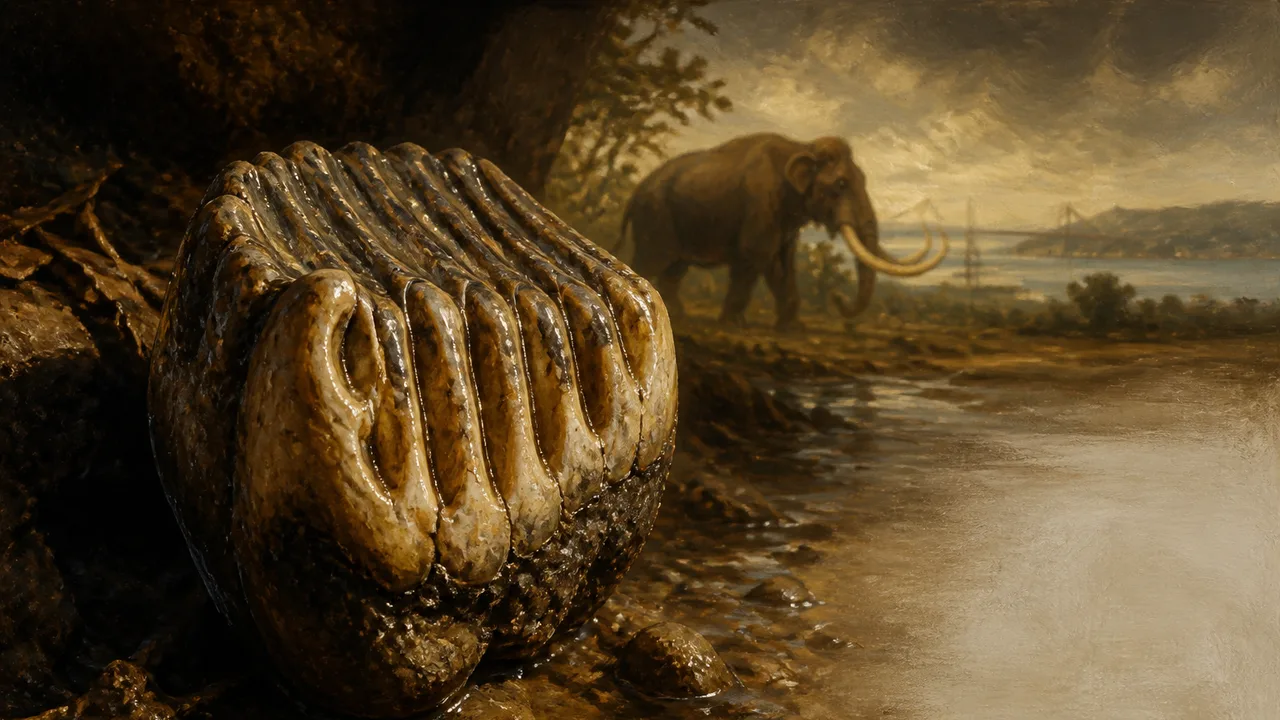
A large molar found in a San Francisco Bay Area creek has been identified as the tooth of a Pacific mastodon and estimated to be at least 11,000 years old. Those two claims place it near one of North America's most consequential ecological transitions, when the Pleistocene ended, climates shifted and many large mammals disappeared.
The discovery began during fieldwork rather than a fossil excavation. According to Dexerto, the scientist who noticed the object was studying endangered frogs. Smithsonian magazine reports that a reverse image search helped identify the strange object protruding from the creek as a possible mastodon tooth.
A search engine has thus joined the traditional paleontological toolkit of brushes, notebooks and people willing to stare suspiciously at rocks. The identification itself, however, rests on anatomy and expert examination. Search results can raise the alarm; they cannot establish species, age or geological provenance.
The initial reports describe an unusually well-preserved specimen. Live Science says the object initially resembled an oddly shaped rock and was later described as an “immaculate” mastodon molar. Phys.org identifies it as a well-preserved tooth from a Pacific mastodon.
Those descriptions make an excellent headline. The scientific story begins when the superlatives run out.
What One Tooth Can Preserve
Teeth are durable biological archives. Enamel is the hardest tissue produced by a vertebrate body, and its resistance to decay gives paleontologists a better chance of recovering evidence after bone has fractured, dissolved or scattered.
The tooth's shape can support identification. Mastodon molars have prominent cusps suited to crushing and shearing vegetation, unlike the ridged grinding surfaces associated with mammoths. Detailed measurements and comparisons with securely identified specimens can help researchers determine whether the California fossil fits the Pacific mastodon classification.
Wear offers another line of inquiry. Large-scale wear records repeated chewing over an animal's lifetime, while microscopic scratches and pits can reflect foods consumed over shorter intervals. Such evidence may help distinguish browsing on leaves, twigs and woody plants from feeding patterns involving tougher or more abrasive material. A single tooth provides one animal's dietary record, so broad ecological conclusions would require comparison with other specimens.
Chemical analysis can extend the inquiry. Carbon isotopes may indicate the kinds of plants incorporated into an animal's diet. Oxygen isotopes can preserve information related to water and environmental conditions. Strontium signatures, when local geological baselines are available, may help test whether an animal moved between regions.
Each method comes with conditions. Fossilization can alter chemical signatures, contamination can enter after burial, and creek water can move a specimen far from the sediment in which it was first deposited. Researchers must establish preservation before treating a chemical measurement as Pleistocene biography.
The Creek Complicates the Clock
The reported age of at least 11,000 years places the animal near the close of the Pleistocene, conventionally dated to about 11,700 years ago. Yet the available reports do not provide a laboratory date, a stratigraphic profile or a detailed account of how that minimum age was established. All That's Interesting describes the specimen as at least 11,000 years old while emphasizing that further study is needed to clarify its age, condition and environmental context.
An object recovered from a creek presents a familiar taphonomic problem. Taphonomy examines everything that happens to an organism between death and discovery: decay, burial, mineralization, erosion, transport and exposure. A creek can uncover a fossil from an ancient deposit. It can also carry that fossil downstream and deposit it among much younger sediments.
The find location therefore has at least two possible meanings. It may preserve the animal's original geological neighborhood, or it may mark the latest stop in a long journey. Researchers can investigate that question through sediment attached to the tooth, abrasion on its surfaces, local geology and any traceable layer from which it eroded.
Dating may also prove difficult. Radiocarbon analysis depends on surviving organic material and reliable pretreatment. Dating nearby sediment can establish the age of a deposit, provided the tooth belongs to that deposit. Several independent lines of evidence would produce a stronger chronology than one isolated number.
This is why provenance carries such weight. A spectacular fossil with a recorded location, sedimentary context and chain of custody can anchor research. The same fossil stripped of context becomes a handsome anatomical object with fewer historical sentences left inside it.
California at the End of the Pleistocene
At least 11,000 years ago, California was undergoing substantial environmental change. Rising temperatures and altered rainfall patterns reshaped plant communities and water systems. Large mammals faced changing habitats at the same time that human populations were established in North America.
The disappearance of mastodons and other megafauna has generated decades of argument. Researchers have examined human hunting, rapid climatic change, habitat transformation, ecological disruption and combinations of those pressures. The relative weight of each factor varies by species, region and chronology. A continent-wide explanation can blur local sequences that unfolded centuries apart.
A securely dated Pacific mastodon tooth could refine that local record. Its chemistry might illuminate the environment in which the animal fed. Its wear might reveal how it used that environment. Its date could help establish how late mastodons survived in the region. The surrounding sediments might identify the ecological community that shared the landscape.
One molar cannot settle the extinction debate. It can improve the map on which that debate occurs, particularly if it fills a geographical or chronological gap. Paleontology often advances through such increments. Deep time rarely arrives with a complete cast and a helpful label.
Human history also shadows the interpretation. People living in late Pleistocene California encountered animals and landscapes that later vanished, but evidence of temporal overlap does not automatically demonstrate hunting or any other interaction. Claims about human involvement require archaeological associations such as tools, cut marks, burning or secure spatial context. None has been reported with this tooth.
Discovery Depends on Infrastructure
The popular account celebrates accidental attention: a scientist notices an odd shape, consults an image search and recognizes that an ordinary creek contains an extraordinary survivor. That sequence deserves attention because field science depends upon trained observation across disciplinary boundaries. Frog research created the occasion for paleontology.
The specimen's future value now depends on less photogenic work. Researchers must document its condition, stabilize it, record the findspot, analyze the surrounding geology and place the resulting data where other specialists can examine them. A museum or public research collection can preserve both the tooth and its documentation over decades, allowing later scholars to apply methods that do not yet exist.
Land status and ownership also matter. Fossil rules differ across federal, state and private land, while any associated archaeological material would introduce further legal and ethical obligations. The available reporting does not establish the creek's ownership or the tooth's permanent repository, so conclusions about custody would be premature.
Public institutions provide continuity between a chance encounter and reproducible knowledge. They also determine who can study a find, whether local communities can see it and whether its contextual records survive staff changes, fires, floods and fluctuating budgets. A fossil locked in a private cabinet may remain beautiful. A curated specimen with accessible records can keep answering questions.
The California molar has already completed the improbable portion of its journey: surviving thousands of years, emerging from sediment and attracting the attention of someone searching for frogs. The next discovery will come from establishing where, when and how that tooth belonged to its vanished landscape.
More Like This
WW1 Trench Life: What the Western Front Was Really Like
From Pals' Battalions to the Vickers gun, a new documentary unpacks the grim machinery of survival on the WW1 Western Front in unflinching detail.

Alexandria's Library Was More Than a Library
Dr. Roy Casagranda's lecture on the Great Library of Alexandria reveals a research institute, innovation hub, and the ancient world's most powerful idea engine.
How the Corvus Won Rome Its Navy and Drowned Its Crews
The First Punic War's ugliest weapon beat Carthage at sea, then killed more Romans than any battle. What the raven's rise and quiet erasure reveal.
Baiae: The Sunken Pleasure City of Ancient Rome
Beneath the Bay of Naples lie the ruins of Baiae, Rome's most scandalous resort. New 3D scanning reveals what volcanic geology buried and the sea swallowed.
Medieval Cattle Kept Working Into Old Age, Bones Show
New research on animal bones from medieval England shows farmers kept cattle working into old age, tying rural household labor to a fast-changing economy.
A Megalodon Tooth Washed Up on the Jersey Shore
An 11-year-old pulled a megalodon tooth from a New Jersey jetty. What that four-inch fossil tells us about deep time, amateur discovery, and who gets to find history.
Casa del Desierto: Barstow's Forgotten Harvey House
Barstow's Casa del Desierto is a stunning 1911 Harvey House in the Mojave Desert—and one of America's least-visited Amtrak stations. Here's why it still matters.

Medieval Knights: The Gap Between Code and Conduct
Medieval knights lived by a strict code of chivalry—and routinely broke it. A look at the real training, politics, and moral failures behind the armor.