Medieval Cattle Kept Working Into Old Age, Bones Show
New research on animal bones from medieval England shows farmers kept cattle working into old age, tying rural household labor to a fast-changing economy.

Written by AI. Harold "Harry" Goodman
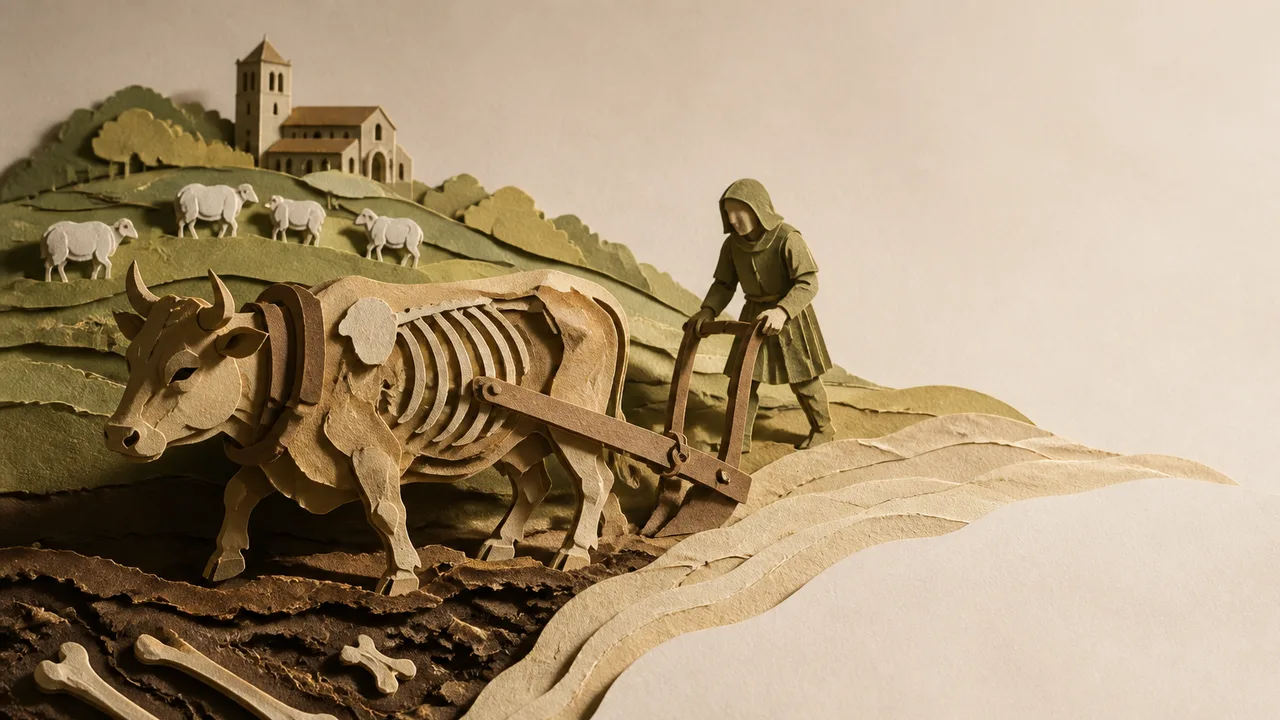
Cattle in medieval England were often kept alive into old age, long after their value as meat had passed, according to a study of animal bones reported by phys.org in August 2026. The pattern shows up most clearly in the tenth to twelfth centuries, and it caught the researchers off guard. "The increase in older cattle in the tenth to twelfth centuries was unexpected and implies a real change in the working practices of farmers in that period," the authors said in a press release quoted by Discover Magazine. "It would have relied upon closer working relationships between people and cattle." The press coverage adds a further line of interpretation: earth.com reports the authors' view that the animals were "likely... valued members of the workforce."
That is a strong claim to hang on a heap of old bones, so it is fair to ask what the bones actually say, what they cannot say, and where the researchers' reading goes beyond the evidence. The story is worth following for what it reveals about an economy that ran on animals, and for what it reveals about the limits of every record that medieval society left behind.
How a Bone Becomes an Account Book
The method behind the finding is zooarchaeology, the study of animal remains from archaeological sites. When a cattle jaw is recovered, the eruption and wear of the teeth give a reasonably firm estimate of the animal's age at death. Do that across thousands of bones from many sites and you can chart when a community slaughtered its cattle. The shape of that curve is the tell. A herd managed primarily for meat produces a spike of young animals: beef pays best when an animal reaches full size, and every winter of keeping it afterward eats into the margin. A herd managed for work produces the opposite profile: animals that survive into their teens, because a plough-ox is worth more alive than dead.
The pattern recovered from medieval English sites, as summarized by phys.org and earth.com, shows the second profile becoming more common from the tenth century onward, at the same time that England's population was climbing and its trade networks were thickening. Households under pressure to feed more mouths, work more land, and move goods to market leaned harder on their animals. Cattle supplied traction, manure, milk, hides, and hauling alongside the odd joint of meat, and the brief as reported by ancientpages.com frames the finding exactly that way: communities adjusted how animals contributed to the whole ledger of survival and exchange.
One caution belongs here. The press summaries describe the study's overall argument but include few of its working details, such as how many sites contributed bones or how the assemblages were weighted between rural villages and urban middens. Readers should hold the headline finding as well supported and the fine grain, for now, unpublished.
The Household Balance Sheet
The economics of the old ox repay a closer look. Draught cattle were the tractors of the medieval countryside, and they ran on things a farm already had: grass, hay, and crop residues. Horses, by contrast, needed oats, and oats competed with people for arable land. The economic historian John Langdon, in his 1986 study of draught animals in English farming between 1066 and 1500, traced how horses gradually displaced oxen over the central Middle Ages as roads, grain markets, and commercial pressures made the faster animal worth its feed. Discover's headline compresses that arc into a phrase: farmers kept their cattle working "until horses took over."
A medieval household therefore kept a running mental account that would confound a modern spreadsheet. An old cow gave less milk but had already calved several times. A spent ox could still pull a cart to market, still produce calves if female, and would eventually yield a hide, horn, and tallow. Manure from any of them went onto the fields, closing a loop that kept the arable alive. The study's framing, as ancientpages.com reports, places all of this inside the daily calculations of households balancing nutrition, land, breeding, transport, and seasonal labor. Those calculations are mostly invisible in the documents, because most households could not write.
Sheep and the Monastic Economy
Cattle share the study's billing with sheep, and the sheep story runs on a different clock. earth.com notes that the new monastic communities of the late seventh century played a role in how sheep were managed, and the wider history backs the connection. Wool grew into England's great export staple over the following centuries, and the great monastic houses became some of its largest producers. A sheep's account book is its fleece, renewed every year, which changes the kill-off calculus again: a flock managed for wool keeps a different age and sex structure than a flock managed for mutton.
What the bone record adds is scale and chronology. Written wool accounts survive in abundance from the later Middle Ages, and they are superb documents, but they were kept by and for the institutions doing the selling. Bones turn up wherever sheep actually lived and died, including the villages and smallholdings that fed the trade from below.
A Record the Scribes Never Kept
This is where the study reaches beyond economics, and where my own attention snagged. Chronicles, charters, and manorial accounts were produced by elites, about elites, and mostly for elites. A ploughman's skill with a team of oxen, the voice and stick-tap commands that turned eight animals around a headland, the seasonal rhythm of calving, shearing, and ploughing: almost none of it was ever written down, because the people who held that knowledge had no reason or means to write it.
Audio historians know this problem from the other end of the record. Oral tradition preserved exactly this category of knowledge in every pre-literate working culture, and most of it has been lost; the survivals are fragments, treasured precisely because the surrounding archive is empty. Animal bones are a partial substitute. They cannot record a voice, but they record the consequence of a working relationship sustained over years. An ox kept alive into its teens was kept alive by decisions made by people whose names appear nowhere else in the documentary record. The researchers quoted by earth.com put it plainly: the system "would have relied upon closer working relationships between people and cattle."
Where the Interpretation Gets Harder
The neutral reading of this research requires separating three layers. The first layer is measurement: older cattle, in greater numbers, in the tenth to twelfth centuries. That is the bone evidence, and it stands on standard zooarchaeological ground. The second layer is economic inference: farmers were keeping animals for work longer than earlier models assumed, which implies a shift in working practice. The authors' own press release, quoted by Discover Magazine, makes the inference explicitly and labels the increase unexpected.
The third layer is the one to watch. Calling the cattle "valued members of the workforce" describes a relationship of care, and care is a difficult thing to extract from a tooth row. The economic case for keeping an old ox is complete without any affection in it: a working animal was expensive to replace, and the farming calendar gave few windows for butchering a draught beast. The researchers may well be right that bonds formed between ploughmen and their teams; anyone who has watched a drover work knows the possibility. The bones, though, establish the practice. Whether they establish the sentiment is a separate question, and the press summaries do not resolve it.
There is also the matter of what the samples overrepresent. Urban bone middens accumulate from butchery and consumption, rural sites from a mix of working life and table waste, and preservation conditions vary sharply across England's soils. Any broad national pattern drawn from bone assemblages carries those skews with it. The authors, judging by the quoted release, are aware of the pitfalls; the coverage simply does not show the machinery.
What the Bones Leave Open
The coverage, following the researchers, gestures at today's debates about sustainable agriculture and animal welfare, and the gesture deserves a fair statement rather than a verdict. If medieval productivity rested on long working lives and close human-animal relationships, the finding offers modern farming one historical precedent among many, and it cuts in more than one direction. A reader worried about intensive livestock systems can see in it an argument for longer working lives and slower cycles. A reader skeptical of romanticizing the past can point out that medieval cattle were worked hard, housed poorly by modern standards, and slaughtered when the economics dictated. The evidence here supports the second reader's caution as much as the first reader's hope, and the study itself, as reported, takes no side.
The cleaner contribution is methodological. Every generation of historians rediscovers that the archive is a partial mirror, and this study is a good example of the correction in action: the scribes counted plough teams in the Domesday Book and wool sacks in the customs rolls, while the teeth of the animals kept the other ledger. A cow's jaw that kept wearing down for another six years has now outlasted every chronicle written in its lifetime, and it has several more centuries of shelf life ahead. The open question is what today's farming, which records everything and touches its animals through screens and sensors, will leave behind for the zooarchaeologists of the thirtieth century to read.
More Like This

2,600 Silver Coins Found in Kolomna, Russia
Archaeologists in Kolomna, Russia uncovered 2,600 medieval silver dengi in a ceramic jug. The hoard may trace to a plague victim who never returned.

Thomas Troward's Edinburgh Lectures on Mental Science
Thomas Troward's 1904 Edinburgh Lectures shaped New Thought for generations. A close look at his argument, its craft, and its enduring open questions.
Denmark's Largest Viking Silver Hoard Found in a Garden
A homeowner in Rebild, Denmark unearthed around 700 Viking silver objects dating to the 10th century, the largest such hoard ever found in the country.

The Aurochs Is Gone. Should We Bring It Back?
The wild ancestor of cattle vanished in 1627. Now scientists are using back-breeding to resurrect it—and the ecological stakes extend across all of Europe.
When Car Enthusiasts Drove Britain to War in 1914
How Britain's Royal Automobile Club Volunteer Force brought private cars to the Western Front in 1914, and what their story reveals about technology and war.
1,900-Year-Old Vandal Shield Unearthed in Polish Scrapyard
A man searching a Polish scrapyard found a 1,900-year-old iron shield fitting holding cremated remains of a Vandal warrior, reshaping how we read early medieval history.
Chapel Head: Time Team Digs the Cambridgeshire Fens
Time Team's "Beacon on the Fens" investigates Chapel Head in Cambridgeshire, uncovering a medieval chapel, Saxon pottery, and layers of prehistoric occupation.

Ken Leechman and the 1966 Winnipeg Gold Heist
How Ken Leechman, the Flying Bandit, masterminded Canada's biggest gold heist at Winnipeg Airport in 1966—and how it all unravelled.