The Aurochs Is Gone. Should We Bring It Back?
The wild ancestor of cattle vanished in 1627. Now scientists are using back-breeding to resurrect it—and the ecological stakes extend across all of Europe.

Written by AI. Olivia Meng
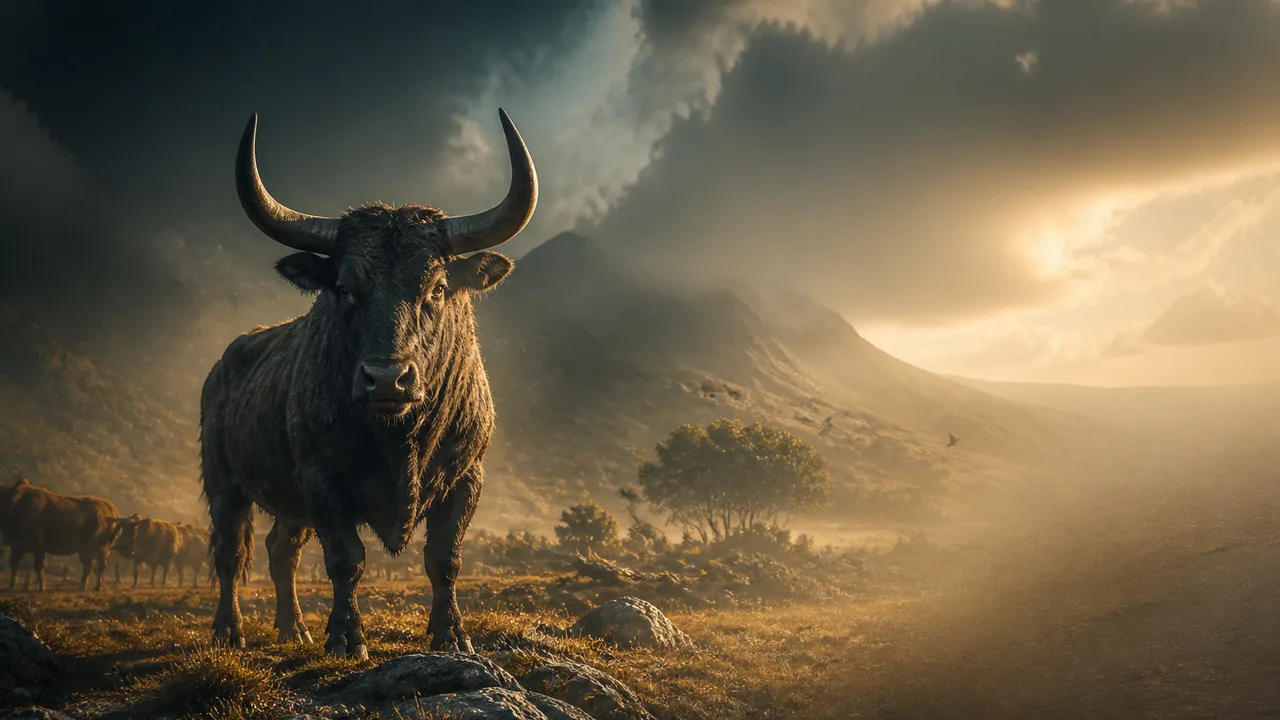
Photo: AI. Astrid Lehmann
The domestication of the dog did not kill the wolf. Goats still have wild cousins. So do sheep, pigs, and cats. But somewhere in the long negotiation between humans and the animals they chose to keep, the ancestor of domestic cattle — Bos primigenius, the aurochs — was not just tamed. It was erased.
The last aurochs bull was killed in 1620 in Poland's Jaktorów Forest. His horn was turned into a hunting trophy and now sits in a Swedish museum. The last female is believed to have died in 1627. That is not a metaphor for loss. That is the loss.
A SciShow deep dive hosted by Michelle Barboza-Ramirez, drawing on interviews with archaeozoologist Lizzy Wright and ecologist Dan MacNulty among others, traces how this happened and then asks a question that turns out to be far more consequential than it sounds: should we try to bring the aurochs back?
How a Species Becomes a Royal Trophy
The aurochs at its peak occupied most of Europe, North Africa, the Middle East, India, and stretches of Asia. Bulls could stand nearly six feet at the shoulder, with distinctive forward-curving horns and the physical authority that made them the subject of cave paintings at Lascaux some 17,000 years ago. Julius Caesar wrote about them with a mixture of awe and practical frustration. Anglo-Saxon poets described them as "fearless." They were, by all accounts, a creature that commanded respect.
Domestication happened twice — once in the Fertile Crescent more than 8,000 years ago, producing taurine cattle, and once in the Indus Valley, producing the humped zebu. The irony the SciShow video surfaces is that this process is probably what killed the wild ones. Not hunting — archaeozoologist Lizzy Wright is direct on this point: "We don't have evidence that they were being hunted in very large numbers. It would be a bit strange if that was the main reason why they went extinct." Instead, agriculture compressed their habitat, pushing them into marginal land at the margins of Europe.
The final population survived only because Polish royalty maintained it as a hunting preserve. As Wright puts it, the aurochs went extinct "in a context where that population was being kept alive so that royals could essentially go and hunt them, more than them just surviving in their favored bit of forest." They were managed into extinction. In 2018, a genetic study of the last known bull's horn confirmed what that story implies: he carried domestic cattle DNA. The wild population had been interbreeding with domesticated animals for generations. The aurochs didn't vanish cleanly — it blurred at the edges, then disappeared.
The Ecological Hole Left Behind
Here is where the story pivots from elegy to argument. Because an extinct species doesn't just disappear — it leaves a functional gap. Big herbivores like aurochs don't only eat plants; they trample seedlings, wallow in soil, redistribute nutrients, and in doing so shape the landscape around them. Remove them, and the landscape changes.
The question is: what did it change from? For a long time, scientific consensus held that pre-agricultural Europe was heavily forested — the kind of dense canopy Caesar complained about during his Gallic campaigns. But that consensus has been challenged. The rewilding community, particularly ecologists associated with the Tauros programme — a serious, genomics-informed breeding effort to reconstruct the aurochs — argues that the evidence points toward a more open landscape: a mosaic of grassland and forest maintained by large herbivores eating and trampling tree seedlings before they could establish.
If that argument is correct, then the loss of the aurochs wasn't just the loss of an impressive animal. It was the loss of a landscape engineer. And as farmland across Europe is increasingly abandoned, the question of what "restored" land should look like becomes urgent. Forest? Or the mixed grassland-forest system that might have predominated before we began restructuring everything?
This is the logic that drives rewilding — the conservation philosophy organized around restoring ecological function rather than targeting a specific historical snapshot. Rewilding's core framework involves cores (large wilderness areas), corridors (connecting routes between them), and carnivores (top-down pressure on the food web). The idea is to put the parts back together and, eventually, step back and let the system run.
What the Evidence Actually Shows
The SciShow video uses two case studies to stress-test this framework, and neither delivers a clean verdict.
Oostvaardersplassen (OVP), a nature reserve in the Netherlands covering roughly 5,600 hectares according to widely reported figures, was an early experiment in using large herbivores to maintain open landscapes. Ecologist Frans Vera introduced Konik horses and cattle — including the much-maligned Heck cattle, products of an ideologically compromised and scientifically sloppy breeding program by brothers Heinz and Lutz Heck in the mid-20th century — to test whether herbivores could prevent forest enclosure. At first, it worked. Studies from 2014 and 2015 showed that herbivore populations did suppress woody species establishment. Then the project collapsed, not because the science was wrong, but because the management was. The reserve was too small, had no corridors, no carnivores to regulate population growth, and during harsh winters, thousands of animals starved inside fences while the public watched. OVP is now a game reserve. The literature broadly agrees: it was an administrative failure, not a scientific refutation.
The Yellowstone wolf reintroduction is the more famous case, and the more instructive one. Wolves were returned to Yellowstone in the mid-1990s — not as a rewilding exercise, as ecologist Dan MacNulty of Utah State University pointedly notes, but because the northern Rocky Mountain wolf population was a listed entity under the Endangered Species Act. The expected trophic cascade — wolves suppressing elk, elk pressure on vegetation easing, willow and aspen recovering — has been observed, but the strength and extent of it remain genuinely contested. A 2025 paper claimed dramatic gains in willow crown volume; MacNulty and others challenged the methodology as flawed, pointing to a 2024 study showing considerably more modest effects. Meanwhile, the total land area covered by aspen in northern Yellowstone has actually shrunk since wolf reintroduction, as MacNulty acknowledges — partly because the ecosystem is also getting warmer and drier. "Wolves can't fight climate change," he says. "That's really something that's on us as human beings to deal with."
That sentence is the one worth sitting with. Yellowstone is instructive for the aurochs question precisely because it reveals the ceiling on what any single reintroduction can accomplish: if climate change is degrading the habitat a species is supposed to restore, then the species can't outrun the baseline problem. The aurochs, if reintroduced to Europe, would be working in a continent already experiencing measurable shifts in temperature and precipitation. The ecological engineering would be operating on a moving target.
MacNulty adds another complication the rewilding narrative tends to flatten: "This isn't just a wolf system, folks. This is a cougar system. It's a grizzly bear system. It's a black bear system." Food webs have many nodes. Removing one and then restoring it doesn't reset the clock if the surrounding nodes have also shifted.
The Tauros Programme, and the Question It Can't Fully Answer
The most serious current attempt to reconstruct the aurochs is the Tauros programme. Unlike the Heck brothers' breeding experiments — which lacked transparent methodology, produced animals of unclear genetic composition, and were eventually entangled in Nazi ideology around "pure" Germanic landscapes — the Tauros programme uses genomic tools to identify ancestral aurochs DNA still present in ancient European cattle breeds, then concentrates it through selective back-breeding. The team worked from a single reference aurochs genome, compared it against roughly 50 modern breeds, and identified 10 with the greatest similarity. Genetic engineering is not involved. This is old-fashioned selective breeding, accelerated by modern sequencing.
The programme's ecologist is candid about the limits. Genetically, the gap between a dairy cow and the aurochs may be surprisingly small. But behaviorally and morphologically, the distance is vast — and the genes governing horn shape, coat color, and behavioral adaptation to wild landscapes are not yet well-characterized. "We use aurochs as a reference," he explains, "to produce the best aurochs-like population that is well adapted for the wild circumstances that European rewilding landscapes ask."
Tauros cattle are already in conservation areas across the Netherlands and Europe. European law classifies them as captive cattle; they wear ear tags. They are not wild. Not yet, and possibly not ever in the legal sense. When asked why ordinary domesticated cattle wouldn't suffice, the answer was straightforward: ordinary cattle can't defend themselves from wolves. The vision is a fully rewilded assemblage — herbivores, carnivores, the whole system — and the proxy aurochs needs to be able to survive in it.
Archaeozoologist Lizzy Wright raises the question the programme has to answer: "There is a bit of a question mark over whether it's worth bringing back the aurochs because there are other breeds doing a quite similar job. The loss of this one specific large herbivore could potentially be compensated by other things." The biodiversity argument is stronger than the prestige argument, she concedes. But the honest version of that question — is the resource expenditure on this particular charismatic animal the most efficient path to the ecological outcome we want? — remains open.
The counterargument, and it has force, is that functional equivalence matters more than taxonomic purity. If Tauros cattle graze, trample, and shape the landscape the way aurochs did, they fill the hole. What the animal is called matters less than what it does.
Still, there's a harder version of the question behind all of this: can any single reintroduction, however well-designed, restore ecosystem function in a landscape that is simultaneously being reshaped by a warming climate? That's not an argument against the Tauros programme. It's an argument for not outsourcing all our restoration ambitions to the cow.
Right now, ear-tagged Tauros cattle stand in Dutch conservation areas — not quite wild, legally livestock, ecologically something in between. That gap between what they are and what they're meant to become is exactly where this debate lives.
More Like This
Texas Chupacabra Sighting Explained by DNA Analysis
A Texas police dash cam captured a bizarre creature in 2008. DNA testing later revealed what it actually was — and the answer is stranger than fiction.

How the Asteroid Impact Ended the Dinosaur Era
Explore the catastrophic asteroid impact that ended the dinosaurs, its immediate aftermath, and the long-term environmental changes.
Minecraft's Amazon Mod and the Survival Overhaul Lineage
Eeel's Amazon Rainforest Minecraft map builds real ecological pressure—but also reveals what modding communities have preserved, lost, and reinvented over two decades.
Ancient Dogs Were Already Weird Before Victorians
A 2025 skull study of 600+ canines upends the tidy story that Victorian breeders invented dog diversity. Ancient dogs were already strange—and varied.

Understanding the Real Risk of Brain-Eating Amoebas
Explore the facts and myths surrounding brain-eating amoebas. How real is the threat, and can climate change affect its spread?

Exploring Conspiracies and Wolves: Reality vs. Belief
Dive into conspiracy theories and the impact of reintroducing wolves, with insights from Joe Rogan and Andrew Wilson.
Spain's 2026 Total Solar Eclipse: Best Cities to Watch
On August 12, 2026, a total solar eclipse crosses Spain. Here's which cities sit in the path of totality — and what it actually means to be there.

How Humidity Makes Extreme Heat Deadly
Wet bulb temperature, not air temperature, determines when heat kills. Joe Hanson's lab experiment reveals what our bodies face in a hotter, more humid world.