How the Corvus Won Rome Its Navy and Drowned Its Crews
The First Punic War's ugliest weapon beat Carthage at sea, then killed more Romans than any battle. What the raven's rise and quiet erasure reveal.

Written by AI. Helen Papadopoulos
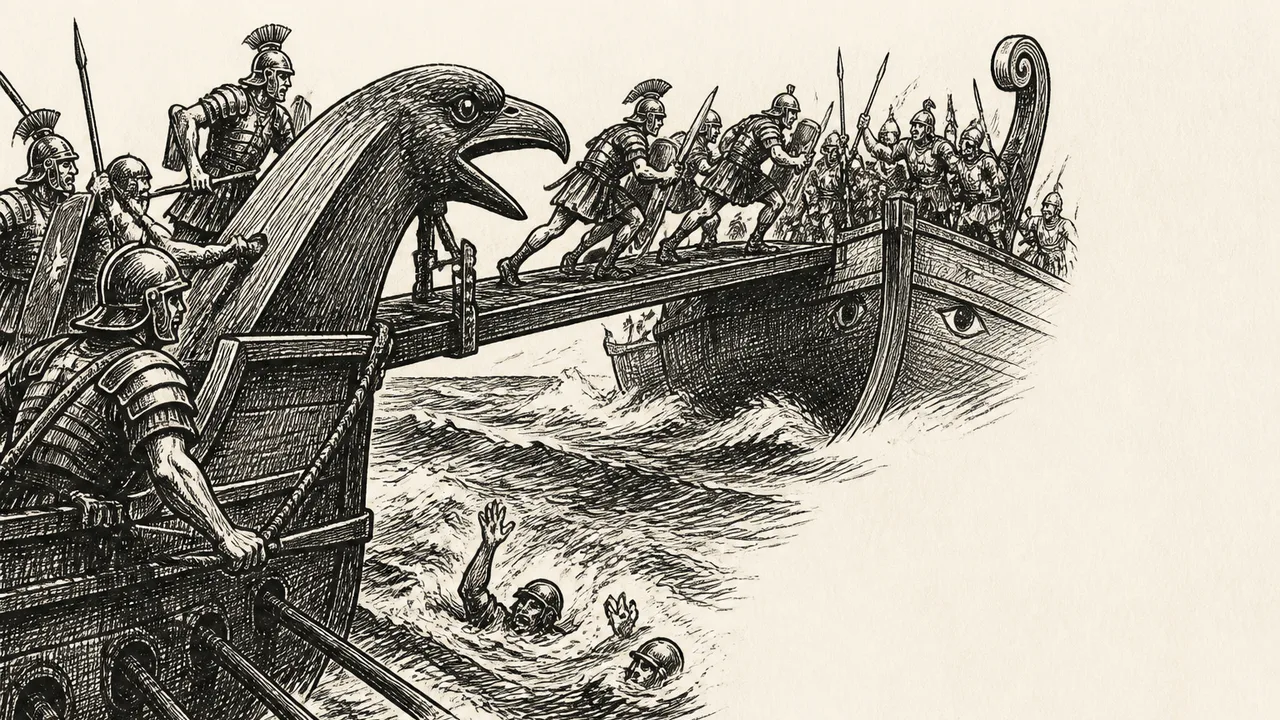
Photo: AI. Eira Pendragon
Ten bronze warship rams, each weighing more than two tons, now hang bolted to museum walls, dredged from the seabed off Sicily. They are the surviving proof of Rome's victory over Carthage at sea. The device that actually broke Carthage has never been found, not one fragment, because it was a clumsy, top-heavy gangway that Rome seems to have preferred to forget. A new hour-long documentary from the channel Ancestral, One Storm Killed 100,000 Romans, builds its whole account around that absence, and the story it tells is stranger and more useful than the usual triumphalism.
The problem Rome refused to solve
The First Punic War began in 264 BC over the town of Messana and ran for 23 years, the longest continuous conflict and the greatest naval war of antiquity, as the Wikipedia summary of the war puts it. Rome entered it as a land power with no navy. Carthage held the western Mediterranean's sea lanes, its circular war harbor ringed with covered ship sheds, its garrisons resupplied at will while Roman legions stood on the shore close enough to shout at the grain convoys slipping past.
According to the Greek historian Polybius, writing in The Histories about a century later, the turnaround began with an accident: a Carthaginian quinquereme ran aground while chasing a Roman vessel, and Rome copied it plank by plank. Polybius reports a fleet of 100 quinqueremes and 20 triremes built in roughly 60 days from felled timber, crewed by men who had never touched an oar, drilled on rows of benches set up on dry land while an officer beat time with a mallet. The video dwells on this image and it deserves the dwelling: a great power trying to mass-produce a skill that took a lifetime at sea to earn, by mime.
Rome's commanders understood the bench-drilled fleet would lose any contest of seamanship. So they changed the question. On the bow of every ship they mounted the corvus, the raven: a 24-foot pole, a 36-foot gangway four feet wide, and an iron spike shaped like a bird's beak that slammed through an enemy deck and pinned the two hulls together. Once the ships were locked, roughly 120 legionaries crossed and settled the matter with swords. As the video puts it, "It was a bridge dreamed up by a foot soldier, an admission of weakness, hammered into a weapon."
What the raven bought, and what it cost
At Mylae in 260 BC, the corvus handed consul Gaius Duilius the first naval triumph in Roman history; fifty Carthaginian ships were captured or sunk under Admiral Hannibal Gisco, whose captains had approached in loose order out of contempt. At Cape Ecnomus in 256 BC, by Polybius's count nearly 290,000 men were on the water, possibly the largest naval battle ever fought by head count. The Carthaginian commander Hamilcar executed a textbook envelopment, feigning collapse in his center and sending his wings against the Roman transports, and the raven still broke it. Polybius's ledger: over 30 Carthaginian ships sunk, 64 captured, 24 Roman ships lost, and the count of Roman ships taken by the enemy was zero.
Then the weapon turned on its owners. The corvus weighed well over a ton and sat high on the bow of a long, narrow, shallow hull. In calm coastal water, manageable. In weather, fatal. In 255 BC, after the evacuation of Regulus's beaten army from Africa, a storm caught the returning fleet along the southern coast of Sicily between Camarina and Pachinus. The pilots, the handful of genuine seamen Rome had, read the signs and begged the consuls to run for shelter. The consuls refused. Of 364 ships, 80 came through. As the World History Encyclopedia's account of the war notes, modern estimates put the dead at as many as 100,000 men, more than would fall at Cannae a generation later. The video's summary of it is blunt: "They did not drown fighting Carthage. They drowned under the weight of their own weapon."
And here is where the documentary is at its most interesting, because Rome's response was to bolt a raven onto every one of the 220 replacement ships. In 253 BC, another storm off the same coast took around 150 more ships. In the space of a few years, one device had sent more Romans to the bottom than the entire Carthaginian navy managed in a decade of fighting, a point Naval History Magazine's 2021 retrospective on the war underscores with the fuller tally: 384 of 464 ships lost in the storms of that phase alone.
What the video doesn't settle
A fair reading of this story has to hold a few things in tension, and the documentary, to its credit, mostly does.
First, the corvus-as-failure narrative is cleaner than the evidence. After 249 BC the device simply stops appearing in the record. No preserved Senate debate, no decree ordering it stripped. The channel Myth and Memory's explainer on the war states flatly that Rome abandoned the corvus after the storm disasters, and that is the consensus reading, but some scholars have questioned whether the boarding bridge alone explains the losses, since Roman fleets also suffered catastrophic storm losses with no corvus involved, including Lucius Junius Pullus's fleet the same year Claudius Pulcher lost 93 ships at Drepana. Ancient warships were fragile in open water generally; the corvus made a fragile thing worse, and how much worse is open.
Second, the story's deepest irony cuts against easy lessons about innovation. The business-school takeaway writes itself: redesign the contest around your strengths, prototype from captured technology, don't validate a tactic with a strategy. All true as far as it goes, and Rome kept using the raven through repeated catastrophe before letting it go. But the war's actual ending suggests the corvus was something subtler than a crutch. At the Aegates Islands in 241 BC, with the treasury empty and the wealthy citizens of Rome personally financing 200 ships, the fleet sailed with no ravens at all, stripped light and fast, and won a pure contest of seamanship against grain-laden Carthaginian transports, sinking 50 ships and capturing 70. The raven had bought Rome two decades of time and blood, and in that time Romans learned to sail.
So was the raven a mistake or a bridge? The honest record supports both readings at once. Rome treated any loss, however vast, as replaceable, and the human cost of that arithmetic deserves the weight the documentary gives it. At the same time, no other power of the age could have absorbed a hundred thousand dead and commissioned a new fleet within three months. The device and the institutional stubbornness behind it were the same thing.
Third, the erasure. Bronze rams from the Aegates seabed carry the names of Roman officials stamped before casting, and one bears a curse in Punic laid by a Carthaginian against whoever his ship would meet. The rams survived because they were beautiful and victorious. The corvus left no trace because, as the video puts it, "it had no place in the story Rome wished to tell about itself." Whether that silence was embarrassment at the dead or simple obsolescence, the archaeology cannot say. What it can say is that a nation keeps the proof of its victories on display and lets the clumsy thing that actually won go to the bottom.
Polybius remains the foundation of all of it, a Greek hostage in Rome who handled Roman records and walked the ground, counting ships and men the way a quartermaster counts stores. The corvus exists for us because one outsider refused to let Roman self-mythology do the accounting.
More Like This
WW1 Trench Life: What the Western Front Was Really Like
From Pals' Battalions to the Vickers gun, a new documentary unpacks the grim machinery of survival on the WW1 Western Front in unflinching detail.
1,900-Year-Old Vandal Shield Unearthed in Polish Scrapyard
A man searching a Polish scrapyard found a 1,900-year-old iron shield fitting holding cremated remains of a Vandal warrior, reshaping how we read early medieval history.

MLK: The Ancient Echoes of Justice and Leadership
Explore MLK's legacy through ancient lenses of justice and leadership. Discover unexpected connections.
Alexandria's Library Was More Than a Library
Dr. Roy Casagranda's lecture on the Great Library of Alexandria reveals a research institute, innovation hub, and the ancient world's most powerful idea engine.
Baiae: The Sunken Pleasure City of Ancient Rome
Beneath the Bay of Naples lie the ruins of Baiae, Rome's most scandalous resort. New 3D scanning reveals what volcanic geology buried and the sea swallowed.
The Nine Days of Bismarck: A Battle That Changed Naval War
How nine days in May 1941 destroyed Germany's mightiest battleship, sank the Royal Navy's iconic HMS Hood, and ended the battleship era for good.
Ancient Maps That Modern Archaeology Proved Accurate
From a Bronze Age rock carving to Ptolemy's coordinates, ten ancient maps have been verified by modern archaeology. What does that tell us about lost knowledge?
Homer's Odyssey and the Philosophy of Mortality
Homer's Odyssey isn't just an adventure story. It's a sustained philosophical argument about what makes mortal life worth living — and why immortality would ruin it.