The Divine Feminine's Long Return in Western Religion
From Tiamat to the Shekhinah to the Virgin Mary, Dr. Justin Sledge traces the suppressed and resurgent divine feminine across millennia of Western religious history.

Written by AI. Helen Papadopoulos
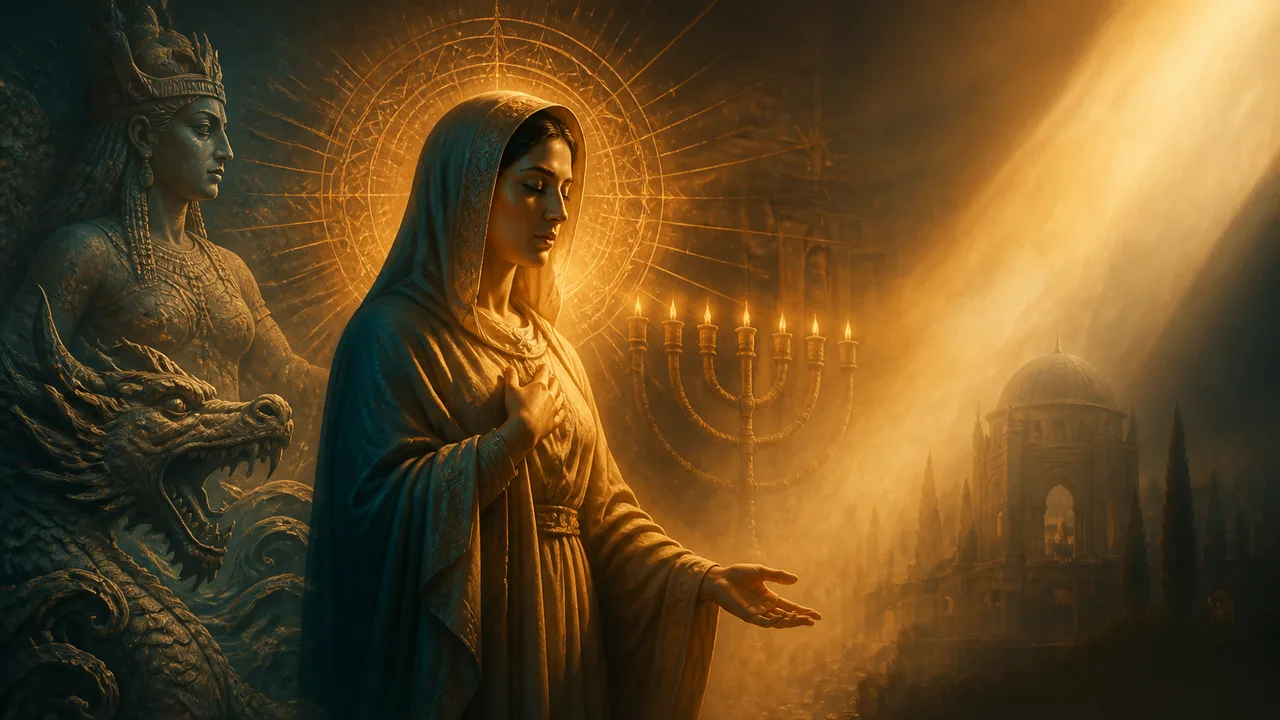
Photo: AI. Astrid Lehmann
Inscriptions and votive statues unearthed at sites like Kuntillet Ajrud suggest that the God of ancient Israel — the one who would eventually become the God of monotheism — once had a consort: Asherah. The archaeological record is not subtle about this. And yet, as Dr. Justin Sledge of the YouTube channel Esoterica argues in a recent 53-minute deep dive, the rise of strict monotheism effectively buried the feminine divine — not destroyed it, but buried it. And like everything buried under sufficient pressure, it eventually came back up. In surprising forms. In alarming forms. That Freudian framing — the return of the repressed — gives Sledge's argument its spine, and it's not a bad one.
The video, titled How God Became a Woman: From Primordial Chaos to Medieval Goddess, is a tour through several thousand years of religious history: ancient Near Eastern creation myths, biblical wisdom literature, Gnostic cosmology, medieval Marian devotion, and the theosophical system of the Zohar. It is, by any reasonable measure, a lot of ground to cover. Sledge covers it with considerable erudition and an affectionate irreverence that keeps the whole thing from collapsing under its own weight.
The problem monotheism keeps generating
The thread running through all of it is a genuine theological puzzle: if God is radically transcendent — utterly unlike and beyond creation — then how does anything happen? How does an infinite, undifferentiated absolute relate to a finite, differentiated world? This is not a minor housekeeping problem. It is, as Sledge correctly identifies, the central structural tension in Western monotheism, and it has been generating solutions — and new problems — for millennia.
One ancient solution, largely forgotten in favor of the more philosophically tidy creatio ex nihilo, is creatio ex profundis: creation not from nothing but from a primordial chaos, a watery deep. In the Hebrew Bible this is the tehom, the deep, populated with titanic sea monsters — the tanninim — whose cognates appear in Babylonian myth as Tiamat (cognate with tehom, probably) and in Canaanite myth as Lotan, the precursor to Leviathan. The Israelite God subduing Leviathan appears not just in Job but in the rather overlooked creation hymn of Psalm 74. What Sledge emphasizes is that in the oldest stratum of these myths, the primordial chaos is consistently gendered feminine — monstrous, yes, but feminine. Creation is an act of masculine ordering imposed on feminine disorder.
This is, as Sledge dryly notes, "not exactly a feminist high point in the history of the divine feminine." Tiamat is clubbed, speared, and dismembered by Marduk, her body parts reassembled into the physical world. The feminine is present at the very foundation of creation, but present as what must be overcome. That this mythological structure was later philosophically laundered into creatio ex nihilo — creation from nothing, with no uncomfortable primordial feminine chaos to account for — is itself a kind of erasure.
Wisdom playing before the Lord
More theologically interesting, and considerably more startling for readers who have not paid close attention to Proverbs 8, is the figure of Hokhmah — Wisdom — who delivers a first-person speech describing her own origins. Sledge reads the passage in Robert Alter's translation, and it is worth sitting with:
"The Lord created me at the outset of his way, the very first of his works of old. In remote eons, I was shaped at the very start of the first things of earth. When there was no deeps, I was spawned..."
The Hebrew verb used for "created" here is not bara or yatsar — the standard biblical terms for divine creation — but something closer to "acquired" or "came to possess." She is not made the way the world is made. She predates the tehom itself, that primordial chaos that is otherwise the oldest thing in the ancient Near Eastern cosmological imagination. She was "by him, intimate, his delight day after day, playing before him at all times." The word translated as "intimate" — amon — also means artificer, craftsperson, demiurge.
Sledge is direct about what a straight reading of this text yields: "If this isn't the divine feminine plainly being worked out in the text as a creation story, it'll do until she shows up." The hermeneutical tradition has worked hard to domesticate this passage — reading Wisdom as a literary personification, a mere rhetorical device, rather than a genuine theological entity. Whether that reading is warranted or whether it reflects, as Sledge suggests, "the hermeneutical tyranny" of prior monotheistic commitments is a question the evidence genuinely leaves open.
A medieval arms race in the feminine divine
The argument's most historically specific and perhaps most compelling section concerns the 13th century, where Sledge identifies a dialectical relationship between two traditions developing simultaneously under conditions of considerable pressure.
On the Christian side: the explosion of Marian devotion. Gothic cathedrals dedicated to Notre Dame were rising across France. The mystic Mechthild of Magdeburg called Mary, flatly, a goddess — "in a text that did not get her in a great deal of trouble," Sledge observes, with audible surprise. Mary had by this point accumulated a catalog of roles that would strain any systematic theologian: mother, virgin, bride, queen of heaven, intercessor, warrior, lactating nourisher. The Council of Ephesus in 431 had affirmed her as Theotokos, Mother of God, without technically permitting her worship. Popular piety, as Sledge notes, was not particularly interested in that technical distinction.
On the Jewish side: the same century saw the composition of the Zohar, the foundational text of Kabbalah, produced by a circle of mystics around Moses de León in Iberia. The context matters enormously here. Iberian Jewish communities were under sustained pressure — forced disputations, the reconquista's advancing front, the periodic violence of anti-Jewish massacres. Maimonidean rationalism, which had accommodated Judaism to Aristotelian philosophy, was accused by traditionalists of providing philosophical cover for apostasy: if religion is just allegory, why not adopt the allegory that keeps your family alive? The Zohar was, among other things, a traditionalist counter-offensive.
And crucially, as the scholar Arthur Green has argued — his 2002 article "Shekhinah, the Virgin Mary, and the Song of Songs" in AJS Review is the recommended reading Sledge cites — the Zohar's construction of the Shekhinah as a fully realized divine feminine entity developed in dialectical relationship with the Marian cult. Not simple borrowing. Something more like competitive elaboration.
The Shekhinah as supercharged counter-Mary
The Shekhinah — from the Hebrew root meaning "to dwell," denoting God's immanent presence — had existed as a theological concept in rabbinic Judaism without being explicitly gendered feminine, despite the grammatical gender of the noun. The Zohar changed that. In the system of the ten sefirot (divine emanations), the Shekhinah is identified with Malkhut, the lowest sefirah, the one closest to creation — the womb of the cosmos, the gateway of all prayer, the exile companion of Israel.
Green's four axes along which the Shekhinah developed — chastity, sexuality, motherhood, and martial ferocity — map interestingly onto Marian attributes while systematically exceeding them. Like Mary, the Shekhinah is virginal, untouchable, the object of impossible devotion. Like Mary, she is an intercessor, amplifying human prayer before the hidden God. Like Mary, she suffers in solidarity with those who suffer. But unlike Mary, she is also the erotic partner par excellence within the divine, the consummation of sacred marriage (hieros gamos) within the Godhead itself. And unlike the perpetual virgin of Catholic theology, she is explicitly, cosmologically sexual. Celibacy, as Sledge puts it, "isn't a Jewish virtue."
The Shekhinah is also a warrior: fiery-haired, commanding angelic battalions, capable of consuming mountains. She even absorbs and rehabilitates the ancient goddess Asherah — the very consort of Yahweh whose worship the Hebrew Bible had spent considerable energy suppressing. The Zohar brings her back, reframed as the Shekhinah herself.
The Shema — "Hear, O Israel, the Lord is our God, the Lord is One" — is reinterpreted by the Zohar not as a declaration but as a goal. The task of ritual practice is to unify the divine, to bring about the sacred marriage within the Godhead. The phrase leshem yichud, "for the sake of the unification of the Name," still accompanies the performance of mitzvot in Kabbalistic practice. And yichud remains the term for the liminal moment when bride and groom are alone together for the first time, before consummation.
What Sledge is tracking across this entire history is not a single linear narrative of suppression and recovery but something more recursive: a structural problem in monotheism that keeps generating feminine solutions, each of which gets suppressed, submerged, and eventually resurfaced in new form. The Shekhinah welcoming in the Sabbath on Friday evenings is now a staple of mainstream Jewish liturgy. The Queen of Heaven has a church named after her in neighborhoods across the world. Both, in their different idioms, are the inheritors of Tiamat — domesticated, transfigured, triumphant.
Whether that triumphant return represents genuine theological inclusion of the feminine divine, or whether it represents a more sophisticated form of containment — the feminine welcomed in, but on strictly managed terms — is a question the history, carefully read, keeps open.
More Like This

Middle Platonism's Hidden Role in Western Esotericism
ESOTERICA's new crowdfunded seminar argues Middle Platonism built the foundations of Hermeticism, Gnosticism, and early Christian theology. Here's what that means.
WW1 Trench Life: What the Western Front Was Really Like
From Pals' Battalions to the Vickers gun, a new documentary unpacks the grim machinery of survival on the WW1 Western Front in unflinching detail.
The Gods of Pre-Islamic Arabia, In Their Own Words
Ancient desert inscriptions reveal the polytheistic world before Islam—gods, prayers, sacrifice, and fate, recorded by the nomads who lived it.

Harvey Friedman: Math's Foundations Are Shaking
Harvey Friedman spent 60 years proving that ordinary math can't be trusted. His work in reverse mathematics may be the most unsettling idea in modern logic.

The Plato Nobody Taught You: Middle Platonism
Middle Platonism shaped Christianity, Gnosticism, and Western esotericism—yet it's barely taught. A new free seminar asks why, and what we've been missing.
Waco Siege: Ancient Echoes in Modern Tragedy
Explore the 1993 Waco siege through the lens of ancient cult dynamics and modern law enforcement challenges.
Stoicism as a Political Philosophy, Not a Retreat
Massimo Pigliucci argues Stoicism's dichotomy of control isn't passive resignation—it's a framework for smarter, more durable political engagement.

Pandemics That Brought Down Ancient Civilizations
From Cahokia to Constantinople, ancient DNA is rewriting how civilizations fell. Disease was often the hidden accelerant history forgot to record.