The Case for Packing Less When Traveling with Kids
A travel creator who's taken her toddler from Alaska to Patagonia argues that most baby gear on packing lists is unnecessary. Here's what she skips—and why.

Written by AI. Mariel Fontaine
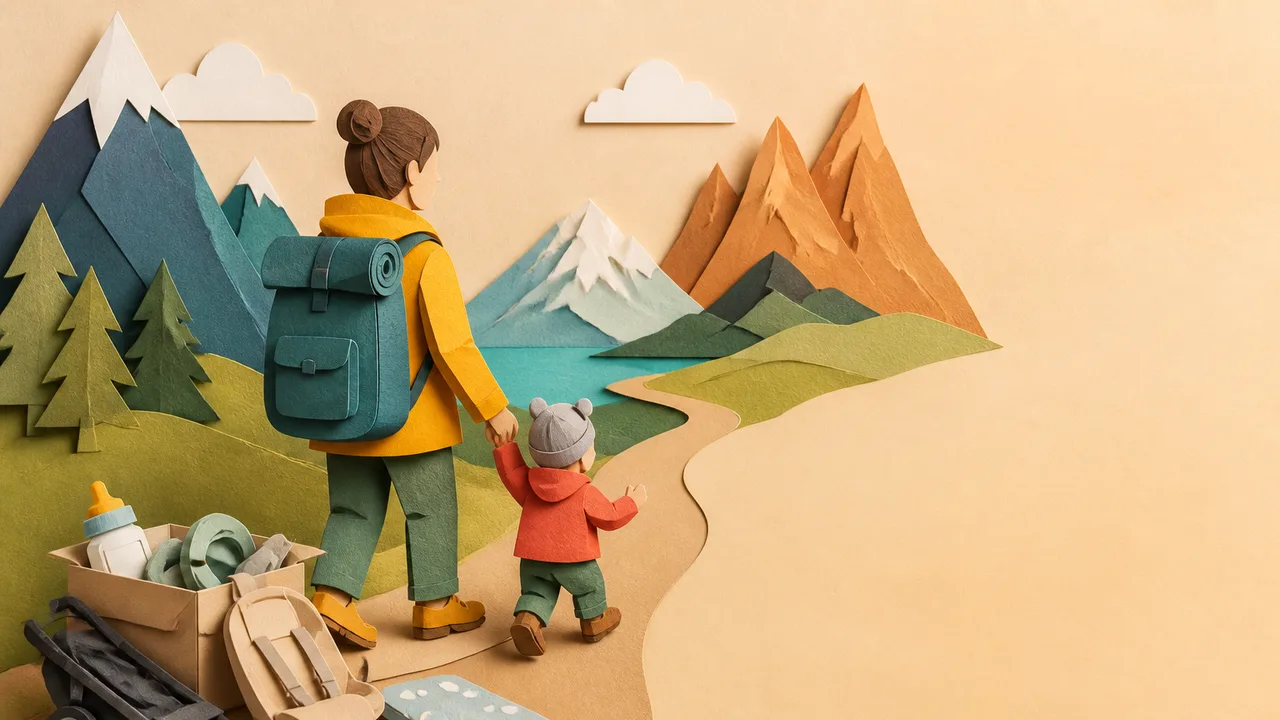
Photo: AI. Lila Bencher
There is an entire economy built on convincing new parents that travel with a baby requires a specific, expensive, and very large set of objects. Browse any parenting forum or affiliate-linked blog and you will find near-identical lists: the travel stroller, the blackout sleep pod, the portable high chair, the sound machine. Each item arrives with glowing testimonials and a convenient purchase link.
The creator behind the Samuel and Audrey travel channel has a different view. In a recent video, she walks through five items she considers unnecessary for family travel—gear she has deliberately left behind across a journey that has taken her toddler from Alaska to Patagonia, and through planes, trains, boats, buses, and cars in between. Her argument is not that these products are useless in all contexts. It is more pointed than that: she thinks the internet has a financial incentive to overstate how much you need.
"Everybody out there is trying to make money," she says in the video. "They want to sell you a product that has a really nice commission." This framing is worth sitting with. Travel influencer culture does run heavily on affiliate arrangements, and baby gear is a particularly lucrative category. That does not mean every recommendation is cynical, but it does mean skepticism is warranted when the same five products appear on every list.
The Stroller Question
Her first target is the premium travel stroller—a category that includes products priced close to, or well over, a thousand dollars. Her case against them is less about the price point and more about what that price tends to buy: compactness. Many expensive travel strollers are engineered to fold small enough to fit in an overhead bin. She finds this optimization misguided.
The tradeoff, she argues, is structural. Compact strollers tend to have small, lightweight wheels—fine on smooth airport floors, less useful on cobblestones, broken sidewalks, or the dirt roads that characterize genuinely adventurous travel. What she prioritizes instead is a stroller with large rubber wheels, single-piece collapsibility, and enough durability to gate-check without anxiety. Her current stroller has had three previous owners. She bought it secondhand.
The gate-check point is worth unpacking for first-time traveling parents who may not realize this is a standard option. You use the stroller through the terminal, hand it off at the gate door, and—most of the time—collect it again on the jet bridge when you land. The overhead-bin obsession solves a problem that gate checking already handles, at significantly lower cost.
What Hotels Already Provide
Two of her five items challenge a similar assumption: that you cannot rely on the destination to provide what you need. The blackout sleep pod—a tent-like structure designed to create a dark sleeping environment for light-sensitive babies—and the portable sound machine both fall into this category.
Her counterargument for the sleep pod is empirical: in her experience, virtually every hotel room already has blackout curtains. She acknowledges this assumption may not hold at the budget end of the accommodation spectrum, but for travelers staying in standard hotels, the product is solving a problem that the room typically handles itself.
On sound machines, she is more explicit about the fact that her family's experience may not generalize. Her daughter, she says, has simply never needed one—a result of how she was raised rather than anything inherent to the child. But for families whose babies do rely on white noise to sleep, her point is narrower: a dedicated device is redundant when a phone, tablet, or hotel television can play the same audio. The argument holds if the device can be replaced. It holds less cleanly for parents whose babies respond specifically to a particular machine or sound profile.
The Luggage Claim
Perhaps the most surprising item on her list is the baby's own suitcase. She describes traveling—on multiple occasions—with a single checked bag for a family of three. Half the suitcase went to the adults; half to the baby, divided further between diapers and clothing. The system depends on doing laundry mid-trip and packing pieces that mix and match rather than complete, dedicated outfits. Whether this works at your destination depends significantly on how easy laundry access actually is—a variable that shifts considerably between, say, a boutique hotel in Lisbon and a guesthouse in rural Guatemala.
It is also worth noting that diaper quantity has a ceiling. A nearly two-year-old requires fewer diapers per day than a newborn, which changes the luggage math in ways that may not apply at earlier stages.
The Portable High Chair
On clip-on high chairs, her case is less about an alternative the destination already provides and more about probability. She estimates that roughly 80 percent of restaurants she visits have high chairs available—and when they do not, the stroller serves as a fallback. The practical objection to this is geographic: that 80 percent estimate reflects the specific kind of international travel her family does, and it may be optimistic in regions or contexts where restaurant high chairs are genuinely uncommon. For families traveling to places where child-accommodating infrastructure is less standardized, the calculation may shift.
What She Does Carry
Against all five items she leaves behind, she holds up one non-negotiable: a well-stocked diaper bag. Hers contains a changing pad, diapers, wipes, two spare outfits, a sweater, a muslin cloth, a water cup, snacks, and two or three small toys. A tablet is also in there, described as a last resort for long travel days rather than a first line of entertainment. "I've got everything I need for a potential emergency," she says.
This is, it should be noted, not a minimalist diaper bag so much as a carefully curated emergency kit—compact precisely because each item earns its weight against multiple possible scenarios. The muslin is a sun cover, a wind barrier, and a warmth layer. The spare outfits cover the inevitable blowout. The toys are small, tactile, and developmentally appropriate for a teething toddler.
The underlying logic here is the same logic that runs through the entire video: less gear, chosen thoughtfully, outperforms more gear, chosen anxiously. A $900 stroller bought out of fear that a cheaper one will fail you on cobblestones is less useful than a secondhand jogging stroller bought because you thought carefully about where you were actually going.
There is a version of this advice that only works if you already travel light by temperament, stay in reliable mid-range hotels, and have a baby who sleeps easily. She acknowledges this, and the disclaimer is real. But there is also something worth examining in the underlying dynamic she identifies: that the standard baby travel packing list has been assembled, at least in part, by people who profit from it.
The question is not whether any individual item is useful—some of them clearly are, for some families, in some circumstances. The more useful question is whether you, specifically, actually need it, or whether you are packing for a worst-case scenario someone else sold you.
More Like This

Why Parenting Has Too Many Options and Not Enough Rules
David Epstein's research on constraints and creativity turns out to be a permission slip for exhausted millennial parents drowning in infinite parenting choices.

Gaiman, Argentina: A Welsh Town Deep in Patagonia
Gaiman in Argentine Patagonia preserves a Welsh settler heritage unlike anywhere else on earth. Here's what the town actually offers curious travelers.

Inside Argentina's 7-Generation Working Estancia
Estancia La Tomasa near Buenos Aires has welcomed guests since 2023. Here's what a weekend on this 140-year-old working ranch actually looks like.

Estancia Villa Maria: A Tudor Manor Near Buenos Aires
Estancia Villa Maria blends Argentine cattle-boom history with Tudor architecture and four daily meals—40 minutes from Ezeiza Airport. Here's what to expect.

Rio Gallegos, Argentina: A Patagonian City Passing Through
Rio Gallegos is Patagonia's most overlooked capital. Here's what one day in this transit city actually looks like—and why it's worth the stop.
Hotel Check-In Safety Checks Worth Doing
From bed bugs to hidden cameras, a former hotel worker's check-in routine covers safety, hygiene, and avoiding surprise charges—here's what actually holds up.

Bosnia Travel Tips: What to Know Before You Go
From Mostar's slick cobblestones to Balkan time, here's what seasoned travelers wish they'd known before visiting Bosnia and Herzegovina.

Lima's Neighborhoods and the Inequality Dividing Them
A street-level look at Lima, Peru's capital, where gang-controlled districts and wealthy enclaves exist just blocks apart—and government neglect connects them both.