Tabby's Star Mystery: A Super-Jupiter May Be the Culprit
Ten years after its discovery, Tabby's Star may finally have an explanation—a massive hidden planet flinging comets toward the star. Here's what the evidence actually shows.

Written by AI. Priya Sharma
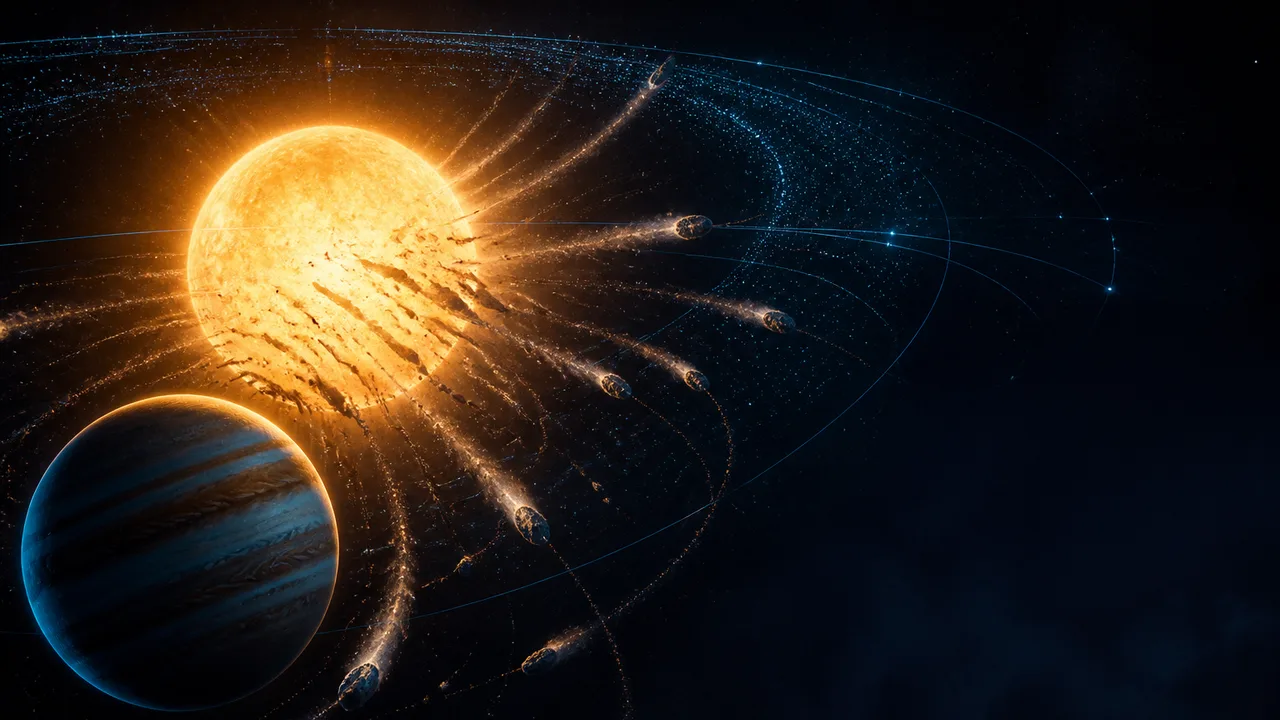
Photo: AI. Dante Nwosu
Ten years ago, astronomers found a star that refused to behave. Not dramatically, not in a way that exploded across the sky—just a light curve that kept doing the wrong thing, producing dips in brightness that were irregular in timing, inconsistent in depth, and occasionally blocking up to 20% of the star's light at once. Nothing in the standard playbook explained it. KIC 8462854—better known as Tabby's Star, named for its discoverer Tabetha Boyajian—became the kind of anomaly that invites both rigorous investigation and spectacular speculation. Alien megastructures got floated. They always get floated.
Now, a decade of careful observation later, a new paper may have identified not the thing casting the shadows, but—in a lovely piece of scientific reasoning—the thing making the shadow-makers.
What the light curve actually tells us
The Kepler space telescope, which flagged Tabby's Star in its survey data, was built to find planets through transit photometry: measuring the tiny, regular dimming of a star as a planet crosses in front of it. The key word is regular. Planets follow predictable orbits and cast predictable shadows. As PBS Space Time host Matt O'Dowd explains, "the regularity of these transits tells us that the shadow is caused by the repeated orbit of a planet."
Tabby's Star produces nothing of the sort. Its dips are aperiodic—they arrive on no fixed schedule—and their depths vary wildly. Planets don't do that. Neither do rings, nor any solid opaque structure we can imagine, because all of those produce what astronomers call achromatic, or gray, dimming: blocking blue and red light equally, regardless of wavelength.
The first real clue toward an explanation came in 2018, when Tabetha Boyajian's team published spectroscopic observations showing that Tabby's Star's dimming is chromatic—stronger at shorter wavelengths, weaker at longer ones. That's the fingerprint of dust. Tiny particles scatter and absorb blue light more aggressively than red, which is precisely why our own sunsets turn orange and why interstellar dust clouds redden the stars behind them.
So: dust. The problem is that dust near an active main-sequence star is an unstable arrangement. Stellar radiation pressure sweeps fine particles away on timescales far shorter than a human lifetime. Young stars are swaddled in primordial dust that gets blasted away early; dying stars can eject fresh dust continuously. Tabby's Star is neither. At roughly 1.4 solar masses, it sits comfortably in the prime of its main-sequence life, with no obvious mechanism to generate the amount of dust it appears to be throwing at us. As O'Dowd puts it: "The leftover dust of its birth should be long gone, and it isn't producing dust itself. And yet, it's been showing these strange varying dust shadows for years."
The dust has to come from somewhere. It has to be replenished.
Enter the comet hypothesis—and its gravitational engine
In our own solar system, comets are the relevant analogy. Objects in the Kuiper Belt and Oort Cloud—vast reservoirs of frozen primordial debris at the outer edges of the system—occasionally get gravitationally nudged inward, where solar heating sublimates their ice and releases the dust trapped within. That dust forms the visible tail and eventually disperses.
The operative word, again, is occasionally. Our solar system rarely hosts more than one or two active comets at any given time. Producing the sustained, months-to-years-long dust signatures seen around Tabby's Star would require not occasional comets but continuous swarms—a steady rain of icy bodies into the inner system.
To get that, you need something doing the flinging. A massive gravitational disruptor, parked far enough out to have access to a reservoir of icy bodies, but massive enough to destabilize their orbits and throw them sunward in large numbers. In our system, Jupiter plays a version of this role. Around Tabby's Star, you'd need something considerably more formidable.
The transit that wasn't supposed to be one
Here is where the current paper enters the story. In 2019, NASA's Transiting Exoplanet Survey Satellite (TESS) monitored Tabby's Star for 55 days. Amid the star's characteristic chaos, TESS recorded a single isolated dip: symmetric, clean, lasting just over 20 hours, and blocking about 1.1% of the star's light. At the time, researchers assumed it was an unusual dust event and moved on.
Over the following years, nobody managed to build a convincing dust model that reproduced the dip's distinctive symmetry. Dust clouds are lumpy and irregular; they don't typically produce that kind of textbook shape. Then, a team led by Cristina Maderga Favieres returned to the data with a different hypothesis: what if the symmetric dip isn't dust at all? What if it's a planet?
"Perhaps this dip is not dust, but rather the dust maker," O'Dowd explains in the PBS Space Time episode. "Perhaps it is exactly the type of planetary transit event that Kepler and TESS were built to discover—in this case, the massive body hypothesized to be flinging comets at Tabby's Star."
The logic is worth sitting with. Once you accept that Tabby's Strange light curves are caused by dust, and that sustained dust requires a comet supply, and that a comet supply on this scale requires a gravitational disruptor, then finding a disruptor becomes a prediction rather than a surprise. The team looked backward through archival data from Kepler, TESS, and other monitoring programs to search for any prior transits consistent with a planet. They found none—which, counterintuitively, helped them constrain the possibilities. Orbital periods that would have produced a past detectable transit were eliminated. What remained was a cluster of viable periods between 1,000 and 1,300 days.
Combining that constraint with the 20-hour transit duration—which encodes the planet's orbital speed—yields an orbital period of approximately 3.3 years and an orbital radius roughly 2.5 times Earth's distance from the Sun, positioning the hypothetical planet between where Mars and Jupiter sit in our system. The depth of the transit implies a planet about 70% larger than Jupiter. That is, to borrow O'Dowd's framing, a huge planet.
How confident should we be? Not very, yet.
The transit evidence is suggestive but not confirmatory. Standard practice in exoplanet science requires three transits—two complete orbital cycles after the first detection—to establish a planet via the transit method. The team has one. That's intriguing, not conclusive.
The researchers also looked for a radial velocity signal—the tiny Doppler wobble that a massive planet induces in its host star's light as they co-orbit their shared center of mass. They found something tentative. The mass estimate from the best-fitting radial velocity model is strikingly large: approximately 10 times Jupiter's mass, which would technically push the object toward the boundary between planet and brown dwarf. The detection carries a confidence of 2.3 sigma, which translates to roughly a 1-in-50 chance that the signal is noise. That's not negligible. It doesn't meet the conventional 5-sigma threshold that the field treats as a detection. The team knows this, and says so.
There's an additional complication: Tabby's Star rotates rapidly, which smears its Doppler signature and makes radial velocity measurements harder to interpret cleanly. The signal is there; the question is whether it's real or an artifact of the star's own rotation interacting with the analysis.
December's data release may settle the question
The most promising independent test will come from an unexpected direction. The Gaia space telescope—the European Space Agency's extraordinary astrometric survey instrument—operated from 2014 until March of this year and spent that time measuring the positions of roughly 1.5 billion stars with extraordinary precision. Its final data processing release, expected in December, will include precision astrometry covering the first five and a half years of the mission.
Among Gaia's ambitious goals is detecting the astrometric wobble of stars—the literal, tiny change in a star's position on the sky as it orbits its common center of mass with an unseen planet. This is conceptually distinct from radial velocity, which measures motion toward and away from us; astrometric wobble measures side-to-side motion. The Maderga Favieres team predicts that if the super-Jupiter is real, its astrometric signature should appear in Gaia's December release.
If it does, the decade-long puzzle largely resolves: Tabby's Star is an ordinary-ish main-sequence star being bombarded by evaporating swarms of comets, thrown inward by a colossally massive planet in a way that our own Jupiter never quite managed. Strange, yes, but strange in a way the laws of physics can accommodate.
If the signal isn't there—if Gaia's extraordinary precision finds no wobble—then the hypothesis fails at one of its most testable predictions, and astronomers are back to watching and wondering.
The candor in how PBS Space Time frames that possibility is worth noting: "if the planet is not there, well, we keep on thinking and watching and wondering about the strangest star in local space-time." That's not deflation. That's what scientific honesty sounds like.
A 2.3-sigma detection and a single transit don't make a discovery. But they do make a prediction. December will tell us whether the prediction holds.
More Like This
A New State of Matter in Earth's Core?
Exploring Earth's core: Could it exist in a superionic state, both solid and liquid? A new study delves into this possibility.
Betelgeuse's Hidden Star: Solving Celestial Mysteries
Unveiling Betelgeuse's hidden companion star reshapes our understanding of stellar evolution and supernova precursors.
Why Finding Earth's Twin Among Exoplanets Is So Hard
The TRAPPIST-1 system looks promising—seven rocky planets, three in the habitable zone. But tidal locking and migrating gas giants make it far more complicated.
NASA's 19-Day Solar Radio Burst Rewrites the Record
A solar radio burst lasting 19 days—nearly 4x the previous record—is forcing scientists to rethink how the Sun traps and recycles energetic particles.
Planet 9, Pluto, and the ISS: Neil Tyson Fields the Big Questions
Neil deGrasse Tyson tackles Planet 9, Pluto's demotion, galaxy shapes, dark matter, and the ISS deorbit in StarTalk's latest Cosmic Queries episode.
Euclid Space Telescope Maps the Dark Universe
The Euclid Space Telescope is rewriting cosmology—mapping dark matter, finding ghost galaxies, and forcing scientists to rethink what the universe is made of.

How Opponent Recognition Unlocks Cooperation in Evolution
A Rutgers physicist argues that tailoring cooperation to specific opponents—not blanket strategies—may be evolution's simplest path out of the Prisoner's Dilemma trap.

Heavy Fuel Oil Powers Global Shipping at a Steep Cost
Heavy fuel oil powers nearly 80% of global shipping. It's cheap, toxic, and nearly impossible to replace. Here's what it actually is and what's at stake.