The Rise and Fall of the Aztec Empire Explained
How the Aztec Empire rose from a wandering tribe to a Mesoamerican superpower—and how Spanish conquest and disease ended it forever.

Written by AI. James Morrison
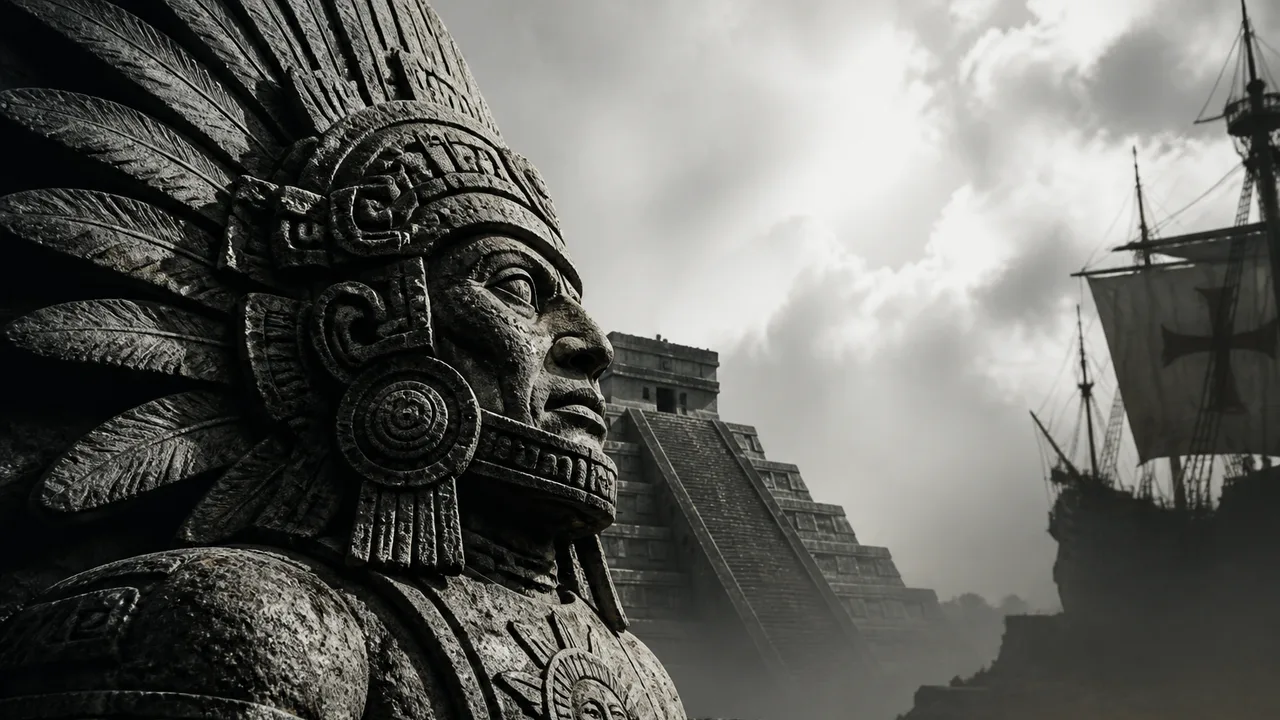
Photo: AI. Kasper Winter
Before Rome had finished building its aqueducts, a city of roughly 200,000 people was flourishing in central Mexico. The Romans had no knowledge of it. Neither did the Greeks, the Egyptians, or the Han Chinese. The place the Aztecs would later name Teotihuacan—"the place where gods were born"—operated in complete isolation from every civilization that history textbooks call foundational. That fact alone should give anyone pause before treating the story of the Aztec Empire as a simple tale of savage peoples and civilizing conquerors.
The Odyssey documentary The Complete Story of the Rise and Fall of the Aztecs works its way through that story with reasonable care, tracing the arc from Teotihuacan's mysterious collapse through the emergence of the Mexica people, the construction of Tenochtitlan, and the catastrophic arrival of Hernán Cortés in 1519. It is, at roughly 48 minutes, necessarily compressed. But its scholars make several observations worth sitting with.
A City Without a Name
Teotihuacan presents an immediate problem for anyone who likes their history tidy. Archaeologists know the city existed—the physical evidence is substantial. They know it influenced virtually every Mesoamerican civilization that followed, including the Zapotecs, the Maya, the Toltecs, and the Aztecs. What they do not know is what the city's inhabitants called it, what language they spoke, or precisely why it collapsed. The name "Teotihuacan" is Aztec—bestowed centuries after the city was already abandoned, by people who arrived at the ruins and concluded, reasonably enough, that only gods could have built such a place.
One scholar in the documentary makes the honest admission plainly: "You have lots of cultures that lived long before the Aztecs—highly developed—but we don't know that much about them just from the archaeology, and not from the chronicles themselves." That gap matters. It means that the story of Mesoamerica before the Aztecs is largely inference and archaeology, not narrative history. The Aztecs themselves didn't have writing in the Western sense, which compounds the problem downstream.
The documentary notes that the Aztec civilization flourished between the 14th and 16th centuries—a period the West calls the Renaissance. Leonardo da Vinci and Michelangelo were working in Florence while Tenochtitlan was being built on an island in Lake Texcoco. Neither world had any concept of the other's existence.
The Architecture of an Empire
The Mexica, the people we call the Aztecs, began as a wandering tribe from a northern territory. Their founding legend holds that they followed their war god's instruction to settle wherever they saw an eagle perched on a cactus with a serpent in its mouth—the image that still sits on the Mexican flag. Whether history or mythology, the legend points to something real: this was a people who understood war as a religious obligation, not merely a political tool.
Tenochtitlan, founded in 1325 on an island in Lake Texcoco, grew into a capital of substantial scale. Aztec society organized itself in strict hierarchical layers: nobles, commoners, serfs, and slaves. The king occupied a category above the social structure entirely—understood not as a political leader but as a living manifestation of divine power. One scholar in the documentary is blunt about the comparative context: "If you compare them really to Europe, we were the barbarians at that time and not the Aztecs. They were excellent in astronomy. They had schools, agriculture, everything you could imagine."
That observation deserves neither reflexive agreement nor dismissal. The Aztecs did construct an empire of considerable sophistication. They also practiced human sacrifice at institutional scale—captured enemies were brought to the top of temple pyramids, held down on sacrificial stones, and had their hearts removed. The documentary's experts are careful to explain the internal logic: the Aztec cosmology held that the gods required human blood to ensure the sun would rise each day. That doesn't make the practice less brutal by any modern standard, but understanding why a civilization does something is not the same as endorsing it—a distinction that apparently still needs defending in some corners of popular history.
The nobility, the documentary notes, were also expected to perform daily blood sacrifice from their own bodies. This was not a practice reserved for conquered enemies; it was an obligation of the ruling class.
The Asymmetry of Contact
Christopher Columbus sailed from Spain in August 1492 believing he was charting a westward route to Asia. He was wrong about where he was going and wrong about the size of the Earth. He was, however, accurate about one thing: he wrote of the indigenous people he encountered that he could conquer them with fifty men. That turned out to be a reasonable operational assessment.
Cortés arrived on the Yucatan Peninsula in 1519. The documentary's scholars push back against the popular image of a handful of Spanish soldiers overwhelming a mighty empire through sheer audacity. "Today in the media you read and hear everywhere that it was just a handful of Spaniards that conquered the whole Aztec Empire—but it was not." Cortés was a minor nobleman of limited means and considerable intelligence. He understood almost immediately that the Aztecs had enemies, and he turned those enemies into allies. After defeating the Tlaxcalan tribe—sworn opponents of the Aztecs—he incorporated them into his force. By the time he reached Tenochtitlan, his army included indigenous warriors in substantial numbers alongside his Spanish contingent.
Montezuma II, who had ruled the Aztec Empire since 1502 at its peak of territorial power, initially welcomed Cortés peacefully. Contemporary accounts describe a dignified exchange of gifts, diplomatic courtesies, and the loan of a palace. One scholar describes Montezuma as fundamentally "a diplomat." Whether he genuinely believed Cortés might be the god Quetzalcoatl returning—as the colonial chronicles suggest—or whether that story was layered onto events afterward remains a matter of scholarly debate. What is less debatable is what happened next.
Cortés, feeling surrounded and vulnerable inside Tenochtitlan, took Montezuma prisoner. The emperor, apparently calculating that open warfare in his own capital would be catastrophic, initially complied. "He didn't want to have a war in the middle of the capital," one scholar explains. "He said, 'I'll just rule in accordance with them and let's see what happens'—and there was this big mistake."
The peace shattered. Montezuma was killed—accounts differ on whether the Spanish or his own people were responsible—and Cortés fought his way out of the city. He regrouped and returned. By then, smallpox had done much of his work for him. The Aztec population had no immunity to European diseases. The epidemic that swept Tenochtitlan after the Spanish arrival killed a significant portion of the city's defenders. Cortés retook the capital and the Aztec Empire ceased to exist as a political entity.
The Gold That Was Never There
The conquest did not satisfy Spanish appetite—it redirected it. The documentary follows the conquistadors south into Colombia around 1536, where they encountered the Muisca people. The Muisca possessed gold in quantities that seemed to confirm rumors of fabulous wealth waiting to be seized. The first written references to El Dorado—the "golden man," a chieftain who reportedly covered himself in gold dust for ritual ceremonies—appear in a 16th-century chronicle by Gonzalo Fernández de Oviedo. The ceremony itself may well have been real; the sacred lake of Guatavita, where gold was reportedly thrown as religious offering, exists and has been partially excavated.
What the Spanish did with the story is instructive. A ritual practice became evidence of a city. A city became evidence of a kingdom. Each cache of gold found confirmed that more must exist somewhere else. Muisca people were tortured for information about gold they did not possess. "There's a persistent sense that gold is being hidden," one scholar observes, "that it's not all being delivered." The conquistadors kept finding gold, which only intensified their certainty that the real prize was still out there.
El Dorado was never found because it never existed in the form they sought. The legend migrated—from Colombia to the Amazon to North America—always just beyond the next expedition. The Muisca population, which had numbered close to a million in the early 1500s according to the documentary's account, was effectively destroyed within decades, killed by disease even more than by violence.
The justification the Spanish offered for melting down Muisca religious objects is worth quoting directly from the documentary: "It's far easier to justify taking gold and silver and precious stones if they're in the form of religious objects which need to be melted down, need to be destroyed in order to wipe out these heathen pagan religions than it would be if it was simply taking money from people."
That reasoning did not originate with the conquistadors, and it did not die with them. The pattern—dress resource extraction in the language of civilization or salvation, and the looting becomes a duty—has shown up with depressing regularity in subsequent centuries.
The Aztec Empire was an extraordinary human construction that lasted less than 200 years from founding to fall. It was brought down by a combination of military defeat, political miscalculation, epidemic disease, and the calculated use of indigenous grievances by a foreign power. None of those elements is unique to Mesoamerica. Students of military history will recognize most of them from conflicts that came much later. The question worth carrying forward is not whether the Aztecs were admirable or brutal—they were, by turns, both—but whether the civilization that replaced them offered something better to the people left behind.
The evidence on that point is not encouraging.
More Like This

Ray Dalio's Framework for Tracking Empire Decline
Ray Dalio argues empires follow measurable, repeating cycles of rise and fall. His framework deserves scrutiny—and raises questions relevant to today's geopolitics.
Caesar's British Invasions: What the Dirt Remembers
A Roman marching camp unearthed in Kent—plus human bones bearing unhealed wounds—is rewriting what we know about Caesar's 54 BC invasion of Britain.
FBI's Struggle Against Omega 7: A Tale of Terrorism and Intrigue
Explore the FBI's complex investigation of Omega 7, a Cuban exile terrorist group, amid community challenges and evolving tactics.
Ancient Greece: Democracy, Empire, and Extremes
From Homer's epics to Alexander's conquests, ancient Greece shaped the Western world through democracy, warfare, and cultural fusion. Here's what the evidence shows.
Mansa Musa: The Emperor Who Crashed Egypt's Economy
Mansa Musa's 1324 pilgrimage to Mecca brought 60,000 people and so much gold it destabilized Egypt's economy. Here's the history most textbooks skipped.
Rapa Nui Archaeology Challenges Collapse Theory
New archaeological research by Nicolas Cauwe challenges the Easter Island ecological collapse theory, revealing Rapa Nui resilience, cultural transition, and colonial devastation.
Russia's Strategic Preparation for Napoleon's 1812 Invasion
Before Napoleon crossed into Russia in 1812, St. Petersburg had already built an intelligence network, reshaped its army, and chosen a strategy to deny him victory.
The Battle of Verdun: Attrition, Leadership, and 300,000 Dead
Ten months, 300,000 dead, and less than five miles of ground changed hands. Epic History's Verdun series examines what that arithmetic actually meant.