Richard McCoy Jr.: The Hijacker History Forgot
In 1972, Richard McCoy Jr. parachuted from a hijacked plane with $500,000. He was caught in 48 hours. Why does D.B. Cooper get the legend and McCoy gets the footnote?

Written by AI. Sofia Ramirez
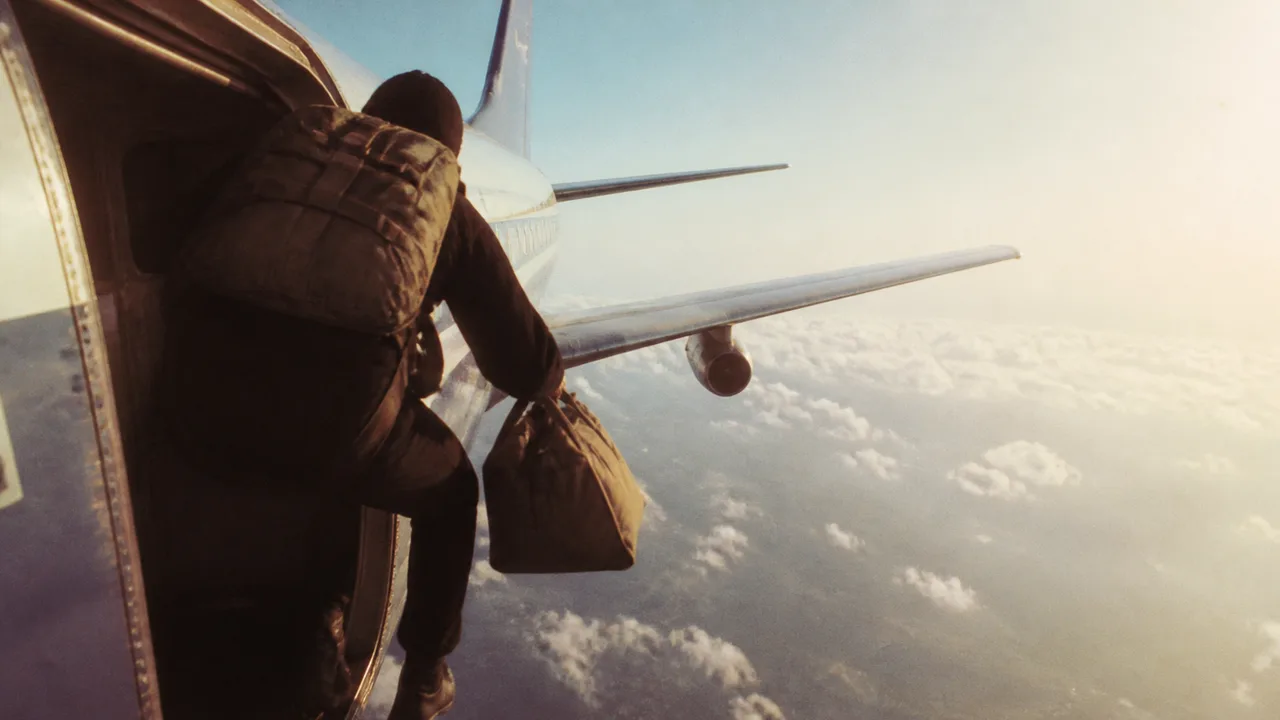
Somewhere over Utah, in April 1972, a 29-year-old Army veteran named Richard Floyd McCoy Jr. clipped a duffel bag stuffed with $500,000 in ransom cash to his body, strapped on a parachute, and jumped out of a commercial airliner. He had a hand grenade and a pistol. He had a plan. What he did not have was 48 more hours of freedom.
McCoy was arrested by federal marshals in Provo, Utah, on April 9, 1972, according to the New York Times, which ran the story under the headline: Skydiver Held as Hijacker; $500,000 Is Still Missing. That last detail — the money still unaccounted for at arrest — tells you something about how quickly the whole operation dissolved. The plan that looked, from the inside, like precision engineering, fell apart almost before the parachute did.
What happened in between the jump and the handcuffs is a story about a lot of things. Audacity, obviously. The strange fever dream of early-1970s aviation, when hijackings were routine enough to generate their own cultural grammar. The FBI's emerging investigative infrastructure. But look closer and it's also a story about a motorist who picked up a stranger, and a flight crew who did their jobs under conditions no job description ever covers, and — fifty years later — about who gets to become a myth and who gets filed under "solved."
The World McCoy Jumped Into
To understand what McCoy did, you have to understand that it wasn't that unusual. Not the jumping-out-of-a-plane part — that was unusual. But the hijacking itself? In the early 1970s, skyjacking had become, by some accounts, almost a feature of American air travel. The era that produced McCoy also produced the infrastructure that would eventually make his crime nearly impossible to replicate. He was both a product of that moment and one of the people who ended it.
The template McCoy was working from had been set five months earlier, in November 1971, by the still-unidentified hijacker known as D.B. Cooper — who commandeered a Northwest Orient flight, collected $200,000 in ransom, and parachuted somewhere over the Pacific Northwest, vanishing into permanent American mythology. According to the FBI's account of the McCoy case, McCoy hijacked United Airlines Flight 855 and parachuted from the plane over Utah, having obtained a $500,000 cash ransom and armed himself with a hand grenade and a pistol — a near-exact structural replay of Cooper's escape, with the ransom demand scaled up.
That scaling up matters. The Cooper hijacking was everywhere in the news; McCoy absorbed it, processed it, and apparently decided the original had underpriced itself. According to Sylvia Wrigley's detailed account on Substack, McCoy needed money — which is almost always the most honest explanation for things that get dressed up in adventure mythology after the fact.
The People on That Plane
Here is what we almost never talk about when we tell these stories: the flight crew.
The Wikipedia account of the hijacking notes, plainly, that McCoy "gave the crew similar instructions as Cooper had" — and the crew complied. That sentence does a lot of quiet work. Behind it are people who went to work that day, boarded a Boeing 727, and found themselves managing a man with a hand grenade at somewhere north of 20,000 feet. They made decisions — probably dozens of them, in real time — that kept everyone alive. We don't know their names from the sources available here. The historical record, as it so often does with working people doing difficult things well, moved on without them.
The arrest, though, came through someone whose role is even easier to overlook: a motorist. According to Wikipedia's account, police began investigating McCoy following a tip from a driver who had picked him up. Think about what that actually means. Someone in Utah in 1972 gave a ride to a stranger — which happened constantly, in an era before the moral panic around hitchhiking fully calcified — and then, presumably after hearing or seeing news coverage of the hijacking, made the connection and called it in.
That is not a small decision. You've just given a man a ride. You don't know what he's capable of. You do know that calling the police with a tip is the kind of thing that can go sideways in all sorts of ways, and that being wrong would be embarrassing at minimum. The motorist did it anyway. The FBI built its case from there, and McCoy was in federal custody within two days of his jump. The FBI's own account frames his capture as a demonstration of investigative competence — which it was — but the competence started with a civilian who made a judgment call that the record barely bothers to name.
The Cooper Question
Almost immediately after McCoy's arrest, people began asking whether he and D.B. Cooper were the same person. The structural similarities were impossible to ignore: same aircraft type, same parachute method, same general approach to ransom extraction. Some investigators believed McCoy was Cooper, operating under a different name on a second run.
The FBI ultimately rejected that theory, in part because witnesses described Cooper as significantly older than McCoy, who was 29 at the time of his arrest. The Bureau has maintained the two cases as separate, and the Cooper case remains officially unsolved.
But the question itself is revealing. The reason people wanted McCoy to be Cooper isn't really about evidence — it's about narrative economy. If McCoy was Cooper, the story resolves. The mystery closes. The myth gets a face. The problem with McCoy as a Cooper candidate is precisely that McCoy is too knowable: he has a name, a hometown, a military record, a family. He got caught. He went to prison. He later escaped from federal prison and was killed in a confrontation with FBI agents in 1974, according to All That's Interesting. That's a complete biography, not a legend.
Cooper, by contrast, vanished. And in American popular mythology, disappearance is practically a prerequisite for immortality. You can't sell a t-shirt to a man whose mug shot is on file.
What the Mythology Costs
The comparison isn't just interesting for what it says about McCoy and Cooper individually. It's a window into which stories we choose to keep, and in what form.
D.B. Cooper became a folk hero — the subject of books, films, an annual festival in Ariel, Washington, a FBI case that stayed active for 45 years. McCoy became a footnote in the Cooper mythology, useful primarily as a foil or a suspect. The structural difference between their stories is thin. The cultural distance is enormous.
Part of what drives that gap is resolution. We mythologize the unsolved because the solved demands accountability. But part of it is something harder to name — a kind of legibility. Cooper is a blank screen onto which people project whatever they want: anticapitalist rebel, desperate everyman, master criminal, accidental hero. McCoy, who was a real person with verifiable circumstances and who according to Wrigley needed money, is too specific for that projection. His story has friction.
We do this across history: we mythologize the ones who escape accountability and explain away the ones who face it. It's cleaner that way. It lets us keep the romance without the reckoning.
The Security State That Followed
None of this is purely historical, which is the part that tends to get dropped when the story gets told as adventure.
The skyjacking epidemic of the early 1970s — of which McCoy's hijacking was one case among hundreds — produced a policy response that reshaped American life. The airport security infrastructure that emerged from this era didn't stay neatly bounded by its original rationale. It expanded, layered, and deepened. After September 11, it became something qualitatively different: a system in which the question of who gets screened, how thoroughly, by whom, and under what legal framework carries enormous stakes for specific communities.
The people who bear the heaviest weight of that system are not the ones who run it, and they are not the ones who get written into the mythology. They are the people who show up at TSA lines and are pulled aside. They are the ones whose names trigger secondary screening. They are the ones for whom the phrase "aviation security" does not evoke abstract policy history but a specific, embodied experience of being treated as a threat.
Richard McCoy's jump, and D.B. Cooper's jump, and the hundred other jumps and threats and demands that made up the skyjacking era — they are the origin story of that system. Not the whole story. But the beginning.
The motorist who turned McCoy in made a call that helped close a case. The flight crew on United 855 kept people alive. Those are the acts of ordinary people navigating an extraordinary situation, and they don't get the festival in their honor.
That's not just a quirk of how we tell stories. It's a pattern. And patterns are worth noticing.
More Like This
Douglas MacArthur and the People He Left Behind
MacArthur is remembered as a military legend. But what about the veterans he gassed, the soldiers he abandoned, and the Japanese citizens who built a new democracy?
Ken Leechman and the 1966 Winnipeg Gold Heist
How Ken Leechman, the Flying Bandit, masterminded Canada's biggest gold heist at Winnipeg Airport in 1966—and how it all unravelled.
The Bari Disaster: Mustard Gas, Secrecy, and 1943
On December 2, 1943, a German raid on Bari killed over a thousand people—and released mustard gas that officials spent decades trying to erase from history.
Attila the Hun: Scourge of God or Economic Strategist?
Attila never sacked Rome—yet he's history's ultimate barbarian. The real story is stranger, and more familiar, than the legend.
J. Edgar Hoover: How the FBI's First Director Held America Hostage
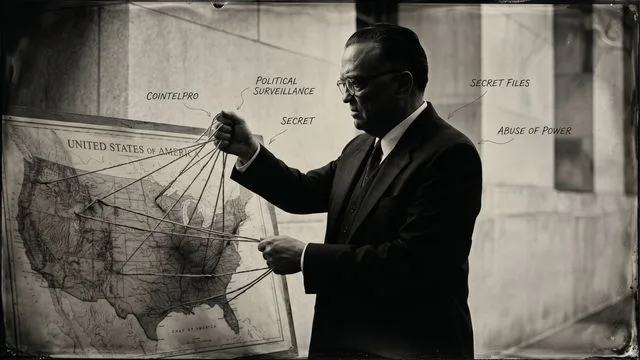
For 48 years, J. Edgar Hoover ran the FBI as his personal empire. His story is a masterclass in what unchecked institutional power actually looks like.

Mir 1997: When Heroism Was the Backup Plan
Michael Foale's retrospective on the 1997 Mir collision reveals what really saved the station—and what it means for the future of human spaceflight.
Egypt's New Delta Project: Green Miracle or Mirage?
Egypt is engineering a new Nile in the desert. But satellite data, groundwater depletion, and a troubling history raise urgent questions about who this is really for.
Ancient Megastructures That Still Puzzle Engineers
From Göbekli Tepe to the Great Pyramid, these ancient sites raise genuine questions about what early human societies were capable of building—and how.