The Real People Behind Famous Disease Names
Alzheimer, Asperger, Gehrig, Down — we say their names constantly. Joe Scott's video asks who they actually were. The answers are complicated.

Written by AI. Sofia Ramirez
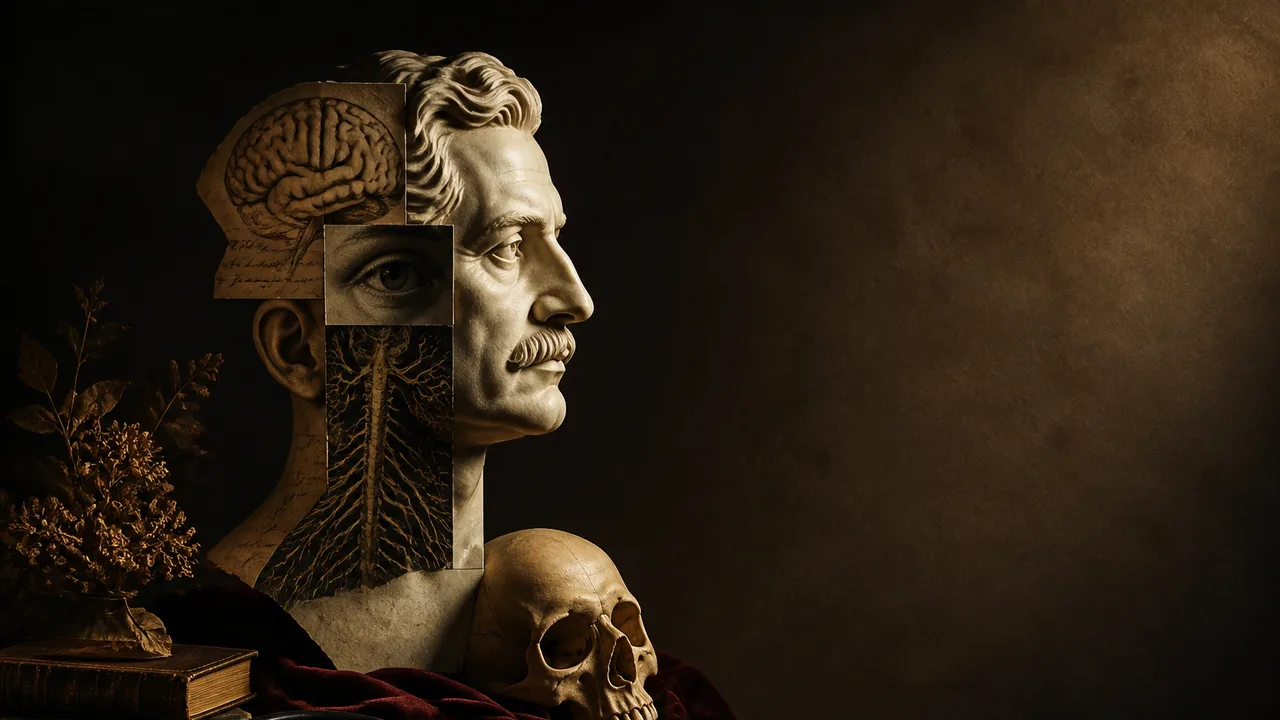
Photo: AI. Liora Goldstein
There's a particular kind of historical erasure that happens when a name gets attached to a disease. The person disappears into the diagnosis. Alzheimer becomes a fog that settles over aging families. Tourette becomes a punchline. Down becomes a prenatal test result delivered in a sterile office. The human being who lived and worked and had opinions and contradictions — gone. What's left is just the label.
Joe Scott's recent video People With Diseases Named After Them sets out to reverse that erasure, putting faces back to names most of us have heard hundreds of times. It's a solidly researched piece of popular science history, and it turns up some genuinely surprising material. It also, almost inevitably, runs into the central problem of this kind of history: the people behind these names don't resolve neatly. Some were heroes. Some were compromised. Some were both, depending on which documents you read and which decade you're asking in.
That messiness is, to me, the most interesting part.
Alois Alzheimer Paid for His Patient's Care Out of Pocket
Start with the most famous one. Alois Alzheimer was a German physician whose primary obsession was finding physical explanations for psychiatric symptoms — tangible, anatomical evidence that mental illness wasn't mysterious or moral, it was biological. In 1901, he began treating a woman named Auguste Deter, who was experiencing severe memory loss and paranoia at only 51 years old. He didn't just study her. He took her in. He arranged for her to live at his hospital, and he personally covered the cost of her care in exchange for access to her medical records — and, after her death in 1906, her brain.
What he found in that brain — the plaques and tangles now synonymous with the disease — had been observed before, but only in much older patients. The assumption had always been that it was just aging. Deter was 56 when she died. Alzheimer argued, correctly, that this was something else: a distinct disease process, not inevitable decline.
He was largely ignored at first. His colleague Emil Kraepelin, who would eventually give the disease its name in 1910, was initially uncertain what to make of the discovery. There's speculation that Kraepelin's enthusiasm for naming the condition was partly motivated by his rivalry with Sigmund Freud — the two disagreed sharply about the origins of mental illness, and a definitive anatomical discovery would have been a useful point in Kraepelin's column. Whether the name was an act of tribute or a tactical move in a professional feud, the research it generated was real. There is still no cure for Alzheimer's disease, but treatments that didn't exist a decade ago now do.
Hans Asperger: The Story That Kept Changing
The Asperger section is where Scott's video gets genuinely difficult, and he handles it carefully.
Hans Asperger was a Viennese physician who, in 1943, described a pattern of behaviors in some of his young patients — social difficulties, intense focus, advanced abilities in specific areas — that he framed, remarkably for the time, as socially valuable. He wrote that "autistic people have their place in the organism of the social community." This was not a neutral observation. Austria was under Nazi occupation. The regime's Aktion T4 program was systematically murdering disabled people and those deemed to have insufficient "social value." Asperger was, at minimum, arguing against that logic for some of his patients.
For decades, this made him a sympathetic figure — a doctor who used the available language of eugenics to protect children from it.
Then came the 2018 paper in Molecular Autism by historian Herwig Czech, which complicated that narrative significantly. Czech documented that Asperger had actively cooperated with the child euthanasia program, and that two young patients he examined were transferred to a killing facility following his reports, where they were murdered. Reuters covered Czech's findings, reporting that Asperger had "actively cooperated" with Nazi authorities — not merely failed to resist them.
Scott presents both sides honestly: Asperger's defenders argue he may not have known the full fate of transferred patients, that his room to maneuver under the occupation was severely limited, and that his advocacy for autistic children's value was genuine. His critics, with Czech's evidence, say he knew enough and chose cooperation.
What Scott doesn't editorialize much on — and what I keep thinking about — is that this is exactly the kind of question that gets erased when a name becomes a diagnosis. "Asperger syndrome" became, in popular usage, shorthand for a specific, recognizable cluster of traits. The man himself was a moving target: advocate, collaborator, or both. In 2013, the DSM-5 retired the term Asperger syndrome in favor of Autism Spectrum Disorder Level 1, a change that was partly clinical and partly — given Czech's research — not entirely coincidental in its timing.
John Langdon Down Was More Complicated Than His Worst Paper
John Langdon Down's famous 1866 paper is titled, in the original, "Observations on an Ethnic Classification of Idiots." As Scott puts it: "Oh, grandpa."
Down used a racial classification system, developed by the anthropologist Johann Friedrich Blumenbach, to categorize his patients by their perceived resemblance to people of different races. He applied the term "Mongoloid" to patients who would today be recognized as having Down syndrome — a label that persisted in medical usage until the World Health Organization retired it in 1961.
The framework was racist. Foundationally, structurally racist, built on pseudoscience that assigned a hierarchy to human variation that doesn't exist.
But Down's actual work with patients was something else. He spent roughly two decades as chief physician at the Royal Earlwood Asylum, transforming it from what Scott describes as a warehouse for forgotten people into a facility with educational programs, improved hygiene, and genuine attention to patient dignity. He photographed hundreds of residents — dressed in fine clothes, in thoughtful compositions — specifically to improve their public standing. When the institution refused to compensate his wife Mary for her years of volunteer teaching and organizing, he resigned. The two of them then built their own private facility, Norman's Field, which eventually housed over 160 people with disabilities.
Down's own writing, despite the racist framework it was embedded in, gestured toward an argument for human unity: "These examples appear to me to furnish some arguments in favor of the unity of the human species."
He was using bad science to make a humane point. That's a particular kind of Victorian knot that doesn't untie cleanly.
Lou Gehrig and the People Who Live With His Name
Lou Gehrig was not an ordinary person. He was one of the most celebrated athletes in American history, a man who played 2,130 consecutive major league games across 14 seasons and then, on July 4th, 1939, stood before 61,000 people at Yankee Stadium and told them, "Today I consider myself the luckiest man on the face of the earth." Millions more heard it on the radio. He died from ALS less than two years later.
The disease has carried his name in American popular culture ever since, and that name carries a specific weight — heroic endurance, public grace, the Iron Horse bowing out on his own terms. That image shapes how a lot of people understand ALS before they have any reason to understand it more closely.
But here's the thing about that image: Gehrig's rapid decline, his loss of speech, his gradual inability to breathe — all of that happened behind closed doors, away from the cameras. What the public got was the farewell speech. What the disease actually looks like, day by day, month by month — the total motor neuron breakdown, the progressive paralysis, the median survival of two to five years after diagnosis — that reality didn't come with his name attached.
When someone gets an ALS diagnosis today, they often get the speech quoted back at them. Well-meaning people reach for the only cultural script they have. Meanwhile, ALS patients and their families are navigating a disease that is relentless and offers very little of the tidy narrative arc Gehrig's public exit provided. The 2014 Ice Bucket Challenge significantly expanded research funding and raised genuine public awareness of what ALS actually is. It's worth asking whether the decades of calling it "Lou Gehrig's disease" — with all the heroism that implies — made some of that honest conversation harder.
The Man Who Named Everything After Everyone Else
Jean-Martin Charcot is the thread that runs through all of this. He is considered the father of neurology, a man who put his name — or rather, other people's names — on roughly 15 diseases. He named things after his students, his predecessors, his colleagues. He championed the work of James Parkinson, whose 1817 description of the "shaking palsy" had gone decades without proper recognition.
But he never named anything after himself.
I don't find this merely charming. I find it clarifying. The naming of diseases is, at its core, an act of institutional power — someone decides whose labor gets memorialized, whose observation becomes the official origin story. Charcot had more of that power than almost anyone in 19th-century medicine. He chose to spend it pointing at other people. In an era when scientific credit was hoarded and careers were built on priority claims, that's a specific kind of professional ethics.
The WHO's 2015 guidelines now discourage naming new diseases after people at all, aiming to minimize stigma and the kind of complications we see with Asperger. There's a real case for that. There's also a real case that names like Down syndrome and ALS carry advocacy weight and community identity that a clinical descriptor doesn't.
What Charcot's example suggests is a third option: use names to point outward, not inward. Honor the people whose work gets buried. Don't put your own on the marquee.
Whether medicine — or any institution — has the discipline for that is a separate question.
More Like This

Douglas MacArthur and the People He Left Behind
MacArthur is remembered as a military legend. But what about the veterans he gassed, the soldiers he abandoned, and the Japanese citizens who built a new democracy?
The Bari Disaster: Mustard Gas, Secrecy, and 1943
On December 2, 1943, a German raid on Bari killed over a thousand people—and released mustard gas that officials spent decades trying to erase from history.

Attila the Hun: Scourge of God or Economic Strategist?
Attila never sacked Rome—yet he's history's ultimate barbarian. The real story is stranger, and more familiar, than the legend.

Is the Autism Spectrum Broken? One Pioneer Says Yes
Uta Frith, who shaped modern autism science, now argues the spectrum has been stretched so far it no longer holds. Here's what she means—and why it matters.
Ancient Pathogens That Still Live in Human Bodies
From Toxoplasma in the brain to herpes in the nerves, prehistoric pathogens still live in us. Here's what modern medicine can—and can't—do about them.
What Neuroscience Actually Owes Sigmund Freud
Neuropsychologist Mark Solms argues Freud got the big picture right. Here's what the neuroscience of the unconscious mind actually shows.

Egypt's New Delta Project: Green Miracle or Mirage?
Egypt is engineering a new Nile in the desert. But satellite data, groundwater depletion, and a troubling history raise urgent questions about who this is really for.
Ancient Megastructures That Still Puzzle Engineers
From Göbekli Tepe to the Great Pyramid, these ancient sites raise genuine questions about what early human societies were capable of building—and how.