What Neuroscience Actually Owes Sigmund Freud
Neuropsychologist Mark Solms argues Freud got the big picture right. Here's what the neuroscience of the unconscious mind actually shows.

Written by AI. Priya Sharma
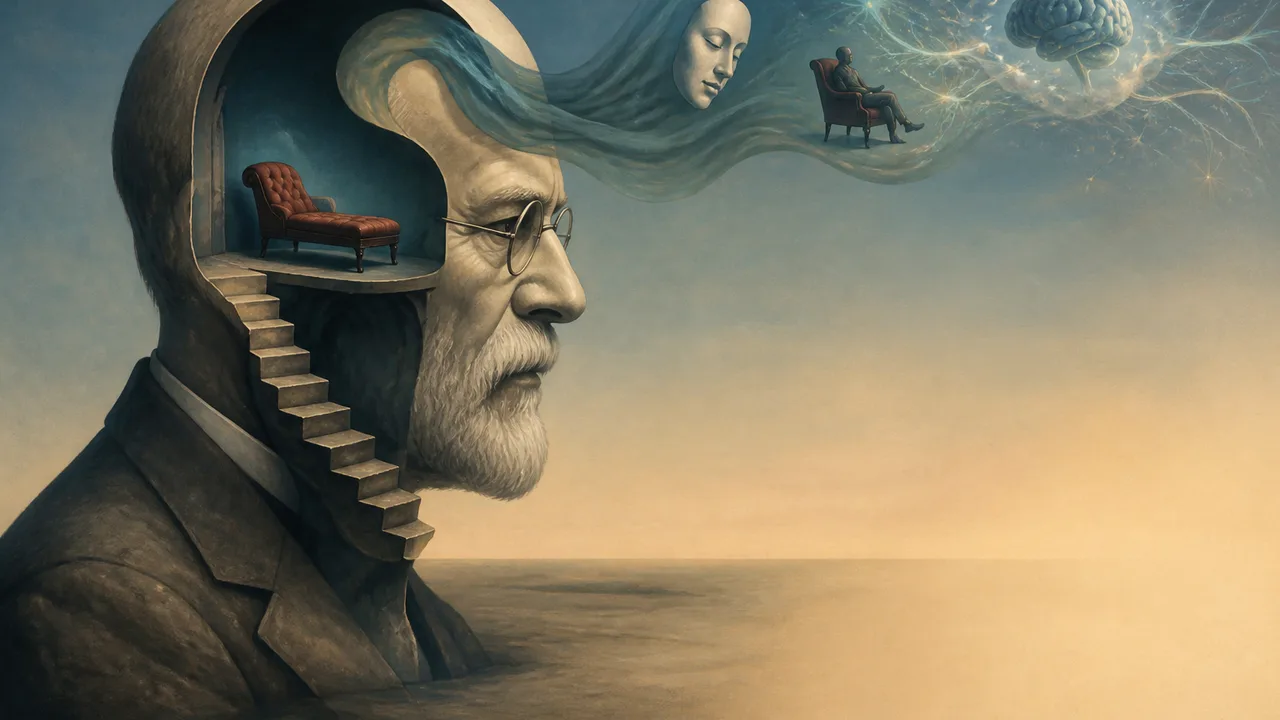
Photo: AI. Iolanthe Fenwick
There is something almost comedic about Freud's position in contemporary psychology. His vocabulary saturates the culture — repression, the unconscious, defense mechanisms, projection — while the discipline that spawned it has largely walled him off. Mark Solms, neuropsychologist and professor at the University of Cape Town, makes this irony explicit: you can now earn a creditable psychology degree in the United States without hearing Freud mentioned in a single class. Not overlooked. Airbrushed out.
Solms's new book, The Only Cure: Freud and the Neuroscience of Mental Healing, is an attempt to complicate that erasure. In a recent conversation on Vox's The Gray Area, he walked through the case for Freud's continued relevance — not as a prophet to be venerated but as a thinker whose foundational insights keep being rediscovered by researchers who don't realize they're retracing his steps.
The argument is worth taking seriously, even by skeptics. And it raises some genuinely difficult questions that neither the Freud-boosters nor the Freud-dismissers tend to sit with.
The unconscious, credited to no one
Solms's most unambiguous claim is also his strongest one. When Freud proposed around 1900 that large portions of mental functioning occur without conscious awareness, the reaction was that this was an oxymoron. Mind and consciousness were synonymous. Unconscious mental processes were, by definition, a contradiction.
Today, that insight is foundational to cognitive science. Not just accepted — assumed. Researchers in cognitive neuroscience now hold that consciousness is a narrow, limited resource, and that the vast bulk of mental processing runs beneath it. What's remarkable, Solms argues, is that this consensus was reached largely through independent methods — brain imaging, memory research, computational modeling — with little acknowledgment that Freud had named the phenomenon a century earlier.
"It was really a matter of independently, all over again, starting the whole thing from scratch, using entirely different methods, arriving at the same conclusions in very broad-brush terms," Solms told host Sean Illing, "and not even realizing that what we're discovering is rediscovering what Freud had discovered and claimed all those years ago."
He extends this to other areas. The importance of early childhood adversity in shaping vulnerability to later psychopathology — now empirically robust, now unremarkable — was a Freudian claim before it was a developmental psychology finding. Solms also argues that the concept of embodied cognition — the idea that mind is not separable from the body it inhabits — traces to Freud, though it is worth noting that this attribution is Solms's interpretive argument rather than settled historiography. The Stanford Encyclopedia of Philosophy credits the development of embodied cognition primarily to a different intellectual tradition, with figures like Lakoff, Johnson, Varela, Thompson, and Rosch more commonly cited as its architects.
The pattern Solms is describing, stripped of the more contestable attributions, is still striking: a figure dismissed as a pseudo-scientist turns out to have been asking the right questions, even when his answers were wrong or improvable.
The problem of subjectivity
The deeper philosophical argument in Solms's position concerns what science can and cannot do with a phenomenon like consciousness. His critique of mainstream psychiatry is grounded here.
The brain, he points out, is the only object we know that has something it is like to be it. Subjectivity is not an epiphenomenon to be explained away — it is the cardinal feature of the brain. And yet for much of the twentieth century, academic psychology under the behaviorist framework denied subjective states any scientific standing. The psyche, as Solms puts it with dry precision, was excluded from psychology.
Freud's methodological contribution, in this reading, was to insist that you have to study the mind from the inside — from the vantage point of being a mind. This is why the psychoanalytic method, for all its limitations, generated something that laboratory behaviorism could not: thousands upon thousands of hours of naturalistic observation of how minds actually work, what they dwell on, how they organize experience.
The objection Illing raises — that a strict materialist would say feelings are just chemicals, full stop — gives Solms his sharpest moment. His response invokes Francis Crick's famous formulation: that "you, your joys and your sorrows, your sense of personal identity and free will are in fact nothing more than a vast assembly of nerve cells and their associated molecules." Solms finds this not reductive but evasive. It names the phenomenon while refusing to explain it. How did those molecules become feelings? Why are feelings there at all, if they're doing nothing? To simply assert identity between the neurochemical and the experiential, he argues, is to leave out the very thing that needs explaining.
His own position — dual aspect monism, which he traces to Spinoza — holds that mind and body are not two substances but two perspectives on the same thing. The analogy he reaches for is lightning and thunder: same event, different sensory channels. Neither is more real. Neither causes the other.
Whether or not that philosophical framework is ultimately defensible, it usefully clarifies what is actually at stake in the debate between psychotherapy and pharmacology.
Symptoms and what they mean
Solms's most clinically consequential argument involves the distinction between treating symptoms and treating causes. His analogy is pointed: imagine a cardiologist responding to chest pain by prescribing an opiate. The pain disappears. The arterial blockage remains. "That would be shockingly bad medicine," he says. "The pain is a symptom. Symptoms mean something."
His argument is that psychiatric medication, at its best, operates on the same logic. It can suppress the signal without addressing whatever is generating it. This is not a dismissal of pharmacology — Solms is explicit that medication can be a lifesaver, and that it sometimes creates the conditions under which deeper therapeutic work becomes possible. He describes it, in the conversation's final exchange, as a bridge: useful for getting somewhere, not the destination itself.
What emotions are symptomatic of, in his framework, is unmet need. Fear signals a need for safety. Rage signals a need to remove obstacles to what we require. Grief signals attachment to a lost object. These are not mere feelings to be managed — they are functional messages from a system trying to survive. The aim of psychotherapy, in this view, is to help people find better ways of meeting the needs their emotions are pointing toward.
This is a more tractable claim than "Freud was right," and it's the one that makes contact with current research. The finding that therapeutic gains — particularly from psychoanalytic approaches — tend to persist and even grow after treatment ends, while pharmacological effects typically diminish when the medication stops, is Solms's strongest empirical card. It is his contention, sourced to his reading of the outcome literature, that this pattern reflects a genuine difference in causal depth. Readers who want to evaluate that argument will find that the comparative efficacy literature is genuinely complicated, with some meta-analyses showing near-equivalence between modalities depending on condition, population, and how outcomes are measured. The honest summary is that this remains an active area of empirical debate.
The human variable
The piece of Solms's argument that tends to get lost in the pharmacology-versus-therapy framing is perhaps the most practically important: the enormous role of the individual therapist.
The mind of the analyst, he says, is the instrument of the treatment. This is not an incidental complication — it is a structural feature of the approach. A skilled psychoanalyst begins their training as a patient, submitting to extensive therapy before treating anyone else. The rationale is that you cannot use a poorly calibrated instrument well. This also means that bad therapy — the paint-by-numbers approach that flattens a person's particular life into a protocol — is not just unhelpful but a betrayal of what the method is actually supposed to do.
"Psychotherapy is a cure by love," Solms says, invoking Freud's own phrase. Not romantic love — he is careful about this — but the kind of sustained, devoted attention that makes space for another person's interior life. It is, he suggests, a reparative process: learning, with a careful witness, how to meet needs that went unmet during development.
The obvious tension here is that this kind of therapeutic attention is expensive, slow, and in short supply. Solms acknowledges this directly — the economics of healthcare favor interventions that are fast, cheap, and scalable. A pill prescribed in fifteen minutes is a very different infrastructure problem than a treatment measured in years.
What that means for how societies organize mental health care is a question Solms raises without fully resolving. That it is a question worth raising — that the dominant model of psychiatric treatment may be optimized for logistics rather than outcomes — is the most genuinely provocative implication of his argument.
The question of what we owe Freud is, in the end, less interesting than the question of what we owe patients.
More Like This

How Opponent Recognition Unlocks Cooperation in Evolution
A Rutgers physicist argues that tailoring cooperation to specific opponents—not blanket strategies—may be evolution's simplest path out of the Prisoner's Dilemma trap.
Do DMT Entities Point to Alien Consciousness?
Cognitive scientist Donald Hoffman claims DMT entities may be real alien minds. The math is real. Whether it proves anything about consciousness is a different question.

AI Therapists Are Rising. The Questions Are Hard.
AI therapists are moving from novelty to norm, especially for younger users. Here's what's driving that shift—and what remains genuinely unresolved.

The Hidden Cost of Reading People Too Well
High perceptiveness has real psychological costs—from social isolation to overthinking spirals. Here's what the neuroscience and lived experience actually say.

Exploring Black Holes and Asteroids with StarTalk
Neil deGrasse Tyson delves into black holes, asteroids, and more in StarTalk's latest Cosmic Queries episode with Chuck Nice.
Why Traumatic Memories Feel Present, Not Past
New research explains why traumatic memories feel so immediate—and what that means for how PTSD is treated. A look at the brain science and its clinical limits.
The Quantum Twin Paradox and the Nature of Time
A new trapped-ion experiment may finally reveal whether time is a quantum property—bridging the long-standing gap between quantum mechanics and general relativity.

Nuclear Clocks Are Now Real — Here Is What That Means
Two independent teams built working nuclear clocks in 2026. Here's what the thorium-229 breakthrough actually achieved — and what it hasn't yet.