Why Traumatic Memories Feel Present, Not Past
New research explains why traumatic memories feel so immediate—and what that means for how PTSD is treated. A look at the brain science and its clinical limits.

Written by AI. Samir Patel
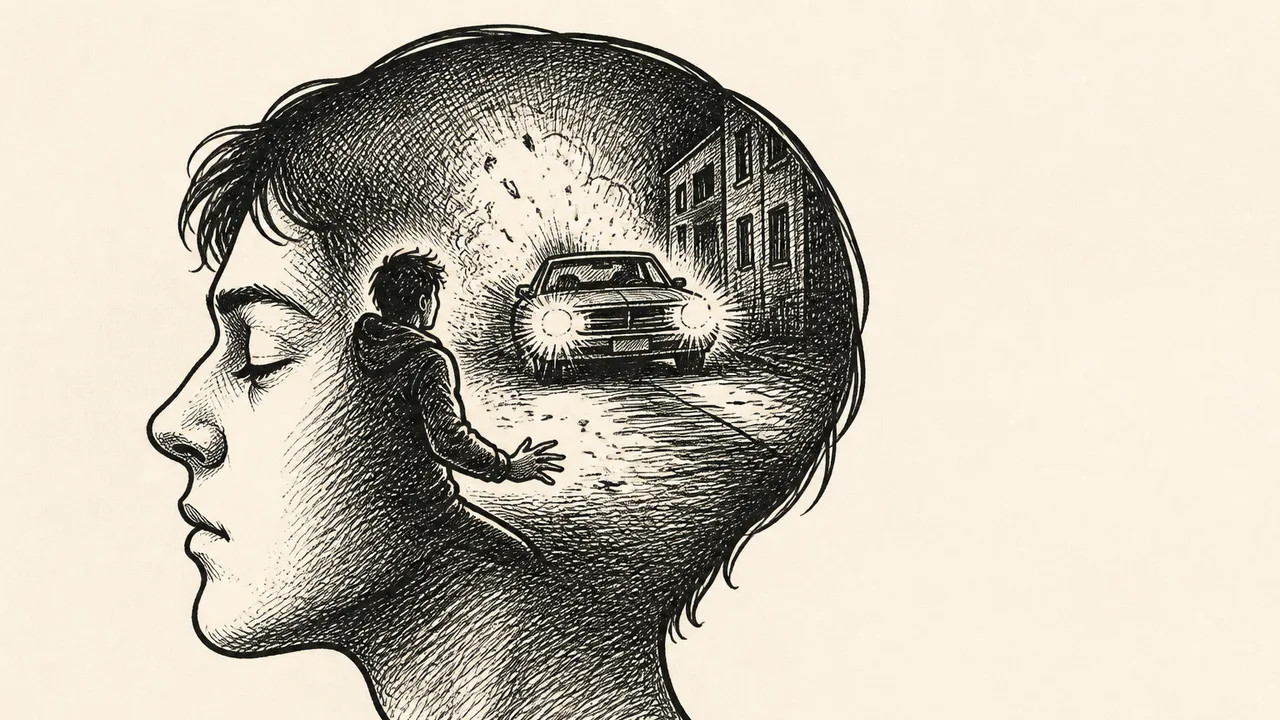
There's a particular cruelty to the way traumatic memory works. The event is over. The body survived. Time has passed. And yet the brain keeps filing an urgent report: danger, now, here. Not as a recollection. As a present-tense emergency.
This isn't metaphor or weakness or a failure of willpower. It's neuroscience—and understanding it changes not just how clinicians should treat trauma, but how the rest of us should think about people who are living inside it.
The brain doesn't store trauma the way it stores other memories
Most autobiographical memories come with a kind of timestamp. You remember your first apartment, or a bad breakup, or a car accident—and some part of your cognitive architecture contextualizes those memories as past. They belong to a version of you that existed before now. Traumatic memories often don't do this.
Psychology Today identifies a key mechanism: in PTSD, brain regions responsible for prediction and threat-detection become less connected from the regions that would update them with current safety information. The prediction centers get stuck running old threat models. They fire as though the danger is still present because, from their vantage point, it never ended.
This matters enormously. The brain isn't malfunctioning, exactly—it's doing what brains do during threat: prioritizing speed and survival over accuracy. The problem is that the "update successful, you are safe now" signal never arrives cleanly. The system remains primed.
The Conversation and Michigan Medicine both describe traumatic memories as biological phenomena—not just psychological ones. Specifically: "Memories are biological phenomena and as such are dynamic. Exposure to cues that trigger the recall or retrieval of traumatic memories activates the neural systems that are storing the memories." This is significant because it shifts the frame. We're not talking about someone thinking about something distressing. We're talking about a physical reactivation of the neural networks that encoded the original trauma.
Every time a trigger fires—a smell, a sound, a particular quality of afternoon light—those networks light up again. The memory doesn't just play back. It reconvenes.
What flashbacks actually are
PTSD UK describes flashbacks as "involuntary, intense and often distressing memories of the traumatic event that can be triggered by certain stimuli," noting they "can take many forms and can vary in intensity and duration." Some people experience them as vivid visual intrusions. Others as sounds, smells, physical sensations, or sudden emotional states that seem to have no origin in the present moment.
ScienceDirect adds texture to this: these involuntary intrusions "have been described as being brief and perceptually detailed, with visual details predominating." During a flashback, "victims feel that the traumatic event is happening again"—not that they're remembering something that happened. That distinction is not subtle for the person experiencing it. It is the whole terrain.
The clinical framing here matters. Flashbacks are not a sign that someone is dwelling or failing to move on. They are an involuntary neurological event. The stigma around PTSD—the implication that sufferers should be able to just decide not to re-experience their trauma—dissolves somewhat when you understand the mechanism. You can't willpower your way out of a reactivated threat network any more than you can decide not to flinch when something flies at your face.
The persistence problem
Here's where the science gets both more interesting and more complicated. Research published in PubMed on the temporal dynamics of trauma memory persistence notes that "intrusive memories and flashbacks after trauma are prominent in several mental disorders, including post-traumatic stress disorder and can persist for years." The paper identifies the reduction of intrusive memories as a viable treatment target—which is useful clinical framing—but also implicitly acknowledges that the science of why they persist so stubbornly remains an active area of inquiry.
This is the honest version of the story. The neuroscience has made real progress on the what: what's happening in the brain during a flashback, what structures are involved, what connectivity patterns differ in people with PTSD. The how to reliably reverse it is harder, more variable, and less settled.
Evidence-based treatments like EMDR (Eye Movement Desensitization and Reprocessing) and trauma-focused cognitive behavioral therapy work, and they work meaningfully—but they work better for some people than others, they require access to trained providers, and they require a degree of safety and stability that many trauma survivors don't have. You can't process your trauma in therapy on Thursday if you're still living inside the conditions that caused it.
What the brain science opens up—and what it doesn't
The value of this emerging understanding is real. If clinicians know that the problem is partly a connectivity failure—prediction centers cut off from updated safety information—then treatment can explicitly target that reconnection. The goal isn't to erase the memory (which appears to be largely impossible anyway, given how reconsolidation works). It's to help the brain finally receive the information that the threat has passed.
That reframe is clinically powerful. It shifts therapy from something that feels like forced confrontation with horror, toward something more like... helping a stuck signal get through.
But the brain-science framing also carries risks worth naming. When we explain trauma primarily through neurobiology, there's a tendency in some corners to treat it as a problem that exists entirely inside the individual—something to be corrected in the brain rather than addressed in the world. That's a narrow and sometimes harmful read.
A lot of what creates persistent traumatic memory isn't a random accident of neurochemistry. It's poverty. It's violence. It's racism. It's living in conditions of ongoing threat where the "you are safe now" signal never fires because it wouldn't be accurate. For people in those circumstances, the most sophisticated trauma therapy on offer can only do so much until the external conditions change.
The neuroscience of traumatic memory is genuinely clarifying. It gives clinicians better targets, gives patients a framework that removes shame, and gives the broader public a reason to stop conflating trauma symptoms with character flaws. All of that matters.
What it can't do is reach outside the skull. The brain learns that it's safe by being in safety. For people who don't have reliable access to that—and there are far more of them than the clinical literature tends to center—the question isn't just how to treat traumatic memory. It's how to build conditions where the brain gets to update its threat model because the threat has actually passed.
That's not a criticism of the science. It's a question the science raises, whether it means to or not.
If you or someone you know is struggling with trauma or PTSD, PTSD UK (ptsduk.org) and the SAMHSA National Helpline (1-800-662-4357) offer resources and support.
— Samir Patel, Mental Health & Wellness Correspondent, Buzzrag
More Like This
Rethinking Loneliness: A Signal, Not a Failure
Explore loneliness as a signal of unmet needs, not a failure. Discover its impact on health and how reframing it can benefit well-being.

When Feeling Stuck Is Actually Feeling Safe
The Art of Improvement argues comfort—not laziness—is what keeps people stuck. The idea is compelling. It's also worth examining carefully.
Understanding Emotion Regulation with Dr. Marc Brackett
Explore emotion regulation with Dr. Marc Brackett, focusing on practical strategies for emotional intelligence in personal and professional contexts.
The Emotional Resonance of Sound: Teresina's Journey
Explore how Teresina Kerubo uses sound to navigate love and grief, finding peace through recorded memories.

How Childhood Trauma Shapes Adult Relationships
Explore how childhood trauma influences adult relationships and discover pathways to healing.
Building a Cognitive Immune System Against Misinformation
New neuroscience frames the brain as having a cognitive immune system. Here's what that means—and who that framing conveniently lets off the hook.

How Trauma Shapes the Way We Love and Receive Love
Trauma doesn't just affect the past—it rewires how we connect with others. Here's what the psychology of love after trauma actually looks like.

The Psychology Behind Habits Linked to High Intelligence
Talking to yourself, craving solitude, obsessing over random topics—psychology research suggests these "weird" habits may signal a sharp, curious mind.