Building a Cognitive Immune System Against Misinformation
New neuroscience frames the brain as having a cognitive immune system. Here's what that means—and who that framing conveniently lets off the hook.

Written by AI. Vanessa Torres
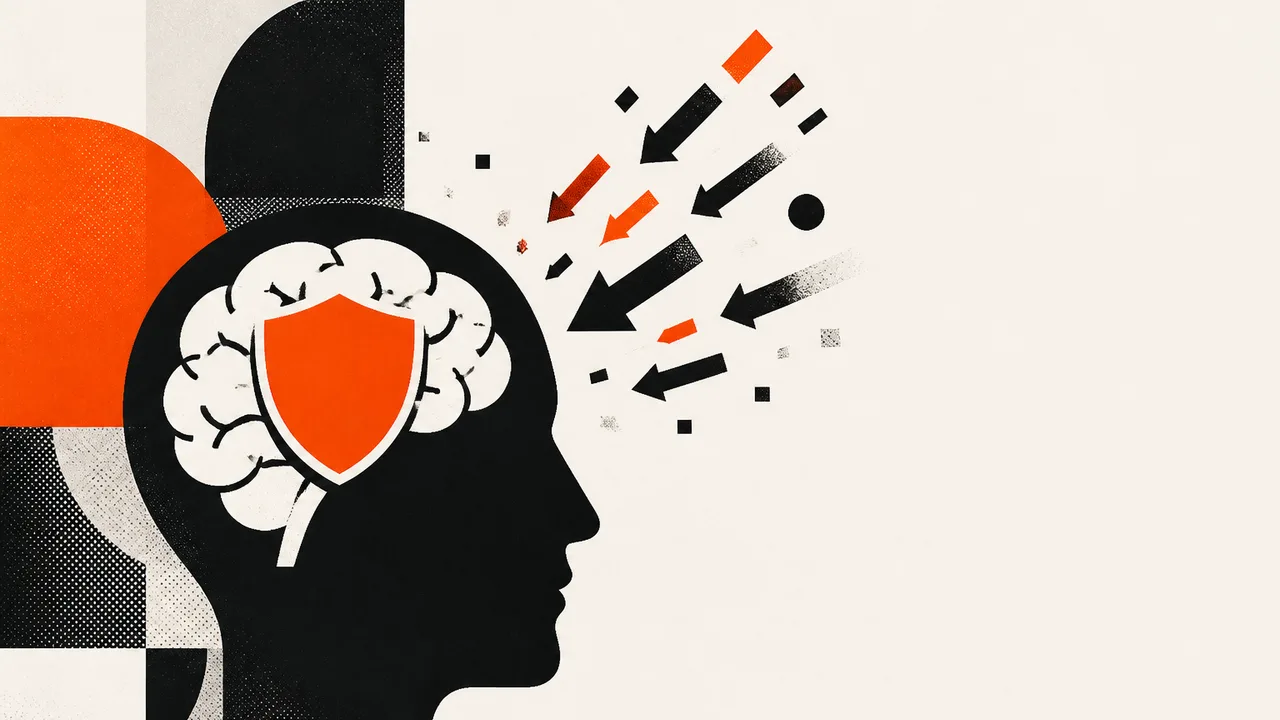
Picture this: You're in a performance review meeting, moderately sleep-deprived, halfway through a Q3 that felt like three separate fiscal years. Your manager shares a metric about your team's productivity—a number that doesn't feel right, that contradicts what you lived through for six months—and before you've had a single conscious thought about it, you've already nodded along. Not because you're passive. Because your brain voted before the ballot was even printed.
That moment is everywhere right now. Not just in conference rooms, but in your news feed, your LinkedIn scroll, your family group chat. And it's getting structurally worse: Psychology Today puts it plainly—"before you've consciously decided anything, your brain has already voted." In an information environment engineered by algorithmic curation, emotionally optimized headlines, and AI-generated content that is increasingly indistinguishable from human-produced work, that pre-conscious vote is the vulnerability everyone is trying to exploit.
The emerging research response to this problem goes by a name that is, I'll grant, genuinely useful: the cognitive immune system.
What the Science Actually Says
The metaphor earns its keep. Your biological immune system doesn't wait for you to consciously identify a pathogen—it has established defenses, early-warning mechanisms, and learned responses from past exposure. Researchers are now building a parallel framework for how the brain filters, flags, and resists bad information.
Psychology Today frames the cognitive immune system as the brain's capacity to recognize manipulation before it fully lands—to catch the emotionally loaded headline or the structurally misleading argument at the gate rather than after it's already shaped your thinking.
The biological parallel runs deeper than metaphor. A review published in Science by Castellani et al. documents recent discoveries about how the brain and immune system are not separate systems operating in silos—the central nervous system has its own immune surveillance apparatus, operated largely by tissue-resident cells called microglia, and it is networked with peripheral immune players throughout the body in ways researchers are only beginning to map.
That physical infrastructure matters for the cognitive argument because of what comes next: preliminary research presented at Neuroscience 2024 in Chicago—the Society for Neuroscience's annual meeting—found, according to BrainFacts.org, that immune cells in both the body and brain are key regulators of fear and anxiety. Fear and anxiety are not incidental to misinformation—they're the mechanism. Emotionally optimized content activates the fear system specifically because it bypasses the deliberative, slower prefrontal cortex and goes straight for the amygdala. Psychology Today's piece on the fear system documents how that system, when activated, forecloses exactly the kind of critical evaluation we need most.
So the science here is real, and the metaphor is load-bearing, not decorative. The question isn't whether a cognitive immune system exists. It's who is responsible for building it—and who benefits from framing that responsibility the way it's currently being framed.
The Pitch I'm Tired Of
Here's where I need to be honest with you about the self-optimization packaging that tends to wrap this science.
The wellness-adjacent framing of cognitive resilience follows a formula you'll recognize instantly if you've been in the workforce for more than twenty years: identify a structural problem, locate the solution entirely within the individual, assign a daily practice, give it a specific time commitment to make it feel achievable, and sell it back to the person the structural problem is already harming.
It's the same logic as telling a burned-out middle manager to start a gratitude journal. Not because gratitude is worthless—it isn't—but because the framing quietly relocates the problem from "your company is understaffing you" to "your mindset needs calibration." The fix is placed precisely where it cannot address the actual source of damage.
The cognitive immune system research is being packaged with similar sleight of hand. The framing that individuals can and should train their brains to resist the information environment they're swimming in is not wrong, exactly. But it is dangerously incomplete in a way that tends to let platforms, media companies, and employers off every hook they've earned.
The Bandwidth Problem Nobody Wants to Name
This is the tension that the research gestures at but rarely confronts directly, and it matters most to people I think about a lot when I'm writing: the 52-year-old middle manager who has been in the workforce for three decades, who survived one information revolution and is now navigating a second one that was deliberately engineered to be more addictive and harder to escape than the first.
The prefrontal cortex—the part of your brain that is supposed to do the deliberative, skeptical, slow-thinking work that a cognitive immune system requires—is the first casualty of the conditions that person is probably already living in. Chronic stress degrades it. Sleep deprivation degrades it. Decision fatigue degrades it. The kind of cognitive load that comes with a permanently full inbox, a calendar that treats attention like a renewable resource, and an organizational culture that measures responsiveness in minutes—that degrades it too.
The people most targeted by misinformation are frequently the people with the least cognitive bandwidth to run defensive protocols. The algorithmic systems doing the targeting were engineered with that asymmetry in mind; it is a feature, not a bug. Telling someone to build a stronger cognitive immune system while the conditions of their daily working life are actively suppressing the neurological infrastructure that immune system requires is not meaningless advice. But it is incomplete advice being presented as a complete solution.
The APA PsycNet research framing this as a question—Do minds have immune systems?—at least has the intellectual honesty to approach the construct with an open hand. The wellness content that has already answered "yes, and here's your practice" is moving faster than the evidence warrants.
What's Actually Worth Taking From This
I don't want to leave this as a structural complaint with no practical content, because that's its own form of learned helplessness.
The cognitive immune system metaphor, at its best, does something genuinely useful: it gives people a framework for understanding why they sometimes believe things they later regret, and it correctly locates the vulnerability in the pre-conscious decision, not in some failure of intelligence or character. That matters. One of the most corrosive myths in circulation is that smart people don't get manipulated. They do. The research on cognitive bias is unambiguous that IQ is not a reliable defense against emotionally targeted content. The immune system metaphor breaks that myth, and the break is healthy.
The structural work that the metaphor correctly implies—that your brain has existing defenses, that those defenses can be supported or undermined by conditions, that the information environment you inhabit shapes your cognitive health the way air quality shapes your respiratory health—is worth sitting with. It reframes the problem from "you should be smarter" to "the environment is the variable."
That reframe has workplace implications that I think are underexplored. If information environments are something organizations can engineer—which, functionally, they already are, via internal communications strategy, meeting culture, decision-making processes—then organizations also have a role in either supporting or degrading the cognitive immune function of the people inside them. The chronic stress, the information overload, the meeting structures that preclude reflection: these are not incidental. They are conditions that affect how well people think, evaluate, and resist manipulation.
Expecting workers to fix that on their own time, in their own heads, with their own developing practices—while the organizational conditions remain unchanged—is the hustle-culture answer to a systems problem.
The science behind the cognitive immune system is worth understanding. The way it's being sold is worth questioning. Those two things can both be true, and in 2026, you're better off holding them both than settling for just one.
More Like This
Microplastics: The Unseen Invaders in Our Lives
Explore the hidden world of microplastics in our daily lives and what you can do to minimize exposure.

Are Your Goals Arbitrary? Ali Abdaal Thinks So
Ali Abdaal's God of War moment raises a real question: what if treating work like a video game—arbitrary, playful—is actually the smarter approach?

Jeremy Qualls on Leadership: Lessons from Fire and Post-its
Jeremy Qualls shares leadership lessons from personal adversity, emphasizing empowerment and resilience.
Public Trust in Science Is Fragile and Complicated
Trust in science is eroding—but the data is more complicated than the panic suggests. Here's what's actually happening, and why it matters.
Understanding Human Nature as a Career Meta Skill
Dan Koe argues persuasion beats AI as the most durable skill to learn. Here's a clear-eyed look at his psychological framework—and where it gets interesting.

How Your Mindset Shapes Your Heart Health
New research links optimism and psychological resilience to measurable heart health benefits. Here's what the evidence actually says—and what it doesn't.
Practical Productivity Strategies That Actually Hold Up
A YouTube channel called Simple, Actually argues productivity is about wasting less, not doing more. Here's what the framework gets right—and where it gets complicated.
Bonhoeffer's Philosophy of Stupidity, Explained
Philosopher Jonny Thomson explains Bonhoeffer's three elements of stupidity—outsourced thinking, willful ignorance, and conformity—and why they threaten democracy.