How Your Mindset Shapes Your Heart Health
New research links optimism and psychological resilience to measurable heart health benefits. Here's what the evidence actually says—and what it doesn't.

Written by AI. Kira Yoshida
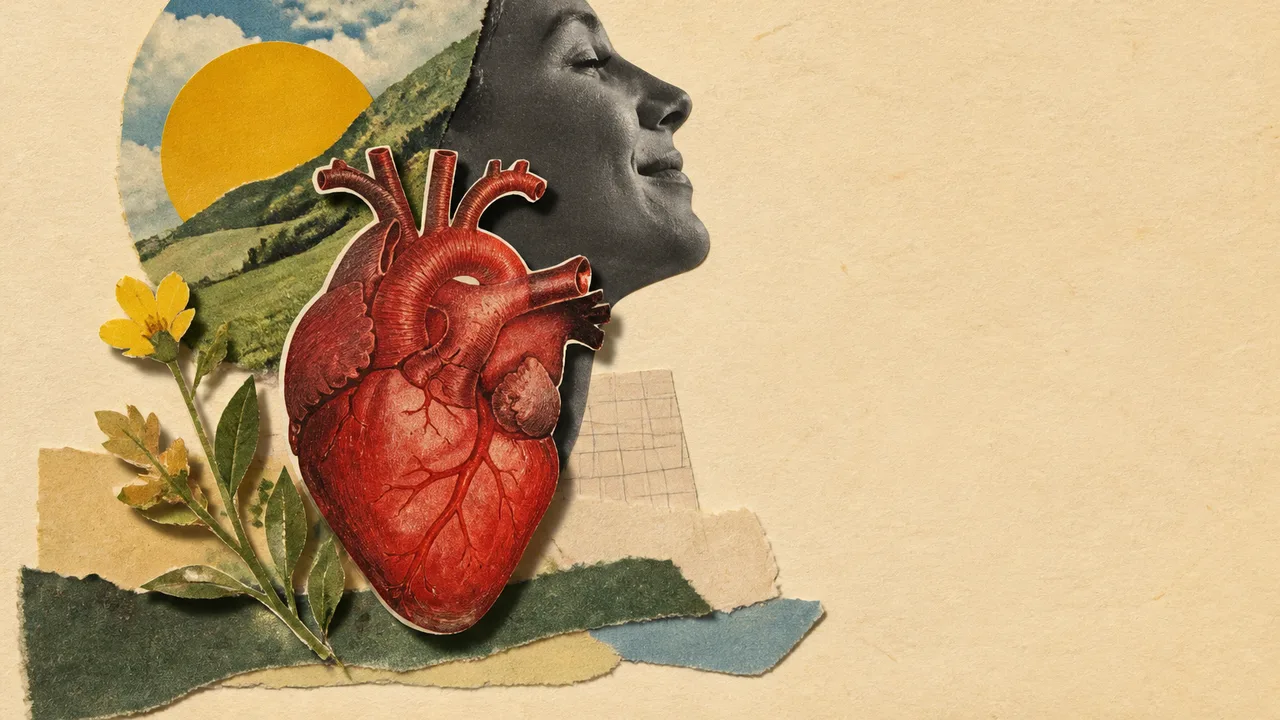
Here's a finding that sounds like it belongs on a motivational poster but is actually showing up in cardiology research: how you think might be doing something real for your heart.
Not in a vague, good-vibes way. In a measurable, physiological way that researchers are taking increasingly seriously—even if the wellness industry got there first and promptly made it insufferable.
So let's look at what the evidence actually shows, where it's solid, and where it gets murky.
The Numbers Are Not Nothing
Start with the Hopkins data, because it's striking. According to Johns Hopkins Medicine, people with a positive outlook were 13 percent less likely than their more negative counterparts to have a heart attack or other coronary event. That held even among people with a family history of coronary artery disease and multiple risk factors—the population you'd most expect genetics and biology to dominate.
Thirteen percent isn't a rounding error. In population-level cardiovascular research, that's a meaningful signal.
Meanwhile, ScriptSave WellRx cites research finding that people rated as having a more positive affect showed a 22 percent lower risk of heart disease. And a study covered by The Oakland Press found that "positive psychology interventions"—gratitude exercises, optimism training, mindfulness-based practices—were associated with consistent improvements in cardiovascular risk factors.
These are associations, not slam-dunk causal proofs. But across multiple studies, multiple populations, and multiple methodologies, the pattern keeps showing up. At some point, that pattern deserves more than a raised eyebrow.
What's Actually Happening Biologically?
This is the part the wellness industry skips because it's less quotable than "good vibes = good heart." But the physiology matters.
Harvard Health summarizes the evidence: psychological characteristics like optimism, gratitude, and a sense of purpose are associated with heart-protective effects. The researchers they cite looked at psychological data from over 8,000 people in the UK and found that those scoring higher on positive psychological traits showed better cardiovascular outcomes.
One proposed mechanism: chronic stress triggers the sympathetic nervous system—your fight-or-flight machinery—which elevates cortisol and adrenaline, raises blood pressure, promotes inflammation, and over time, strains the cardiovascular system. Positive Psychology's stress-and-heart-health coverage maps this pathway clearly. A psychological orientation that buffers against chronic stress doesn't just feel better; it may literally keep inflammatory markers lower and blood pressure more stable.
The other mechanism is behavioral. People who expect good outcomes from their efforts—a core feature of optimism—are more likely to persist with the physical habits that actually protect the heart. Positive Psychology's piece on mindset and heart health specifically highlights this: individuals who expect to recover from lapses in healthy habits are measurably more likely to do so. The narrative you construct about a setback—"I slipped, I'll get back on track" versus "I always fail at this"—may functionally determine whether the lapse is temporary or permanent.
That's not willpower mythology. That's how goal pursuit and self-regulation actually work in behavioral science.
The Physical Habits Still Matter—A Lot
None of this is a case for ditching your vegetables and meditating instead. The physical architecture of heart health is well-established and unchanged.
Mindbodygreen reports that whole-food, plant-forward eating patterns—specifically Mediterranean and DASH—"offer the strongest long-term support for heart, kidney, and metabolic health." These patterns keep outperforming trendier alternatives in the literature, and the research consensus behind them is genuinely strong.
Diet and movement remain the heavy infrastructure of cardiovascular health. What the mindset research suggests is that psychological factors shape how consistently people actually maintain that infrastructure—and may also have direct biological effects running in parallel.
These aren't competing explanations. They're additive.
The Tensions Worth Naming
Here's where I want to slow down, because this topic has a real trap built into it.
The research on optimism and heart health is observational at its core. People with positive affect may have better cardiovascular outcomes partly because they're less likely to be living in chronic poverty, more likely to have social support, more likely to have access to health care, and less likely to face systemic stressors that are out of their control. Optimism doesn't exist in a vacuum—it tends to be more available to people whose circumstances give them more reason for it.
This doesn't invalidate the research. But it complicates the leap from "optimism correlates with better heart health" to "so just become more optimistic"—which is where this literature tends to get weaponized. Telling someone under chronic economic stress or living in a food desert that their heart health would improve if they cultivated more gratitude is... not the full picture. It risks pathologizing the consequences of structural problems as individual psychological failures.
The Oakland Press coverage focuses on positive psychology interventions—structured practices that can be taught and practiced—which is a more careful framing than "be a happier person." Gratitude exercises and mindfulness-based practices are learnable skills with some evidence behind them, not personality traits you either have or don't. That distinction matters.
The research also doesn't tell us much yet about effect sizes over time, or which specific interventions produce which specific cardiovascular changes, or how long those changes persist. The honest answer is: promising, but the science is earlier-stage than some of the coverage implies.
What Integrating This Actually Looks Like
If cardiovascular medicine takes this seriously—and there are signs it's moving that way—it probably looks less like prescribing optimism and more like addressing psychological barriers to behavior change as part of standard care. That means asking not just "are you exercising?" but "what gets in the way when you stop?" and "what's the story you tell yourself when that happens?"
ScriptSave WellRx notes that mindfulness practices specifically—meditation, breath work, body awareness—have shown some association with improved cardiovascular markers, though the evidence base there is still developing. Structured mindfulness-based stress reduction has better research behind it than most of what gets sold as "mindfulness" in the wellness space.
The physical habits still do the heavy lifting. Mediterranean-pattern eating. Regular movement. Not smoking. Managing blood pressure. These aren't going anywhere. But if the research on psychological resilience holds up, the question for both clinicians and individuals may become: what helps people sustain those habits across the inevitable rough patches of an actual life?
That's not a soft question. It might be one of the most practically important ones in preventive medicine—and it's one the field has historically been pretty bad at answering.
More Like This

Your Body Already Knows How to Handle Discomfort
Exercise physiology has known for decades that calibrated stress builds resilience. So why does the wellness industry keep selling you comfort instead?

Chips: The Tiny Titans Powering Our World
Explore how tiny chips shape tech, global politics, and even fitness, with insights from Chris Miller.

How Sports Actually Bring People Together
Sports are celebrated as a universal unifier—but how does that actually work, and when does it fall short? We map the real science and the real limits.

How to Survive a Sleepless Night, According to Science
When sleep isn't possible, science offers real strategies. Here's what sleep banking, caffeine naps, and thermal drops can actually do for you.
Sam Harris: The Self Disappears When You Look for It
Sam Harris tells Brian Keating why the "self" can't survive close inspection—and why that matters more than any wellness trend. A climate reporter's take.

5 Life Regrets That Are Actually Real (With Caveats)
The Art of Improvement's viral regret video gets a lot right — but the gap between what you *should* do and what you *can* do is where self-improvement content always falls apart.

Gut Health Is Real. Most Gut Products Are Not.
Vox talked to doctors and researchers at Cedars-Sinai about what gut health actually means—and why most of what's being sold to you doesn't hold up.
Sugar, Soda, and Mental Health: What the Research Shows
New research links high sugar intake—especially from soda—to depression and anxiety. Here's what the science actually says, and what it doesn't.