AI Therapists Are Rising. The Questions Are Hard.
AI therapists are moving from novelty to norm, especially for younger users. Here's what's driving that shift—and what remains genuinely unresolved.

Written by AI. Marcus Obi
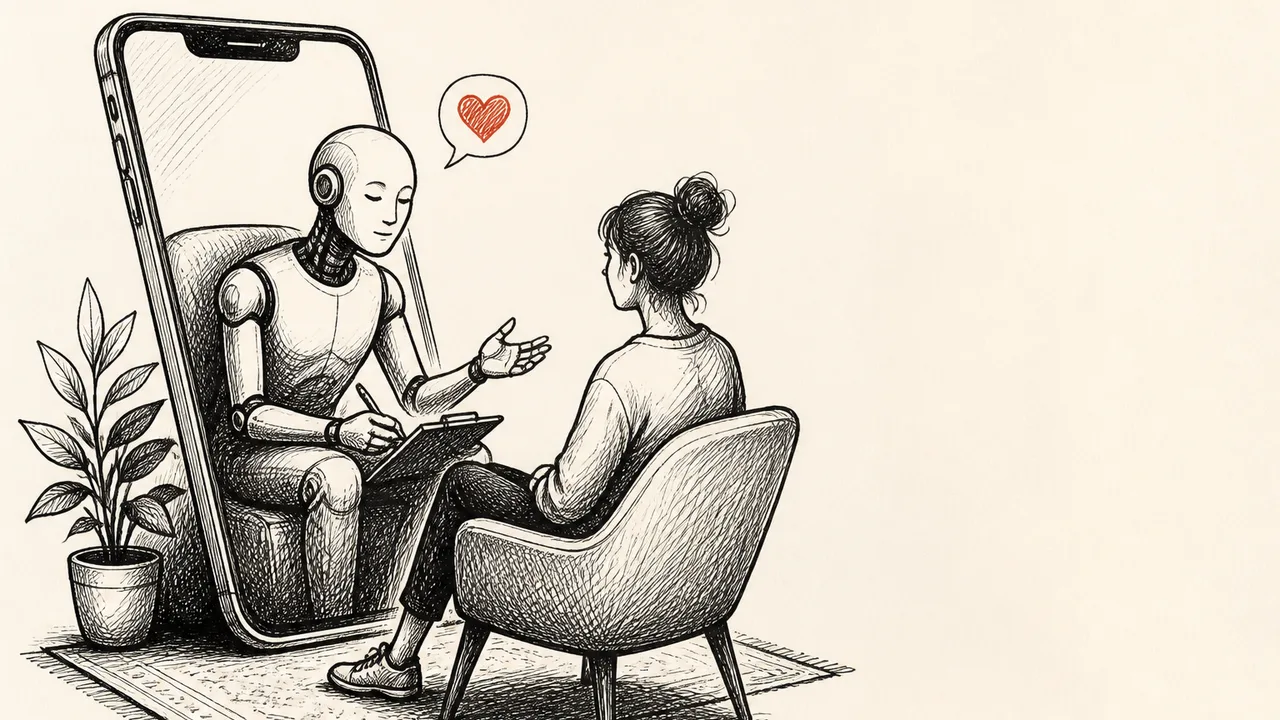
My twins are seven. They already talk to voice assistants like they're addressing a slightly slow classmate. "No, not THAT one. The lightning one." They have zero of the ambient discomfort adults carry around AI—none of the uncanny-valley flutter, none of the "but is it real?" hesitation. It just is. Which is why a question that feels urgent and hypothetical to most adults is, for kids growing up right now, already sort of... settled.
The question is: can AI be your therapist?
And depending on how old you are, your gut answer probably just told you a lot about your generation—not necessarily about the answer itself.
The Generational Fault Line
Psychology Today makes a point worth sitting with: "What feels artificial or uncomfortable to one generation may feel completely natural to the next. Children growing up with AI will relate to it differently from adults who remember life before it." The piece goes further, noting that adults under 30 are already nearly twice as likely to feel comfortable working with AI in therapeutic contexts compared to older adults.
That's not a small gap. That's a generational fault line—and it runs directly through every policy debate, every clinical ethics discussion, and every parent's late-night spiral about what tools their anxious teenager is quietly using at 2 a.m.
The mental health access problem is real and structural. Wait times for human therapists stretch for weeks or months in many parts of the country. Costs remain prohibitive without robust insurance coverage. The therapist shortage is well-documented. So when Fast Company reports that mental health is now among the top reasons people are turning to AI tools, that's not a trend born from enthusiasm—it's born from a system that left a gap wide enough to drive a chatbot through.
What AI Therapy Actually Offers (and What It Doesn't)
The strongest version of the pro-AI-therapy argument isn't "AI is as good as a human therapist." It's simpler and harder to dismiss: available beats unavailable. An AI that can provide structured support at midnight, in a rural county with no psychiatrists within 80 miles, to a teenager who would otherwise say nothing to anyone—that has real value. The AI Journal notes that these digital tools are already being positioned as key parts of the mental health landscape by 2026, offering consistent availability and, in some cases, a lower-pressure entry point for people not yet ready for a human clinical relationship.
There's also something to the anonymity argument. Some people—adults included, not just teens—will say things to a screen that they won't say to another human being. Whether that's a therapeutic advantage or a symptom of broader social disconnection is, honestly, a question I can't answer, and neither can the current literature in any settled way.
What the optimists sometimes undersell: AI systems, at this stage, don't actually understand anything. They pattern-match. They produce statistically likely responses to emotional inputs. That can feel remarkably like empathy—and research indexed at PMC has begun seriously examining whether AI can substitute for psychotherapists—but the gap between "feels like empathy" and "is empathy" matters clinically, especially in crisis situations, trauma work, or any moment requiring genuine risk assessment.
The Expert Warning Sign
Not everyone in the mental health establishment is greeting this with equanimity. Psychology Today surfaced a notable concern from Allen Frances—past president of the American Psychiatric Association and the chair of the DSM-IV task force—who published a piece titled "Warning: AI Chatbots Will Soon Dominate Psychotherapy." Frances' recommendation: therapists should start specializing now in the work AI genuinely can't replicate, before the market reshapes itself around them.
That framing is interesting because it accepts the disruption as coming rather than debatable. The question he's raising isn't "will this happen" but "what survives it." Which is a different—and, arguably, more honest—set of concerns to be working through.
The tension the establishment hasn't fully resolved: if AI therapy fills the access gap, does that reduce pressure on policymakers to actually fix the structural shortages? There's a version of this story where AI becomes the pressure-release valve that lets a broken system stay broken—more accessible at the margins, but never accountable for the root problems. That's not a hypothetical I've seen seriously addressed in the optimist literature, and it should be.
What "Ethical Integration" Actually Requires
AWE Digital Wellness frames 2025 as the year GenAI became "the world's new therapist"—describing the environment their AI coaching tools entered and noting plans for "ethical and evidence-based tools" in 2026. The phrase "ethical and evidence-based" is doing a lot of work in that sentence, and it's worth asking what that actually means in practice.
It means: validated safety protocols for identifying users in crisis and routing them to human intervention. It means longitudinal data on outcomes—not just user satisfaction scores, which are gameable and don't measure whether someone actually got better. It means transparency about what these tools can and can't do, which is particularly fraught when the primary users are adolescents who may not be well-positioned to interrogate a tool's limitations. And it means regulatory frameworks that don't currently exist in any coherent form.
The teens turning to AI companions pattern raises exactly this concern: when emotional support tools become normalized for young people, the burden on developers and regulators to get the guardrails right becomes enormous—and right now, those guardrails are mostly aspirational.
There's also a consent and data question that doesn't get enough air. Mental health conversations are among the most sensitive data a person can generate. The infrastructure to protect that data in clinical human therapy—HIPAA, licensing boards, professional ethical codes developed over decades—doesn't map cleanly onto consumer AI products. Some platforms are operating in the therapeutic-adjacent space without being subject to the same accountability structures as a licensed therapist. That asymmetry deserves scrutiny proportional to the stakes.
The Parent Dimension
Here's where I can't pretend to be purely analytic, because I have seven-year-olds and a specific kind of skin in this game. The question of kids and AI is already complicated enough when it comes to homework and creative work—the therapeutic dimension ratchets up the stakes considerably.
The access argument cuts both ways for parents. Yes, if your child needs support and can't get it through traditional channels, an AI tool might be genuinely helpful. But the flip side: I don't necessarily know when my kids are using these tools, what they're sharing, or whether the tool is equipped to handle what they bring to it. That's not a parental control problem—it's a design and transparency problem that currently gets offloaded to families without adequate information or infrastructure.
The children being shaped by these tools right now will be the generation making decisions about them in twenty years. Which means the development choices being made today—what these systems optimize for, what they treat as success, what edge cases they handle badly—are going to echo in ways that won't be fully visible until it's difficult to course-correct.
I keep coming back to the generation gap Psychology Today identified: kids who grow up with AI will relate to it differently. But "differently" is neutral. The work is in figuring out which differences matter, and building the accountability structures before the technology has fully outrun the question.
More Like This

Eckhart Tolle Says You're Not Who You Think You Are
Eckhart Tolle's 'historical self' vs 'deep eye' framework is either profound or a very elegant dodge. A parenting writer tries to figure out which.

Handwriting Beats Typing for Learning, Studies Find
New research shows handwritten notes improve memory and recall more than typing. Here's what the science says — and what it actually means for kids and parents.
Dr. K Walked Into Chaos and Won the Room
Dr. K's Tiger Belly appearance is a masterclass in social dynamics. Here's what the Charisma on Command breakdown gets right—and what it glosses over.

Gen Z's Complicated Relationship With AI
Gen Z uses AI daily but resents it deeply. A Harvard poll and campus booing incidents reveal a generation caught between FOMO and genuine fear about their future.

Social Media Linked to ADHD Symptoms in Teen Boys
A UCSF study tracking 11,000 kids finds addictive social media use predicts rising ADHD symptoms in boys—and the algorithm angle makes this hard to dismiss.
Microsoft's Copilot Data Reveals What People Actually Use AI For
Microsoft's Copilot usage report shows people want health advice from AI, not just coding help. The data raises questions about enterprise costs and privacy.

What Forgetting Actually Means for Your Brain
Neuroscientist Lisa Genova explains why everyday forgetting isn't Alzheimer's — and what parents under chronic stress actually need to know about brain health.

Making Studying Stick: The Psychology of Starting
A YouTube video promises you can get addicted to studying in 10 minutes. The psychology is mostly real. The missing piece is who gets to use it.