What Forgetting Actually Means for Your Brain
Neuroscientist Lisa Genova explains why everyday forgetting isn't Alzheimer's — and what parents under chronic stress actually need to know about brain health.

Written by AI. Marcus Obi
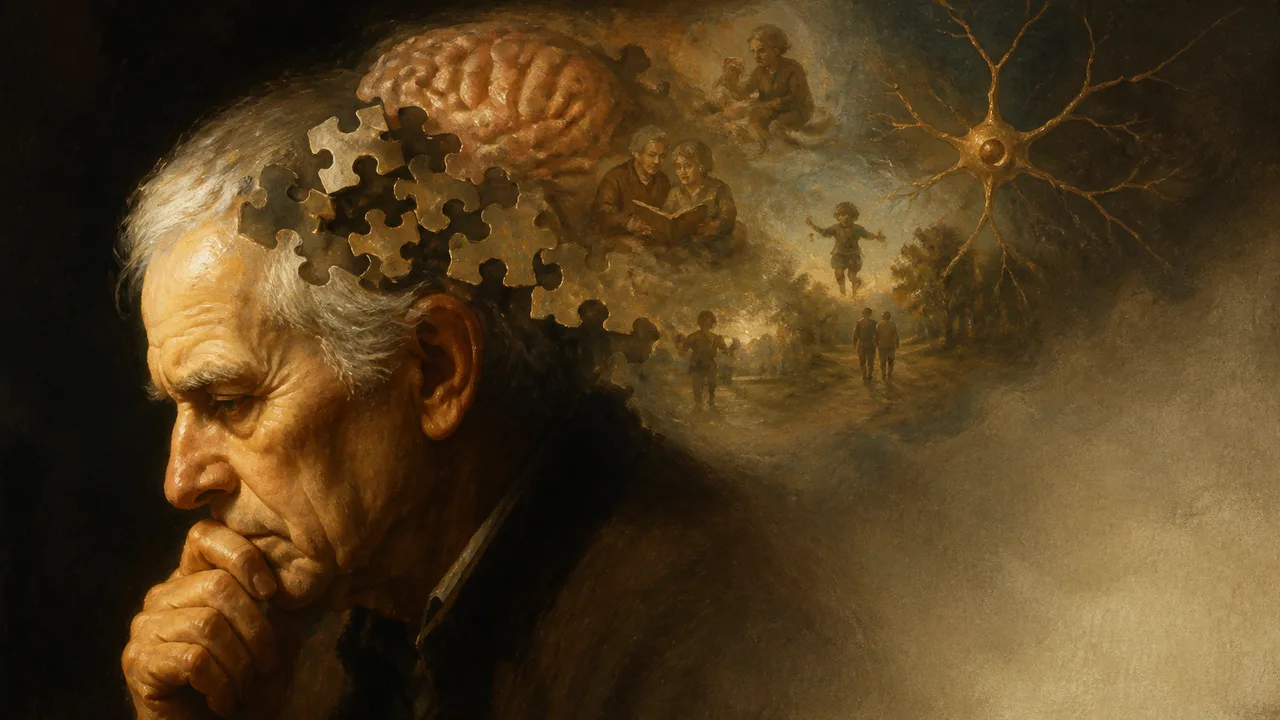
Photo: AI. Henrik Solberg
Last Tuesday, one of my twins asked me what we were having for dinner. I had planned dinner. I had gone to the store for dinner. I stood at the open refrigerator for a full thirty seconds and felt the specific, low-grade panic of a person who cannot locate a thought they had ninety minutes ago. My kid looked at me with the patient, faintly concerned expression of someone watching an elderly relative struggle with a crossword.
I said "chicken" because there was definitely chicken in there somewhere, and then I spent the next hour Googling "forgetting things more at 37 normal or not normal" like a completely functional adult.
That's what sent me to Lisa Genova's interview with Big Think. Genova holds a PhD in neuroscience from Harvard and wrote Still Alice, the novel that became the Oscar-winning film about early-onset Alzheimer's. She's spent the last decade in book signing lines fielding confessions from people who are, in her words, "panicked and afraid and stressed out and really ashamed of these moments of forgetting, which are actually totally normal." Her nonfiction book, Remember: The Science of Memory and the Art of Forgetting, is the direct result — an attempt to explain what your memory is actually doing before people spiral into worst-case territory. I watched the whole thing. Here's what landed.
Your brain was never supposed to remember everything
This is Genova's core corrective, and it's the one I needed to hear most. The dominant folk theory of memory — that we have a kind of internal video camera recording experience, and forgetting means the tape is corrupted — is just wrong. Memory isn't stored in one place. It's distributed across your brain as a pattern of connected neural activity, assembled by a region called the hippocampus. Every time you form a new memory, your brain physically changes — new synaptic connections get built. Every time you recall something, that same pattern gets reactivated.
What the brain doesn't do is record everything automatically. It encodes what you pay attention to. Which means the glasses you set down while answering a text, the name of the person you were half-listening to when you were also tracking your kid at a birthday party, the car parked while you were already thinking about whether you grabbed the permission slip — those never made it in to begin with. No attention, no memory. It's not a failing. It's physics.
Genova offers a particularly useful example here: Akira Haraguchi, a retired Japanese engineer who memorized more than 100,000 digits of pi using storytelling and visualization techniques — and who also, that same year, forgot his wife's birthday. Memory champions still forget the things human brains forget. That's the whole point. The system isn't broken. It's selective.
Prospective memory is the thing that's actually torturing you
This is where I felt genuinely seen. Prospective memory is what Genova calls your "brain's to-do list" — remembering to do something in the future. Pick up the dry cleaning. Call the school. Don't forget to sign that thing.
"Prospective memory is fraught with failure," she says. "In fact, I actually think of it as a kind of forgetting rather than a kind of memory."
Your brain needs a cue — a specific trigger at the right time and place — or it simply won't fire. Without that cue, the intention just evaporates. Genova's fix is the same one used by airline pilots before landing and surgeons before closing: a checklist. Not because they're forgetful. Because even highly trained, highly skilled humans cannot reliably hold future-directed tasks in their heads without external support. If pilots don't trust prospective memory with "lower the landing gear," you don't need to feel bad about putting "send birthday card" in your phone.
Here's what Genova doesn't say explicitly, but anyone who's done a school-day morning with young kids already knows: the entire structure of that morning is a prospective memory gauntlet. Backpack, water bottle, folder signed, show-and-tell item, specific shoes because it's gym day, snack that doesn't contain the allergen of the kid in third period. That's not a memory problem. That's an impossible cognitive load problem dressed up as a memory problem. The checklist isn't a concession to failure. It's the professionally recommended solution.
The Alzheimer's fear is real, and the distinction matters
Genova is careful here in a way I appreciate. She's not just doing reassurance. She actually draws the line.
The normal forgetting — walking into a room and losing the thread, blanking on a name, forgetting why you opened this app — happens before any memory is formed, or involves information that was never meaningfully encoded. Alzheimer's disease, which begins with the accumulation of amyloid beta plaques in the hippocampus, produces something different: an inability to form new memories even for things that were emotionally significant, recently repeated, and clearly paid attention to. Repeating yourself in the same conversation without knowing you just said it. Not recognizing your own car in a parking lot. Losing common words — not proper nouns, which even healthy brains fumble, but "pen" and "door" and "coat."
Genova is careful to note that the "98% of people" figure she cites for Alzheimer's not being genetically predetermined refers to a distinction she draws in her book — that only about 2% of cases are caused by deterministic inherited mutations. For the rest of us, the disease develops over 15 to 20 years through an interaction of genetic predisposition and how we live. That's a long runway. It's also where her lifestyle section becomes more than a wellness checklist.
The lifestyle stuff, and what it actually costs
Sleep, diet, aerobic exercise, stress management, and continued learning. Genova covers all five. The research is real. Studies on the MIND diet — heavy on leafy greens, berries, nuts, fish, olive oil — have shown meaningful risk reductions for Alzheimer's in high-adherence groups, though effect sizes vary across studies and some results have faced replication challenges, so these findings are promising rather than definitive. Consistent aerobic exercise appears to reduce amyloid plaque levels. Sleep matters because glial cells — the brain's janitors — clear amyloid beta while you sleep; chronic deprivation means chronic accumulation.
Here's the thing I keep getting stuck on, though. Genova's audience in that interview feels largely like people who have the bandwidth to optimize. And I'm not saying that to be dismissive of the science — it's solid. I'm saying it because I think about the parents I know who are chronically stressed not because they're failing at self-care but because their lives are structured to produce chronic stress. No paid parental leave, unaffordable childcare, jobs that don't flex, food deserts, neighborhoods without sidewalks, and the particular ambient dread of financial precarity. Genova identifies the top three psychological stressors as social isolation, uncertainty, and a perceived lack of control. That's not a personality failing. For a lot of families, that's a Tuesday.
Chronic, unmanaged stress literally shrinks your hippocampus. That's not a metaphor. It inhibits neurogenesis — the birth of new neurons — and degrades your ability to both form and retrieve memories. It also, over time, increases Alzheimer's risk. Knowing that doesn't make a 30-minute brisk walk four times a week easier to achieve when you're working two jobs and your kids' school gets out at 3.
None of that makes the advice wrong. It makes the system wrong. The research Genova describes is about what brains need. The gap between that and what a lot of parents can actually access is a policy failure, not a personal one — and it's worth saying out loud rather than leaving it implied in a footnote.
The thing I walked away from this interview actually believing: forgetting is mostly a distraction problem, and distraction is the permanent condition of raising small children. You are not losing your mind. You are running an operation that would challenge the organizational capacity of a mid-size logistics company, with fewer resources and no HR department. Your glasses are wherever you put them when someone screamed your name from another room.
The Hamlet soliloquy you memorized in tenth grade? Still in there. The neural circuit is intact. You just need someone to give you the right cue.
More Like This
Your Phone Is Training You. So Is Your Job.
Monami Banerjee's TEDx talk on tech and the subconscious mind hits differently when you're a professional whose job requires being permanently interruptible.
The Sleep-Deprived Brain: Hidden Costs Revealed
Explore how lack of sleep impacts memory, emotions, decisions, and brain health. Discover why sleep is crucial.
Physics Says Time Has No Direction. So Why Does It Feel Like It Does?
Physicist Sean Carroll explains why the laws of physics are time-symmetric — and why that has more to say about regret and urgency than you'd expect.
How Childhood Environments Shape Your Inner Critic
Therapist Kati Morton breaks down five childhood family dynamics that create harsh self-criticism in adults—and why that voice feels so convincingly like your own.

Conway's Soldiers: A Checkerboard Proof of Impossibility
Conway's Soldiers is a deceptively simple game that no one can win — not with infinite pieces. Here's the golden ratio proof that seals the deal.
What Huberman Gets Right About the Grief in Your Body
Huberman's grief episode has real neuroscience in it. It also has a protocol called "rational grieving." Both things are true and worth sitting with.

Making Studying Stick: The Psychology of Starting
A YouTube video promises you can get addicted to studying in 10 minutes. The psychology is mostly real. The missing piece is who gets to use it.

Your Childhood Coping Strategies Are Running Your Life
The marshmallow test wasn't measuring self-discipline. It was measuring trust. What that means for how we parent—and how we were parented.