How Childhood Environments Shape Your Inner Critic
Therapist Kati Morton breaks down five childhood family dynamics that create harsh self-criticism in adults—and why that voice feels so convincingly like your own.

Written by AI. Samir Patel
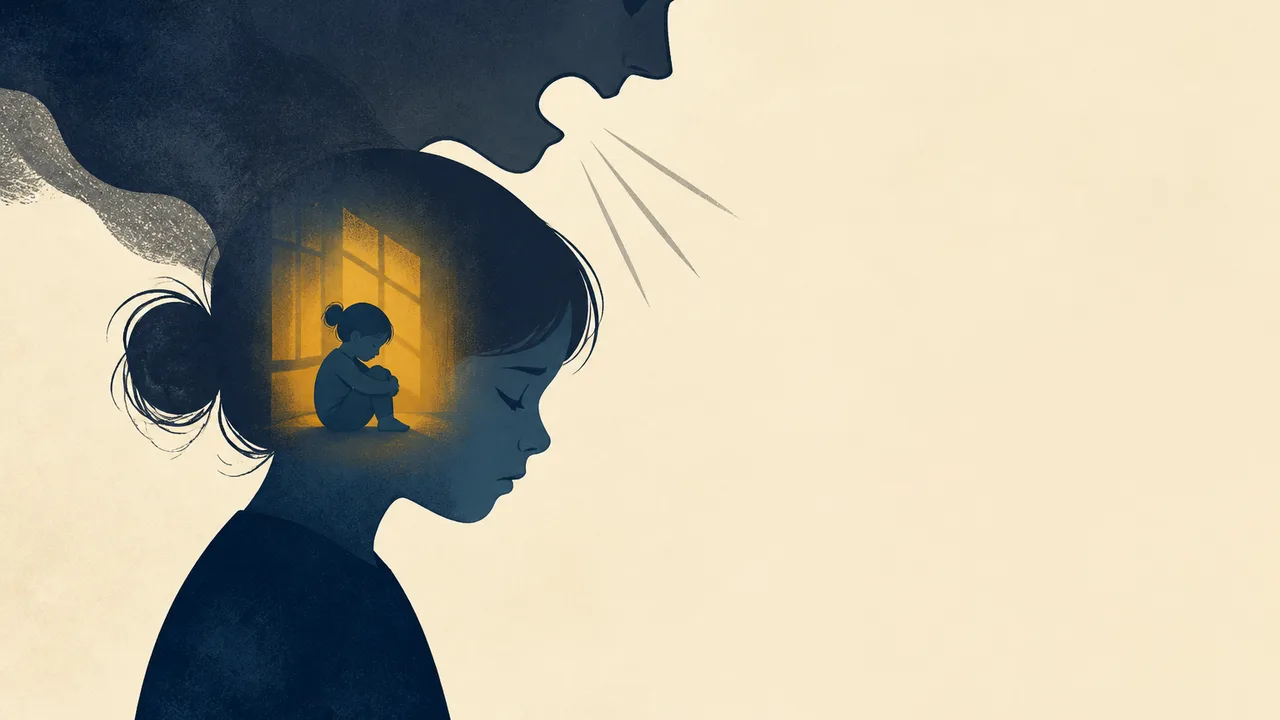
Photo: AI. Mika Sørensen
There's a voice most people carry around that they've never once questioned. It says things like you're falling behind and everyone else has this figured out and you should have known better. And because it sounds exactly like their own internal monologue—same vocabulary, same cadence, same intimate knowledge of every personal failure—they treat it as the most reliable narrator in their lives.
Therapist and mental health educator Kati Morton's recent video challenges that assumption at the root. Drawing on research linking childhood emotional abuse to severe self-criticism in adulthood, she argues that for many people, the inner critic isn't actually their voice at all. It's an old transmission they've been receiving for so long it became indistinguishable from their own signal.
That's a significant claim. And it's worth sitting with, rather than just accepting or dismissing.
The Mechanism: Why It Sounds Like You
The part of Morton's argument that I find most psychologically interesting—and most underexplored in mainstream wellness content—is her explanation for why the inner critic feels so authentic. It's not a mystery. It's developmental logic.
A child's brain, she explains, doesn't have the cognitive infrastructure to evaluate the reliability of a caregiver. The parent isn't just an authority figure; they're the entire system keeping the child alive and safe. Which means entertaining the thought that the parent is wrong isn't just uncomfortable—it's structurally destabilizing in a way a child genuinely cannot afford.
"The possibility that the parent is wrong or that the parent's the problem, it's not really a thought that a young child can hold," Morton says. "We can't really think about that safely because if our parent is wrong, then our whole world suddenly feels unstable and a child can't survive in an unstable world."
So the child does something adaptive—and this is the part that tends to reframe things considerably—they absorb the criticism. They take the critical voice in and make it their own internal dialogue. In doing so, they gain a sense of agency: if I'm the one finding the flaws before anyone else does, I can fix it, I can manage it. The internalization isn't a pathology. It's a survival strategy. A smart one, given the constraints.
The problem is that the strategy doesn't expire when circumstances change. By adulthood, the voice has been running for two or three decades, using your vocabulary, shaped to your specific insecurities, fluent in the particular currency of your self-worth. Of course it feels like you.
Five Environments, Five Flavors
Morton maps five distinct childhood dynamics onto five recognizable versions of the inner critic, and what's useful here isn't just the taxonomy—it's how each produces a different type of self-attack.
The perfectionist household doesn't need cruelty to do damage. It's often warm. But it's organized around the gap between where you are and where you could be, and approval is always conditional on performance. The inner critic this environment produces sounds less like a bully and more like an exhausting coach—never quite satisfied, always raising the bar, celebrating nothing. Morton notes that because this voice often did help people achieve things, "it can take years for us to recognize the cost. What once felt motivating slowly becomes exhausting."
The critical parent is more direct: explicit comments on body, intelligence, choices, behavior. What's particularly damaging, Morton argues, is the absence of repair—the criticism lands and stays there without acknowledgment, without apology, without recognition of effort. The child is left navigating toward an approval they have no roadmap for. And crucially, research Morton cites suggests it's the pattern, not the frequency, that does the shaping. You don't need to be criticized every day.
The emotionally unpredictable home generates a different problem: the same behavior gets warmth one day and punishment the next. The inner critic that develops here functions as a surveillance system—a constant environmental scan for what might be wrong so it can be corrected before consequences arrive. That scanning becomes baseline. In adulthood, in genuinely safe relationships, the surveillance keeps running because that's what it was built to do.
The appearance-focused family produces a critic that lives primarily in the body—monitoring, assessing, always finding new reasons it doesn't measure up. Morton is direct here: "our body becomes a project. I know it feels shitty because it is shitty."
And then there's the emotionally neglectful home—the quietest of the five, and in some ways the hardest to process. No raised voices, nothing that looks like a story worth telling. But emotional attunement was absent. Comfort, validation, support—these were not reliably available. The child learns the safest posture is being easy, capable, self-sufficient. The inner critic that forms here doesn't arrive through harsh words; it arrives through the void those words should have filled. It tells adults that their needs are too much, that their feelings don't matter, that they should be able to handle everything alone.
That last one is worth holding for a second, because people from emotionally neglectful homes often don't give themselves permission to connect their self-criticism to childhood at all. The inner critic offers them the excuse: nothing that bad happened to you. Other people had it worse. Morton's point is that this is the inner critic speaking, not reality.
The Conscience vs. the Critic
One tension the video addresses directly—and it's a real one—is the fear that questioning the inner critic means abandoning your standards. If you silence that voice, do you stop caring about doing things well?
Morton draws a functional distinction: your conscience operates from your actual values, points to specific behaviors, and resolves. It says that was the wrong thing to do—here's what to do differently. The inner critic doesn't work that way. It's disproportionate. A small mistake triggers a verdict on your entire character. It generalizes: one thing wrong, everything wrong. It traffics in shame rather than guilt—it points at you as a person rather than at a specific behavior, and it doesn't stop when you address the thing it pointed to.
"The conscience will say that was the wrong thing to do. The inner critic says you're the wrong kind of person."
This distinction matters practically, because people often resist psychological work on self-criticism precisely because they mistake the critic for the conscience. If you think the harsh voice is your moral compass, quieting it feels like moral compromise. Morton's framework suggests the opposite: the critic isn't your conscience. It's something that hijacked the authority of your conscience and has been impersonating it ever since.
What the Framework Can and Can't Do
The approach Morton offers—listening to the critic's specific vocabulary, mapping its fixations back to what was measured and commented on in childhood, attending to its tone until you can recognize whose it sounds like—is genuinely grounded in therapeutic practice. Externalization, the move from this is who I am to this is something I learned, is a documented intervention across multiple treatment modalities. The distance it creates is real, and it's usually prerequisite to any meaningful change.
But it's worth naming what this framework doesn't address. Identifying the source of your inner critic—tracing it back to a particular parent's disappointment or a household's ambient pressure—is clarifying. It is not sufficient. The research Morton cites on childhood emotional abuse and adult self-criticism sits within a much larger literature on how developmental trauma shapes the nervous system in ways that can't be fully metabolized by cognitive understanding alone. Some people will need more than awareness; they'll need a therapist, sometimes medication, sometimes years of slow work. Understanding where the voice came from doesn't automatically change how loudly it speaks.
There's also a fair question about variability. The five family dynamics Morton describes are recognizable, but they're not airtight categories, and real childhoods tend to blend them, or to produce inner critics that look different from what's described. The framework is a useful map, not the territory.
What Morton gets right—and what makes this worth your time regardless of where you land on the specifics—is the core reframe. The harsh voice running commentary on your worth isn't an accurate assessment of who you are. It's a coping strategy developed under specific conditions by a younger version of you who had limited options. That it no longer fits your circumstances doesn't make you broken. It makes you someone operating on old instructions.
The question worth sitting with: if the voice isn't yours, what does your actual voice sound like?
If you're struggling with self-criticism, shame, or the effects of childhood emotional neglect, support is available. The SAMHSA National Helpline (1-800-662-4357) provides free, confidential referrals to mental health services 24/7.
More Like This

Your Childhood Coping Strategies Are Running Your Life
The marshmallow test wasn't measuring self-discipline. It was measuring trust. What that means for how we parent—and how we were parented.

When Feeling Stuck Is Actually Feeling Safe
The Art of Improvement argues comfort—not laziness—is what keeps people stuck. The idea is compelling. It's also worth examining carefully.

Understanding Emotion Regulation with Dr. Marc Brackett
Explore emotion regulation with Dr. Marc Brackett, focusing on practical strategies for emotional intelligence in personal and professional contexts.

The Emotional Resonance of Sound: Teresina's Journey
Explore how Teresina Kerubo uses sound to navigate love and grief, finding peace through recorded memories.

How Childhood Trauma Shapes Adult Relationships
Explore how childhood trauma influences adult relationships and discover pathways to healing.

Your Distracted Mind Isn't Social Media's Fault
Philosopher Bence Nanay argues our attention crisis runs deeper than TikTok. The real culprit? The cognitive cost of a fragmented mind policing its own secrets.

Languishing Is Real — and Distinct from Depression
Languishing sits between thriving and depression. Here's what the science says about why you feel nothing — and how behavioral activation can help.

Daily Habits That Help Calm Trauma Responses
Psych2Go outlines eight daily habits grounded in neuroscience that may help trauma survivors retrain their nervous systems—without requiring therapy access.