Your Distracted Mind Isn't Social Media's Fault
Philosopher Bence Nanay argues our attention crisis runs deeper than TikTok. The real culprit? The cognitive cost of a fragmented mind policing its own secrets.

Written by AI. Fatima Al-Hassan
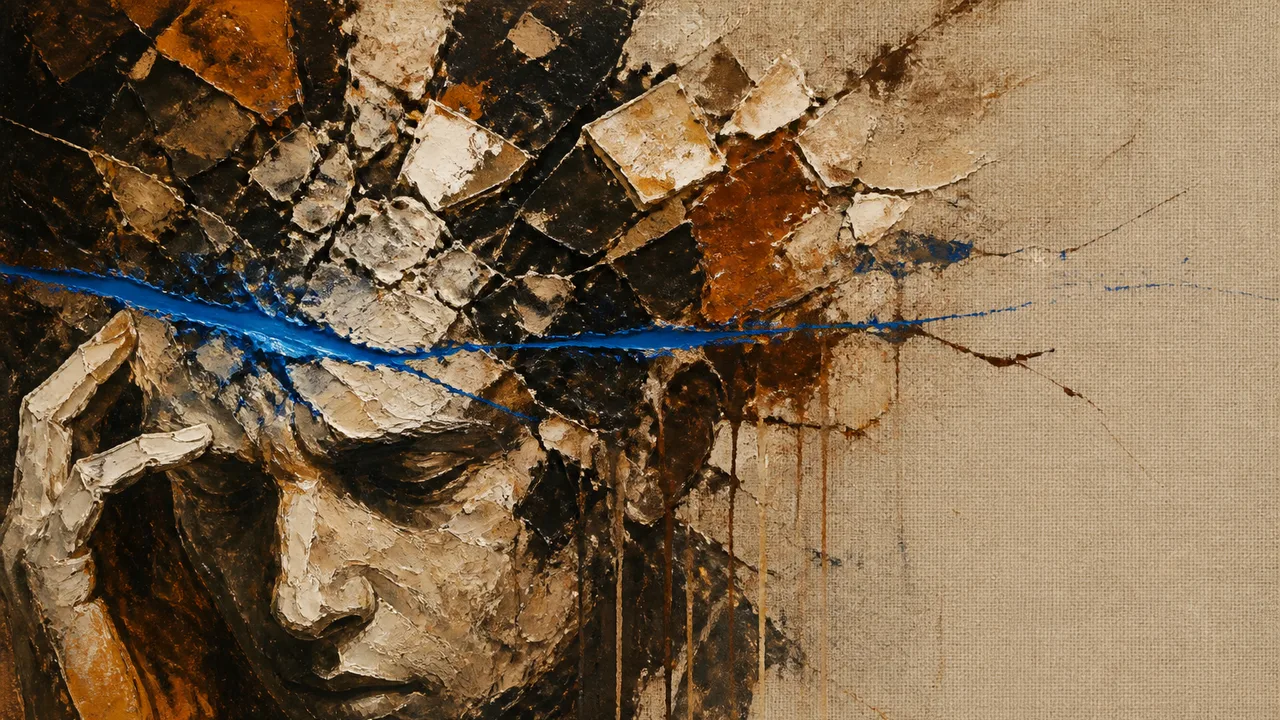
Photo: AI. Saskia Aaltonen
We have a story we tell ourselves about attention, and it goes like this: the algorithms did it. Silicon Valley engineered the perfect dopamine trap, we walked into it, and now we can't read a paragraph without reaching for our phones. It's a satisfying story. It has villains. It lets us off the hook.
Bence Nanay, a philosopher of mind at the University of Antwerp, isn't buying it—or at least, he thinks we're stopping the analysis too early. In a recent talk for the Institute of Art and Ideas, Nanay lays out a more uncomfortable argument: the attention crisis is real, but social media is a symptom, not the disease. The actual problem is structural, cognitive, and considerably older than any app.
"Social media is terrible for us," he says, almost as a concession, "but it's not going to be about that. It's going to be a little more complicated."
What attention actually does
Nanay starts somewhere most attention discourse doesn't: perception. The way you allocate attention doesn't just filter what you notice—it fundamentally changes what you experience. He illustrates this with a Paul Klee painting from 1915, titled Green X Above Left. Most viewers, when confronted with it cold, find the composition unsatisfying, somehow off. Tell them to look for a green X in the upper left quadrant, and the whole thing resolves. Same painting. Different attention. Completely different experience.
This isn't a curiosity. It's load-bearing for everything that follows. If where you direct your attention shapes the quality of what you perceive—and by extension, what you think, feel, and remember—then attention isn't just a resource to be managed. It's a kind of lens that determines the character of your inner life.
Nanay also draws a distinction—borrowed from vision science—between focused and distributed attention. Focused attention locks onto a target: the notification, the craving, the loop. Distributed attention roams, taking in the broader field. Studies on art perception show that trained viewers use distributed attention; novices zero in on the focal object and miss the surrounding composition. Nanay's claim is that distributed attention is generally healthier, more cognitively flexible, and harder to maintain than we might think.
The addiction literature gives him some of his strongest evidence here. Gambling addicts, when exposed to any gambling-adjacent stimulus, have their attention snapped to it—and can't let go. The addiction, on this account, is partly an attention disorder: a capture problem. Too much focused attention, on the wrong thing, for too long.
The zookeepers are tired
Here's where Nanay's argument gets genuinely interesting, and where I think it earns more than a polite nod.
He argues that the main drain on our attentional budget isn't Instagram. It's the cognitive labor of maintaining a fragmented mind. And we all have one.
The mind, he explains, is more or less fragmented depending on how freely information travels between its regions. Neuroscientists measure this through "global functional connectivity"—roughly, how much the activation of one brain region automatically triggers activity in another. Higher connectivity means a less fragmented mind. And global connectivity is lower in schizophrenia patients, and decreases naturally with age.
Some fragmentation is benign: double-booking yourself for Tuesday is annoying, not pathological. Some is even adaptive: compartmentalizing a painful breakup while you're at work is what keeps people employed. But Nanay wants to focus on a particular, costly kind of fragmentation—the kind that happens when we exile inconvenient information rather than integrating it.
The mechanism is recognizable to anyone who's ever done something they weren't proud of. You can't un-know it. You can't delete it. But you also can't let it circulate freely through your self-image—because if it does, the self-image cracks. So you don't forget it; you cage it. You shunt it to a fragment of your mind where it sits, contained, not accessible to your general sense of who you are.
This isn't just about personal failures. Nanay extends it to ideological commitments: the hardcore liberal who receives information that doesn't fit her worldview doesn't discard her worldview, and she doesn't necessarily integrate the information—she finds somewhere quiet to put it. And to the social pressure of comparison culture: you care about marathon running, but Instagram shows you people who are faster, stronger, more dedicated than you'll ever be. That feeling of inadequacy is difficult to metabolize, so it gets exiled too.
"Exiling is not enough," Nanay says. "You also need to police these fragments and make sure that these pieces of information that are kept away from your general self-image and general circulation of ideas are not just not there, but they're not going to come back. They're not going to come back to haunt you."
And that policing, he argues, requires attention. Continuous, background, invisible attention. The cages don't lock themselves.
His metaphor for this is a zoo with a fixed number of keepers. The wilder the animals and the more cages you're running, the fewer keepers are left to do anything else—sweep the paths, maintain the grounds, keep the place functional. Attention is the keepers. The fragmented mind is the zoo eating itself from the inside.
"The more attention you allocate to keeping the mind fragmented, the less attention remains for you to do anything else."
The downstream effects he identifies: procrastination, susceptibility to addiction, weakened self-control. Not because we're lazy or weak, but because the attentional budget is already spoken for—spent on maintenance work we're not even consciously aware of doing.
What this argument gets right, and what it leaves open
The strongest version of Nanay's case is that it reframes the attention problem in a way that's actually actionable. Blaming social media is, ironically, its own kind of attentional trap—we focus on the app, not on the internal architecture that makes the app so effective at hijacking us. If your mind is heavily fragmented, if you're burning cognitive fuel policing dozens of exiled fragments, you're going to be vulnerable to anything that promises easy escape or quick reward. TikTok didn't create that vulnerability. It just found it.
There are questions worth sitting with, though. Nanay recommends distributed attention as the healthier mode—but the relationship between distributed attention and fragmentation isn't fully spelled out. Is a fragmented mind also more prone to unfocused attention, the scattered, anxious kind? Or is it actually over-focused, locked onto its own containment work? These aren't the same thing, and the prescription might differ depending on the answer.
There's also the question of what, practically, "defragmentation" looks like. Integration of exiled material sounds a lot like psychotherapy—which has its own costs, timelines, and limitations. Nanay is a philosopher, not a clinician, and the talk isn't a self-help manual. But the gap between diagnosis and treatment is wide enough to notice.
What Nanay doesn't do—and this is worth saying—is let social media platforms entirely off the hook. His opening concession is genuine: yes, they're bad for us. His point is that they're most dangerous to minds that are already compromised by fragmentation, and that if we fix our analysis at the level of the platform, we'll keep losing the deeper fight.
That framing is uncomfortable in the right way. It relocates responsibility—partly—back to us, while also gesturing toward structural conditions (comparison culture, FOMO, the relentless visibility of everyone else's competence and success) that generate fragmentation at scale. Individual minds don't fragment in a vacuum.
The attention crisis, if Nanay is right, is not primarily a story about technology. It's a story about how much cognitive energy it costs to be a person who can't quite face everything they know about themselves—and how that cost compounds, quietly, until there's almost nothing left to spend on anything else.
More Like This

Your Phone Is Training You. So Is Your Job.
Monami Banerjee's TEDx talk on tech and the subconscious mind hits differently when you're a professional whose job requires being permanently interruptible.

How Childhood Trauma Shapes Adult Relationships
Explore how childhood trauma influences adult relationships and discover pathways to healing.

Tim Dillon on Meta's Slow Death and Facebook Boomers
Tim Dillon's latest episode covers Meta's decline, Facebook-brained Boomers, and the Selling Sunset audience that's done pretending they can own a house.

Your Weird Habits Are "Genius"—Or Are They?
Psych2Go says replaying conversations and laughing alone proves you're highly intelligent. The science says: it's more complicated than that.

The Friendship Recession Is Real—And It's Personal
Three experts break down the science of loneliness, the friendship recession, and why saying "I need a friend" might be the hardest thing adults do.
Boost Your Memory: Strategies That Actually Work
Discover six evidence-based strategies to improve memory by actively engaging with information. It's all about handling, not capacity.

A Stonehenge Precursor Found Under a Housing Estate
A 5,000-year-old solar structure found near Stonehenge raises sharp questions about prehistoric astronomy—and how Britain treats unprotected heritage sites.
Destiny 2 Ends: A Community Bungie Built and Switched Off
Bungie ends Destiny 2 content updates in June. Three creators reflect on careers, community, and what happens when a corporation owns your third place.