Conway's Soldiers: A Checkerboard Proof of Impossibility
Conway's Soldiers is a deceptively simple game that no one can win — not with infinite pieces. Here's the golden ratio proof that seals the deal.

Written by AI. Marcus Obi
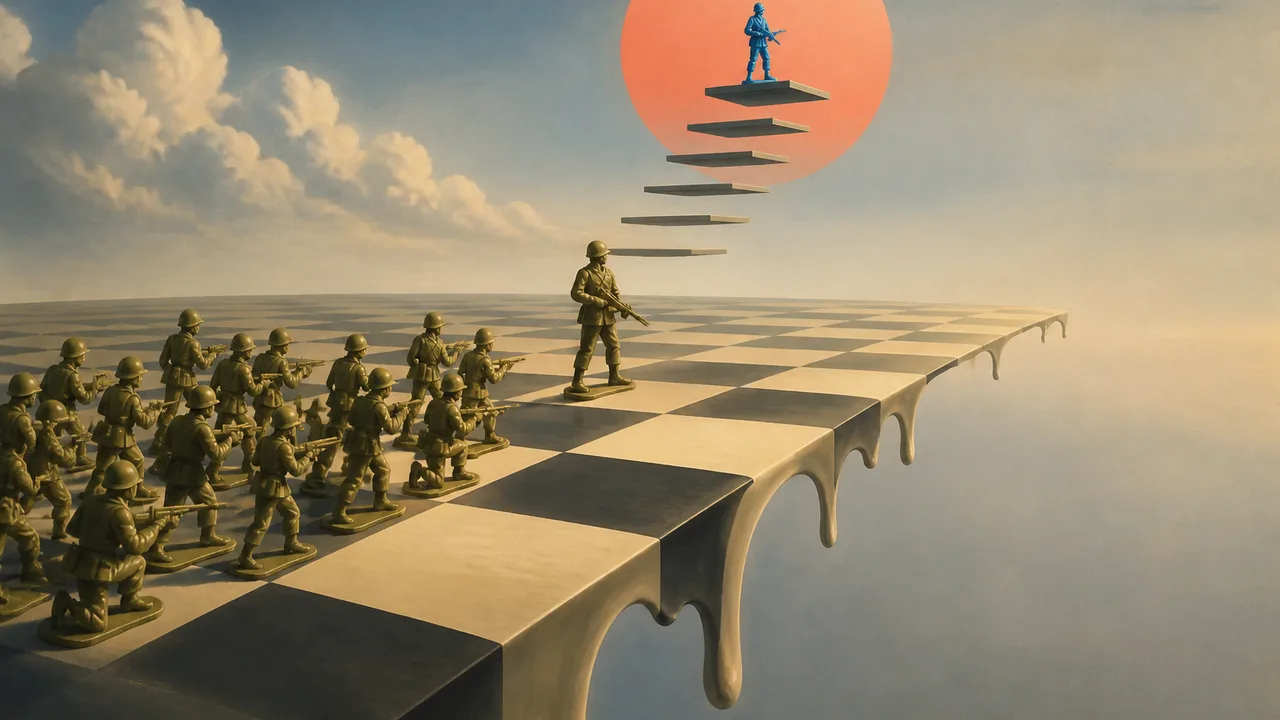
Photo: AI. Iolanthe Fenwick
It was 11:47pm. The twins were finally asleep — a fact I'd confirmed twice by standing outside their door and doing that thing where you hold your breath and listen for the specific quality of silence that means actually asleep versus lying there plotting something. My wife was reading. I was supposed to be doing dishes.
Instead I was on the couch watching a YouTube video about soldiers on a checkerboard.
I can't fully explain the why. I'd had one of those days that accumulates rather than peaks — nobody melted down, nothing caught fire, but by the time I got both kids through dinner and homework and the ongoing negotiation they call a bedtime routine, my brain had exactly one gear left: passive consumption of something that asked nothing of me personally. A math video was perfect. Clean. Consequence-free. Completely divorced from whether anyone had brushed their teeth.
Except it wasn't consequence-free, because about eight minutes in I was sitting forward on the couch mouthing "wait, what" at my phone, and then I was pulling up a notes app and scribbling something that looked like a partial equation, and then it was 1am and I genuinely could not tell you where the time went.
The video is from a channel called Quantia, and it walks through something called Conway's Soldiers — a puzzle that mathematician John Conway worked on sometime in the 1960s. (The video dates it to 1961; I've seen that figure elsewhere but I'll flag it as the kind of specific claim that's hard to verify without primary sources, so take it as approximately-correct rather than settled.) The setup is almost insultingly simple. Infinite checkerboard. A horizontal line across the middle. You place soldiers — as many as you want, anywhere — below the line. A move is a peg-solitaire jump: hop over a neighbor, land beyond, remove the one you jumped. Goal: get a soldier as high above the line as possible.
Row one takes two soldiers. Row two takes four. Row three, eight. Row four — here's the first small weirdness — takes twenty, not sixteen. The doubling breaks. But twenty works. People have done it on graph paper. The fourth row is reachable.
Row five is not. Not in the sense that it's hard, or unsolved, or just needs a different strategy. The Quantia video is unambiguous: "Row five is impossible. Not difficult, not unsolved, impossible. You could start with a billion soldiers. A billion billion. One soldier for every atom in the observable universe. Arrange them however you like. Jump for a thousand years. No soldier will ever reach the fifth row."
That's the claim. Now here's the proof, which is where I lost forty-five minutes of sleep.
The move that cracks it open is counterintuitive: stop watching the soldiers, and start watching a number.
Designate your target — one specific square on row five. Then assign a weight to every square on the board based on its grid distance from that target. The target itself gets weight 1 (that's x⁰, for any value of x). Squares one step away get weight x. Two steps: x². And so on, with x chosen to be less than one so that faraway squares become vanishingly small. Your army's total score is just the sum of weights on every square where a soldier stands.
Now comes the clever part. What value of x should you use? Pick it so that the best possible move — a jump heading directly toward the target — leaves the score exactly unchanged. Work out the algebra: when a soldier at distance n+2 jumps over one at distance n+1 and lands at distance n, the score changes by xⁿ − xⁿ⁺¹ − xⁿ⁺². Set that equal to zero, factor out xⁿ, and you need x² + x = 1.
Solve that equation — x² + x − 1 = 0 — and the positive root is (√5 − 1)/2, which is approximately 0.618. This number is the reciprocal of the golden ratio φ, which satisfies the related equation φ² = φ + 1. The two equations are mirror images of each other, and the connection is exact, not approximate. The same ratio that shows up in sunflower seed spirals (and which is popularly claimed, though contested by historians, to appear in the proportions of the Parthenon) falls out of this checkerboard puzzle with no prompting whatsoever.
With x set to this value, something devastating becomes true: no move increases your score. The best you can do — jumping directly toward the target — breaks exactly even. Every other jump, sideways or backward, strictly reduces it. The score is what mathematicians call a monovariant: it can only stay flat or go down. "There is no move, not one," the video states, "that increases your score."
So here's the trap:
If you fill the entire lower half of the board — every single square, all infinitely many of them — and sum up all the weights, you might expect infinity. But because x is less than one, the weights form a convergent geometric series. When the sums collapse, the total weight of the entire infinite lower half plane comes out to exactly one. Not approximately. Exactly.
Now you're cornered. To place a soldier on the target square — the only way to win — you need that square occupied. Its weight is x⁰ = 1. So at the moment of victory, your score is at least one. But your score can never increase. So your starting score must have also been at least one. But any finite army — however large — leaves out infinitely many squares in the lower half, each with positive weight. Any finite army scores strictly less than one. Always. No exceptions.
You can't start at one. You can't increase toward it. You can never win.
"The infinite board is worth exactly one," as the video puts it. "The goal demands exactly one, and you are forbidden by a single unbreakable inequality from ever closing that final infinite decimal gap."
Here's what got me at midnight, what made me put down my phone and just sit there for a second: the proof doesn't say row five is beyond our current strategies. It doesn't say we need better algorithms or more creative arrangements. It says the universe of all possible configurations, every way you could ever arrange any finite number of soldiers, is worth less than the goal requires. The ceiling isn't high. There is no ceiling. There is a wall, and it's the same width as everything.
Conway didn't find a clever route to row five and didn't fail. He found a quantity — the score — that behaves like a trapdoor, and showed that the trapdoor only swings one way. The technique has a name now: a potential function, or monovariant. The video notes that the same style of argument proves you can't solve certain Rubik's cube scrambles, can't tile certain boards with certain pieces, can't win whole families of games. One well-chosen number does all the work.
The game apparently gets stranger as you modify the rules. The video mentions that allowing diagonal jumps reportedly changes the reachable ceiling, and that playing in three dimensions changes it again — though I'd want to see those specific row numbers verified somewhere before I'd bet on them. The golden ratio, apparently, generalizes right along with the problem.
I did, eventually, do the dishes. And I did eventually try, in the morning, to explain the rough idea to my seven-year-olds. Theo listened for about forty-five seconds and then asked if soldiers could jump diagonals. I said no, that's actually the crucial part, the whole proof depends on— and he had already left the kitchen. Ama, who I'm increasingly convinced is running some long game I don't fully understand, said, "So you need to be worth more than everything possible?" and then went back to her cereal.
I'm still thinking about that.
More Like This
Unraveling the Golden Ratio's Mathematical Magic
Explore how the golden ratio's unique irrationality connects math, nature, and fractals.

Exploring the Enigma of Antimatter at CERN
CERN's antimatter factory reveals mysteries of the universe's matter-antimatter asymmetry and the quest for new physics.
The Simplest Question Mathematics Still Can't Answer
Fields Medal winner James Maynard explains why prime numbers—the atoms of arithmetic—remain deeply mysterious despite centuries of study.
How Tall Is the Dog? The Viral Math Puzzle Solved
A dog, a pole, two measurements—and three different ways to crack it. Presh Talwalkar's viral puzzle reveals something deeper about how we learn math.

Conway's Constant and the Power of Slow Attention
A children's counting game hides a degree-71 polynomial. What John Conway's slow, patient method reveals about how real insight actually works.

How Big Is a Rubik's Cube? Absurdly, Mathematically Big
A mathematician walks through the combinatorics of Rubik's Cubes, from 43 quintillion states to 10^349—and the numbers stop feeling like numbers.

How to Make a College Tour Actually Matter
College tour season is here. Here's how families can shift from passive observers to active explorers—and why who leads the visit changes everything.

Public Trust in Science Is Fragile and Complicated
Trust in science is eroding—but the data is more complicated than the panic suggests. Here's what's actually happening, and why it matters.