Gen Z's Complicated Relationship With AI
Gen Z uses AI daily but resents it deeply. A Harvard poll and campus booing incidents reveal a generation caught between FOMO and genuine fear about their future.

Written by AI. Yuki Okonkwo
Photo: AI. Dante Nwosu
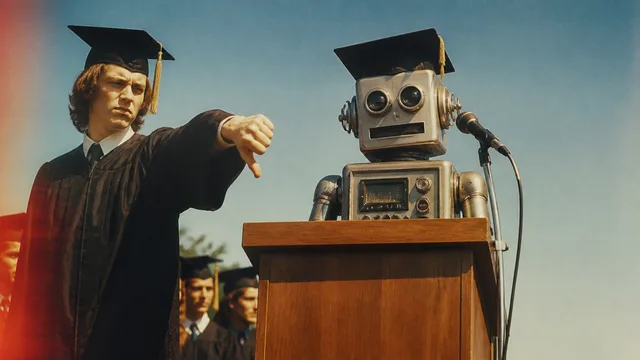
Eric Schmidt walked onto a graduation stage at the University of Arizona expecting the usual treatment accorded to a former Google CEO—polite applause, maybe some reverence. He got booed instead. Not playfully. Booed. By the graduates he was ostensibly there to inspire.
The conventional read on this is that Gen Z is anti-AI. That framing is wrong, and it's also the more interesting story.
Rachel Janfaza, founder of Gen Z research firm The Up and Up, has been sitting with young people across the US and trying to figure out what's actually going on. She spoke with BBC News's The Global Story about what she's found—and the picture is messier, more human, and ultimately more telling than any "Gen Z hates AI" headline captures.
They're using it. They just don't want to be told how to feel about it.
The booing at commencement ceremonies—Schmidt at Arizona, plus a string of other speakers who championed AI to rooms full of new graduates—wasn't really about the technology itself. It was about the message, and who was delivering it.
"Gen Z hates authority," Janfaza told BBC News. "They don't like being told how they're supposed to feel, and they are very skeptical of AI despite the fact that they're using it every day."
That last clause is doing a lot of work. This is a generation that opens ChatGPT in one tab while posting about AI anxiety in another. The contradiction isn't hypocrisy—it's the rational response to being handed a tool that everyone insists will either save or ruin your future, with no reliable way to know which.
Janfaza draws a sharp line between two cohorts she calls Gen Z 1.0 and Gen Z 2.0—roughly the older and younger halves of the generation born between 1997 and 2012-2013. The split isn't arbitrary; it maps onto who had tasted independence before the pandemic locked everything down, and who never got that chance. Gen Z 2.0 came of age entirely inside the crisis, inside short-form content algorithms, inside an internet already being reshaped by AI hype. Their relationship to all of this is correspondingly more raw.
The job market numbers are not subtle
A 2025 Harvard poll of young Americans found that a majority view AI as a threat to their career prospects. That's not a vibe—it's a finding. And the ground-level data Janfaza cites backs it up: in 2025, just 30% of college graduates landed jobs in the field they'd studied for. That's an 11-point drop from 2024. One year. Eleven points.
The entry-level market—historically the first rung of the ladder—is looking genuinely different. Young people describe submitting applications into what feels like a void, with no evidence a human ever reads them. The fear that AI is already filtering them out before they get a fair shot isn't irrational paranoia; it's a reasonable inference from experience.
But Janfaza is careful not to flatten this into a single story of doom. There are students vibe-coding their own apps, building tools, finding real opportunity in the disruption. She visited a pre-professional school called Ignite in Bentonville, Arkansas, and heard from a young man buzzing with excitement about something he'd built himself using AI assistance. The opportunity is real. It's just not evenly distributed, and it doesn't cancel out the anxiety felt by the majority who aren't building apps—who are just trying to find an entry-level marketing job that may or may not still exist.
The FOMO machine
Here's the thing Janfaza keeps coming back to, and it's the part that I think gets underreported: a significant chunk of Gen Z's AI usage isn't driven by genuine enthusiasm. It's driven by fear of being the one person who didn't use it.
"I think a lot of our generation's relationship to AI is driven by FOMO, a fear of missing out, and less of an intrinsic desire to actually use it," she said.
The story she tells to illustrate this is almost painfully relatable: a student at the University of Arkansas completed a virtual job internship interview without using AI—genuinely on her own merit—and then mentioned it to her friends. Their reaction? "Oh, it was totally unregulated. You could have used AI for the whole thing." And suddenly she's the sucker, wondering if she just handed the position to someone who did.
That's not a technology story. That's a collective action problem. Everyone uses it partly because they believe everyone else is, so opting out feels like unilateral disarmament. The "revealed preference" concept (economists use this to describe the gap between what people say they value and what their actual choices reveal) applies here almost perfectly: Gen Z says AI makes them anxious, says they're worried about its climate footprint, says they resent its encroachment on their work—and then opens the app anyway, because the social math demands it.
The education split is making things worse
When ChatGPT arrived, schools panicked. Plagiarism detectors were deployed, AI was banned, essays were moved back to pen-and-paper. Some of that resistance is still there. But a parallel group of educators moved in a different direction quickly—concluding that if this technology was going to be everywhere in students' working lives, pretending it didn't exist was a disservice.
The result is a generation getting two completely different educations depending on which classroom they're sitting in. Some students are learning how to use AI as a tool that extends their capability. Others are still being told to pretend it doesn't exist. Janfaza found that when she asks students to describe their education before and after AI's arrival, they say it feels like two entirely different eras—not just in what they can do, but in the internal conversation they're now having about when to use it, when not to, and what they're giving up when they let a chatbot think for them.
That last anxiety is genuinely interesting to me. These are students who don't want to feel reliant on technology to think. They're worried about skill atrophy—not as an abstract future concern, but as something they're watching happen to themselves in real time.
An unlikely ally
The Pope, of all people, may have read the room better than most tech executives. His recent papal encyclical called for AI to be "disarmed"—but crucially, Janfaza notes, he didn't reject it outright. He called for a more human approach, named the question of accountability, and acknowledged the tradeoffs honestly.
Why does that resonate with young people? Because he's one of the few public figures talking about AI who has no financial stake in selling it to them. Gen Z is—Janfaza is consistent on this point—deeply skeptical of anyone who profits from the thing they're promoting. The AI CEO who tells you that you'll be left behind if you don't adopt his product is not a neutral messenger. That message, delivered at scale, is what's driving the anxiety. Of course it is.
The analog turn
The response, for some, is a strategic retreat. Run clubs. Phone-free dinner parties. Time in nature. Things that would sound faintly retro except they're now being chosen consciously, deliberately, as a counterweight.
Janfaza frames this not as technophobia but as a generation recalibrating what "success" even means. The ladder—study hard, get a credential, get a job, climb—is the framework they were handed. It may not map onto the terrain ahead. The ones finding their footing seem to be those who've stopped trying to optimize for a future nobody can clearly see, and started focusing on what actually produces meaning in the present: skills, relationships, community, work they genuinely care about.
That's not naive. It might be the most realistic response available to people who were promised a playbook and arrived to find the game had changed.
The harder question—the one nobody's answered yet—is what happens when individual recalibration runs into structural conditions that don't budge. Blocking out the noise and following your passions is good advice. It's also advice that lands differently depending on your zip code, your school, your access to the tech ecosystem that's creating the winners in this disruption. Gen Z's relationship with AI is complicated. The conditions producing that complication are not.
More Like This
The Starbucks Problem: Why AI Might Not Kill Jobs After All
Economist Alex Imas argues AI won't eliminate work—it'll shift value toward human connection, taste, and relationships in a 'post-commodity economy.'
Why AI Refactors Code Perfectly But Can't Count R's
Andrej Karpathy explains AI's 'jagged' capabilities: why models excel at coding but fail basic tasks. The answer reshapes how we build software.
AI Is Corrupting Your Documents—And Gen Z Knows It
New Microsoft research finds top AI models corrupt 25% of document content in long workflows. Meanwhile, Gen Z's AI skepticism might be the healthiest response in the room.
Anthropic's CEO Says AI Could Kill Half of Entry-Level Jobs
Dario Amodei predicts AI will eliminate 50% of entry-level white-collar jobs within five years. The data suggests he might be right.
When AI Makes Everything Free, What Are You Worth?
AI tools have broken the old chain of value: production, effort, expertise. Here's what tech workers need to prove instead—and why it's harder than it looks.
Sam Altman Says AGI Arrives in 2 Years. Here's the Data.
OpenAI's Sam Altman just compressed the AGI timeline to 2028. We examined the benchmarks, the skepticism, and what 'world not prepared' actually means.

How Optimization Powers Modern AI and Engineering
From training ChatGPT to imaging black holes, optimization is the hidden engine behind modern AI and engineering. Steve Brunton's lecture explains how.

David Patterson on CPUs, GPUs, TPUs, and 50 Years in Computing
Turing Award winner David Patterson breaks down RISC vs. CISC, the GPU-to-TPU shift, Moore's Law's real status, and what 50 years in computing actually taught him.