The Physics of Sound: Ocean Acoustics and Musical Scales
A Royal Institution talk with Helen Czerski and Philip Ball asks whether underwater sound and the musical scale we use are governed by physics or cultural habit.

Written by AI. Nadia Marchetti
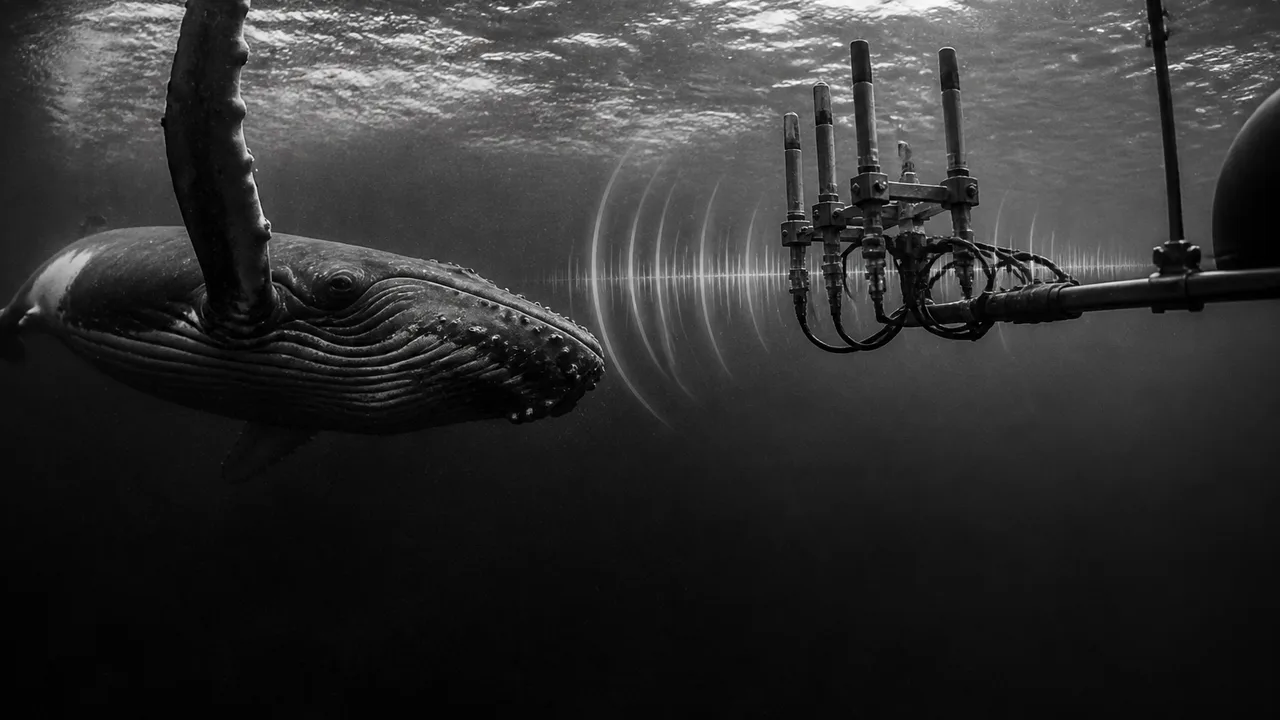
Photo: AI. Atticus Ferenczi
There's a question hiding inside two apparently unrelated fields of science, and once you see it, you can't unsee it: how much of what we take for granted as natural is actually just what we got used to?
That's the thread running through a recent Royal Institution talk featuring oceanographer Helen Czerski and science writer Philip Ball — a double-header that moves from the bottom of the ocean to the piano keyboard, and finds the same philosophical problem lurking in both places. The event, filmed at the Royal Institution on 29 June 2026 in association with the docuseries For the Record: An Incomplete History of Music, is the kind of science communication that trusts its audience enough to leave some questions genuinely open.
The ocean is not silent. It never was.
Czerski opens with Jacques Cousteau — specifically, with his 1956 film Le Monde du Silence (The Silent World), which won the Palme d'Or at Cannes and introduced millions of people to what lay beneath the ocean surface. She has complicated feelings about Cousteau, to put it gently. The film's environmental ethics are, by contemporary standards, genuinely shocking — coral reefs blasted, a whale filmed dying after being struck by a boat. But the damage Czerski is most interested in is more subtle: the name.
"Of all the many things the ocean is," she says, "silent is not one of them."
The physics of water versus air creates a kind of sensory inversion that Cousteau's framing obscured for generations. In air, light is the long-range messenger — you can see mountains miles away, see the moon, see galaxies. Sound is short-range; you can't reliably hear a conversation across a street. Underwater, those roles swap completely. Light gets absorbed within meters. Sound, traveling at roughly 1,450 to 1,600 meters per second (about four times faster than in air), can cross ocean basins. The ocean is not silent. It's acoustically loud — we just can't access it from the surface because the water-air boundary acts as a two-way mirror, reflecting sound back into whichever medium it came from.
The mechanism that makes whale song's legendary range possible is called the SOFAR channel (Sound Fixing and Ranging). It works because ocean temperature decreases with depth (making sound slower) while pressure increases with depth (making sound faster). These two competing forces create a minimum-speed zone about a kilometer down. Sound entering this zone gets bent back toward it from both above and below, trapping energy laterally instead of letting it dissipate in three dimensions. A whale calling into the SOFAR channel isn't just loud — it's using a natural waveguide.
Oceanographer Walter Munk realized in the early 1990s that this channel had a remarkable potential use: if you know how sound speed varies with temperature, and you can measure how long sound takes to cross an ocean, you have a thermometer for the entire ocean in a single reading. The Heard Island Feasibility Test of 1991 proved the principle — listening stations around the globe picked up transmissions from the remote island. The experiment's working log, a hand-typed fax bulletin called the Heard Island Science Daily, records the charming fact that they confirmed global range accidentally the night before the official start, when a researcher in Bermuda called the ship to ask what they were doing — they'd tested the transducers early and had already been heard.
The experiment was never repeated. Concern about impacts on marine mammals that depend on underwater sound — the very animals whose communication system Munk was exploiting for science — put a stop to it. Czerski notes this with something close to admiration: humanity had one go at talking across an entire ocean basin and then decided not to do it again, out of respect for the species that had evolved to use that channel first.
Hippos, carrots, and the limits of what we can know
Czerski's more recent fieldwork takes her to the Chobe River on the Botswana-Namibia border — opaque water, zero visibility, abundant crocodiles, and hippos. The hippo section of her talk is ostensibly comic, and it is funny, but there's a real scientific puzzle inside the jokes.
Hippos are amphibious communicators. They produce sounds in air and in water simultaneously, managing social dynamics across both media. In the completely opaque water of a river like the Chobe, a pod of hippos somehow avoids collision with one another despite zero visual information. The hypothesis on the table: hippos may use a rudimentary form of echolocation — not the sophisticated sonar of dolphins, but a cruder click-train that might provide basic spatial awareness, the way a human can sense the walls of a dark room by speaking aloud and listening to the echo.
The evidence for this comes from a study involving captive hippos in what Czerski describes as a German zoo. Researchers wanted to see whether hippos searching for submerged carrots (their favored treat, a fact that Czerski presents with appropriate bewilderment) would produce clicks — and whether those clicks were navigational rather than social. The result was suggestive: hippos clicked when searching for sunken carrots, not when socializing, and not when no carrots were present. Hippo H1, one of the males, reportedly refused to enter the pool unless his companion H2 was also present, which Czerski describes as representing "serious science" with the straight face of someone who has clearly sat with this for a while.
The paper's phrasing, which she quotes directly: "Of the four hippos trained, only one male showed an interest in searching for carrots underwater."
Does this prove echolocation? No. Hippos are too dangerous to study in the wild at close range, and captive conditions can't replicate wild behavior. It's a genuine open question, and Czerski presents it as one — a mystery that may remain a mystery, which she argues is itself worth saying out loud.
The piano is a compromise, and not a particularly elegant one
Philip Ball's half of the evening covers the physics of musical tuning — a topic he approaches with visible wariness about his own subject matter. "I suddenly thought to myself: I'm going to be doing that music-is-maths thing," he admits, before arguing that almost everything we think is mathematical about Western music is actually a cultural accident.
The argument builds carefully. Musical notes aren't pure frequencies — every natural sound is a mixture of harmonics, a fundamental frequency layered with overtones at integer multiples. The harmonic series explains why the octave feels universal: the first four harmonics of any note include three octaves. Our auditory system evolved to blend these into a single perceived pitch, which is why notes an octave apart feel like "the same note" in a way that notes a tritone apart don't.
From there, it gets philosophically interesting. Once you have the octave as your organizing unit, how do you subdivide it? The Pythagorean scale, derived from simple frequency ratios (the fifth sits at a ratio of 3:2 to the root), sounds beautiful in its home key and increasingly strange as you modulate further from it. The Renaissance solution — just intonation, associated with Gioseffo Zarlino, choirmaster at St. Mark's in Venice — tidied up some ratios but made the key-transposition problem worse. Marin Mersenne's proposed solution in the 16th century was a keyboard with 31 notes to the octave. Nobody played it.
The actual solution — equal temperament — is mathematically brutal. Every semitone step in the chromatic scale is the twelfth root of two, an irrational number that cannot be expressed as a simple fraction. This means every interval except the octave is slightly out of tune by pure acoustic standards. It's a universal compromise: all keys are equally impure rather than some being pure and others horrifying. J.S. Bach's Well-Tempered Clavier (1722) famously demonstrated this flexibility, though Ball notes it's uncertain whether Bach was actually using strict equal temperament or one of several well-tempered variants circulating at the time.
Some string players argue this compromise has permanently coarsened Western music. Ball acknowledges the beats — the interference patterns created by imperfect frequency ratios — that equal temperament introduces. Then he notes that most listeners can't readily hear the difference, and those who can have mostly decided they don't mind.
The devil's interval and what demonization actually means
The diabolus in musica — the tritone, the diminished fifth, C to F#, six semitones — is one of music theory's great pieces of folklore. Allegedly forbidden by medieval church authorities, coded as evil across centuries of Western music, deployed by Black Sabbath on their debut album's opening track as a deliberate invocation of that tradition.
Ball's analysis is deflating in the best way. Helmholtz's 19th-century calculation of acoustic roughness — the sensory dissonance caused by beat frequencies between harmonics — shows that the tritone is not acoustically special. It's not measurably worse than several other intervals. The only interval that's genuinely rough by this metric is the minor second. The tritone's reputation, Ball argues, comes from a theoretical problem: in Pythagorean tuning, the tritone is where the system starts to break down. It got demonized for mathematical reasons, not acoustic ones, and the cultural freight accumulated from there.
"So much of what we experience in music is not because of any deep mathematical laws that govern it and that dictate how it has to go," Ball says, "but because of what our culture has exposed and accustomed us to."
That's the talk's real conclusion — not that music has nothing to do with physics, but that the physics gets you less far than we'd like to believe. The octave is probably real and probably universal. The fifth has genuine acoustic support. Everything else — the major scale, the chromatic division, the diatonic system, the specific emotional charge of the tritone — is learned. The Indonesian slendro scale divides the octave into five equal steps. It sounds slightly strange to Western ears — one note in particular tends to register as off — but only because of what Western ears have been trained to expect.
Which leaves both halves of this talk resting on the same uncomfortable point: the things we hear as natural, inevitable, or self-evident have often been shaped by contingent history, institutional choices, and inherited convention. The ocean isn't silent because physics says so. The scale isn't correct because mathematics says so. Both are stranger and more interesting than their familiar forms suggest — and understanding that, in both cases, probably means listening more carefully to what's actually there.
More Like This

How the Square Root of 2 Shook Ancient Greek Mathematics
The Pythagoreans believed whole numbers governed all of reality. One diagonal line—and one brave mathematician—proved them catastrophically wrong.

The Physics Hiding Inside Your Food
Harvard physicist David Weitz and chef Ben Ebbrell reveal the surprising science behind focaccia, meringue, ice cream, and martinis at the Royal Institution.
The Doppler Effect: From Train Whistles to Speed Traps
Neil deGrasse Tyson unpacks the Doppler Effect on StarTalk—from 19th-century train whistles to sonic booms and the geometry hiding in your speeding ticket.
Nahre Sol's 10-Level Listening Guide Changes How You Hear
Nahre Sol's free YouTube framework teaches ten layers of deep music listening — from surface instinct to full-on daydreaming — and it works on any genre.

The Top Quark and the Fate of the Universe
Physicist Kate Shaw explains how measuring the top quark's mass with precision could reveal whether the universe is stable—or sitting on a quantum knife-edge.

Lucy Rogers on Butterflies, Blue Skies, and Halley's Comet
Engineer Lucy Rogers delivers a Royal Institution talk connecting monarch butterfly migration, Tyndall's 1869 light experiment, and Halley's Comet in one sweeping look upward.
How the Speed of Light Became a Definition
The speed of light wasn't just measured—it was defined into existence. Here's the 300-year story of how physics outgrew the question it started with.

Ovaries Age Before Menopause, Mouse Study Finds
A new mouse study shows ovaries undergo major aging changes well before menopause—raising questions about fertility, timing, and how little we've studied this organ.