The Doppler Effect: From Train Whistles to Speed Traps
Neil deGrasse Tyson unpacks the Doppler Effect on StarTalk—from 19th-century train whistles to sonic booms and the geometry hiding in your speeding ticket.

Written by AI. Amelia Nwofor
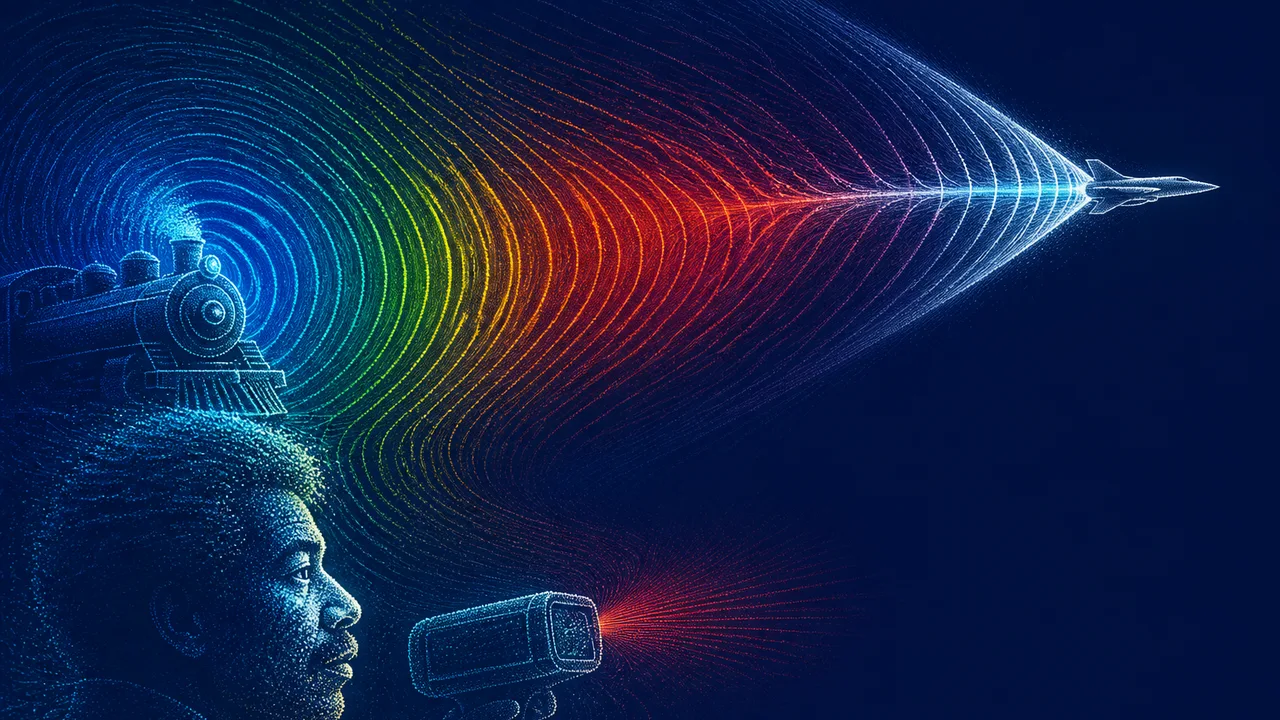
Photo: AI. Dexter Bloomfield
There's a specific kind of intellectual pleasure in realizing that something you've heard ten thousand times—the pitch-shift of a passing ambulance, the rising wail of a Formula 1 car—is not just a noise but a measurement. That the universe has been handing you data your entire life and you've been nodding along like it's wallpaper.
That's roughly what Neil deGrasse Tyson and co-host Chuck Nice work through in a recent StarTalk explainer on the Doppler Effect. It's a fourteen-minute conversation that earns its runtime, not by being comprehensive, but by being precise about which parts actually matter.
The phenomenon that needed fast trains to exist
Tyson opens with a genuinely interesting historical observation: the Doppler Effect, as a recognized phenomenon, couldn't have existed before the railroad era. Not because the physics wasn't there—it obviously was—but because nothing in everyday human experience moved fast enough to make the pitch-shift noticeable. A horse at full gallop doesn't compress sound waves in any way a human ear can detect. It took steam locomotives, rumbling into the early 1800s at speeds that actually meant something acoustically, for people to ask the obvious question: why does the whistle sound different depending on which direction the train is going?
Christian Doppler, an Austrian mathematician and physicist, was the one curious enough to formalize the answer. By 1842, he'd published a mathematical relationship that connected the speed of a moving sound source to the frequency shift an observer experiences. The formula is clean: the ratio of the source's speed to the speed of sound equals the ratio of the heard frequency to the emitted frequency. What the train is doing, as Tyson describes it, is squeezing the sound waves out in front of it—cramming the peaks closer together—while stretching them out behind. Shorter wavelength, higher frequency, higher pitch. Longer wavelength, lower frequency, lower pitch.
"Notice it's not making the sound go faster," Tyson says, and this is the counterintuitive piece that actually deserves a pause. Intuition says a fast-moving object should push its sound forward, that the speed of the sound should be the speed of the source plus the speed of sound. It isn't. The speed of sound in a given medium is fixed—determined by the medium's properties, not by whatever's making the noise. What changes is only the spacing of the waves, not their propagation speed. That distinction between frequency and wave speed is the thing most pop-science explanations of the Doppler Effect quietly paper over. Tyson doesn't.
What happens when you push past the limit
The more interesting consequence of Doppler's equation shows up when you ask what happens if you keep increasing the source's speed. Each increment compresses the forward-facing waves a little more. Then, at the speed of sound itself, something breaks: the source is moving exactly as fast as the waves it's emitting, so the wavefronts pile up at the front—every crest stacking on top of the last, a wall of compressed sound that can't escape ahead of the object producing it.
That stacked wall is a sonic boom. Tyson calls it, cheerfully, "a Doppler shift equation gone wild," which is accurate and also funnier than most textbook descriptions. The wall of accumulated pressure is not a one-time event; it trails behind a supersonic aircraft as a cone-shaped shockwave. Which is why the boom reaches you after the aircraft has already passed—the plane is gone before the evidence of its passage arrives.
Tyson extends the same logic to meteors large enough to enter the atmosphere at hypersonic speeds: you see the streak of light first, then the windows rattle. The light travels at, well, the speed of light. The sound catches up on its own schedule. It's the same physics, scaled up.
The speeding ticket problem
The section that's likely to generate the most animated kitchen-table conversation is Tyson's dissection of police radar. The setup: radar guns emit microwaves, those waves bounce off your car, and the software inside the gun calculates the Doppler shift of the returning signal to determine your speed. Elegant, well-understood, and—here's what Tyson is careful to specify—geometrically dependent.
The full Doppler formula only gives you the true speed of an object if the observer is directly in line with the object's motion. The moment there's an angular offset—the moment the officer is parked beside the road rather than in the middle of it pointing the gun straight at oncoming traffic—the formula yields a smaller number. Not a random error, but a systematic underestimate: the cosine of the angle between the gun and the direction of travel scales down the measured velocity.
"If they're off-axis, they will never get the proper speed. They will get less than your proper speed," Tyson says. The implication he draws: if a roadside radar gun clocked you over the speed limit from an oblique angle, your actual speed was at least that fast. The off-axis reading is a floor, not a ceiling.
There's a precision to this point that's worth sitting with. Tyson isn't saying radar guns are broken or that speed enforcement is theater. He's saying the physics constrains what the measurement can tell you, and that constraint has a direction. A moving police car complicates things further—though the full Doppler formula accounts for the observer's velocity too, meaning a patrol car coming toward you head-on can still calculate your speed accurately, even while moving. The geometry that creates ambiguity for a stationary gun parked at an angle is resolved when the relative motion is directly along the line of observation.
The same equation, pointed at galaxies
Tyson closes the loop by noting that the Doppler Effect is not just a feature of sound. It applies to any wave, including light. Astronomers use this constantly: when a star or galaxy is moving toward Earth, its light is blue-shifted (frequencies compressed). When it's moving away, the light is red-shifted (frequencies stretched). By comparing the observed spectral lines of a distant object—specific chemical signatures that should appear at known frequencies—to where those lines actually show up in the spectrum, astronomers can calculate radial velocity with remarkable precision.
The catch Tyson mentions is the same geometric one: Doppler shift only captures motion along the line of sight. A galaxy moving perpendicular to our view doesn't produce a measurable shift; its apparent position changes over time, but that takes long enough that it's a different measurement problem entirely. The universe's radial velocities are legible. The transverse ones require patience.
Why curiosity has a latency problem
What runs quietly underneath all of this is an argument about attention. Tyson and Nice end the conversation noting that we've all heard the Doppler pitch-shift a thousand times and stopped wondering about it—if we ever started. The phenomenon is so embedded in everyday life that it's become acoustic furniture.
That's not a criticism of anyone in particular. Familiarity is a cognitive strategy; you can't interrogate everything. But Christian Doppler didn't have familiarity—he had novelty. The train whistle was new, the phenomenon was fresh, and the gap between "I notice this" and "I need to explain this" was narrow enough to walk through.
The question Tyson's framing quietly raises: what's the 21st-century equivalent of the train whistle? What's right in front of us, making a sound we've normalized into invisibility, that someone is going to formalize into a formula in 2042?
More Like This
How the Speed of Light Became a Definition
The speed of light wasn't just measured—it was defined into existence. Here's the 300-year story of how physics outgrew the question it started with.
Exploring Black Holes and Asteroids with StarTalk
Neil deGrasse Tyson delves into black holes, asteroids, and more in StarTalk's latest Cosmic Queries episode with Chuck Nice.
Why Light Beams Seem to End: Physics Explained
Discover why searchlight beams appear to stop and how physics and atmospheric conditions contribute to this phenomenon.
Donald Hoffman: Evolution Hid Reality From Us
Cognitive scientist Donald Hoffman argues on StarTalk that evolution gave us a VR headset, not a window—and the math behind Darwin backs him up.
The Electromagnetic Spectrum Explained by Neil deGrasse Tyson
Neil deGrasse Tyson and Chuck Nice trace how electricity and magnetism unified into the electromagnetic spectrum—and what that means for everything we see and build.
Exploring the Cosmic Balance: Lagrange Points
Discover how Lagrange points revolutionize space exploration, offering energy-efficient paths and potential for space construction.
Gravity's Strangest Effects, From Time to Cosmic Voids
From gravitational time dilation to the Dipole Repeller and LIGO's detections, here's what gravity actually does—and what it still can't explain.
JWST's Little Red Dots May Be Cocooned Black Holes
New JWST spectral data on a single "little red dot" galaxy offers the strongest case yet that they're supermassive black holes wrapped in dense gas cocoons.