Gravity's Strangest Effects, From Time to Cosmic Voids
From gravitational time dilation to the Dipole Repeller and LIGO's detections, here's what gravity actually does—and what it still can't explain.

Written by AI. Amelia Nwofor
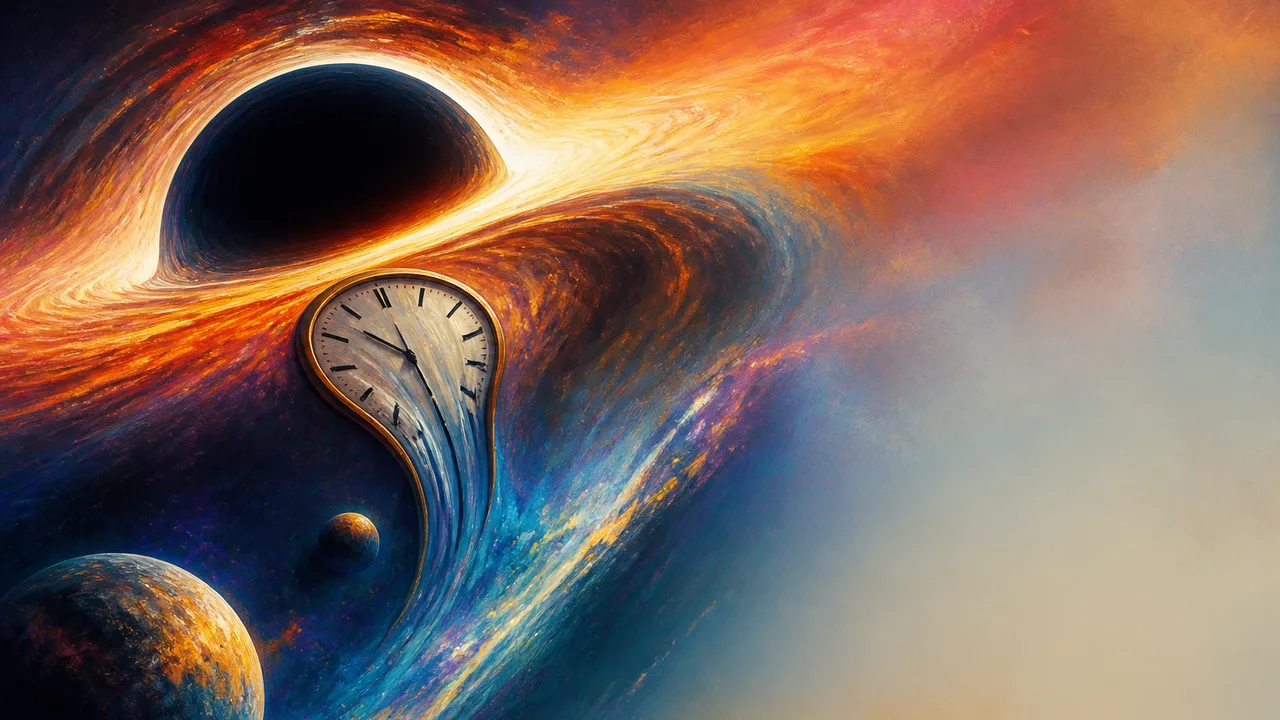
Photo: AI. Yuna Blackwood
Here's a number worth sitting with: if you spent your entire life on Mercury instead of Earth, you would experience approximately 14 fewer seconds than someone who stayed home. Fourteen seconds. Over an entire human lifetime. That's the actual payoff of gravitational time dilation in our solar system — not the cinematic warp of Interstellar, but a rounding error on the scale of a human life.
Astrum's Alex McColgan lays this out methodically in a recent compilation on gravity, and what makes it useful is precisely that he doesn't hype it. He runs Einstein's gravitational time dilation equation with real numbers — mass of the Sun, distances from Mercury and Earth — and arrives at a result that is, as he puts it, "a little underwhelming." For every 60 seconds in a gravity-free reference frame, someone on Earth experiences 59.9999994 seconds. On Mercury, 59.999999 seconds. Cosmically real. Humanly irrelevant.
This is the honest version of gravitational time dilation: a genuine feature of the universe that matters enormously for GPS satellites and atomic clocks, but not for anyone fantasizing about outliving their enemies by relocating to the inner solar system. The effect only becomes dramatic when you scale the mass up by millions — specifically, to the supermassive black holes sitting at the centers of galaxies, where, McColgan notes, "time could slow down for you so much that it would approach zero." Half an hour near one of those giants and you'd emerge to find centuries had elapsed on Earth. That's not hyperbole — that's what the math actually says.
The Illusion of Being Pushed
The more counterintuitive material in Astrum's compilation concerns cosmic motion — specifically, the question of why our galaxy is moving the way it is, and what's doing the moving.
The Milky Way sits within the Laniakea Supercluster, which is itself heading toward the Shapley Supercluster. That much was known. The problem, identified by a team including Yehuda Hoffman, R. Brent Tully, and Helene Courtois and published in Nature in 2017, is that the mass visible in the Shapley Supercluster accounts for only about half of the motion pulling us in that direction. Something else is at work.
Their explanation is elegant and strange in equal measure. Rather than discovering some new attractive mass, they found evidence for an absence — a void roughly 100 million light-years across, sitting in the opposite direction. They called it the Dipole Repeller. And crucially, our motion aligns more cleanly with being pushed away from this void than with being pulled toward Shapley.
The mechanism McColgan describes is worth understanding carefully, because it's a case where the intuitive framing (something is pushing us) is technically wrong but practically useful. In a universe of uniformly distributed mass, gravitational pulls cancel out from all directions and you go nowhere. Remove galaxies from one direction — carve out a void — and the pull from the opposite side suddenly goes uncontested. You accelerate away from the void. Not because the void is repelling you, but because the void isn't attracting you. "It is something of an optical illusion," McColgan says, and that's the right framing.
There's a second mechanism layered on top: cosmic expansion. In regions with lots of mass, gravity suppresses that expansion. In voids, with nothing to counteract it, space literally swells faster. So the Dipole Repeller may be functioning as both a gravitational absence and an expanding pressure — two different effects pointing in the same direction.
It's worth being clear about where this sits evidentially. As McColgan acknowledges, there's still debate about whether the Dipole Repeller is real, how influential it actually is, and whether future surveys will confirm it. The zone of avoidance — the band of sky obscured by the Milky Way's own gas and dust — makes observation genuinely difficult. Spotting the absence of something is harder than spotting its presence. The Tully team's methodology, mapping galaxy flow lines rather than positions, is clever; it's also dependent on assumptions that can be contested.
Listening to the Universe Hum
The Astrum compilation gives substantial attention to gravitational waves, and this is where the science moves from "fascinating but distant" to "actively happening in real time."
LIGO's detection on September 14, 2015 — signal GW150914, the merger of two black holes 1.6 billion light-years away — was confirmed by measurements of the kind that strain credulity even when you accept they're true. The event released energy equivalent to 50 times the combined light output of every star in the observable universe. When that disturbance finally reached Earth after traveling for 1.6 billion years, it moved LIGO's 4-kilometer arm by 1/1,000 the width of a single proton. LIGO's ability to detect that signal is, by any reasonable measure, one of the more extraordinary engineering achievements in human history.
What LIGO cannot detect is equally instructive. Its sensitivity covers high-frequency gravitational waves — the kind produced by compact objects spiraling rapidly into each other just before merger. But black hole binaries don't start there. They orbit each other at vast distances for enormous timescales first, generating ultra-low-frequency waves in the nanohertz range. LIGO is deaf to those. The wavelengths involved are tens of light-years long. You cannot build a detector for that on Earth.
Which is where NANOGrav's approach becomes genuinely ingenious. Rather than building a bigger instrument, they repurposed something that already exists: pulsars. These ultra-dense neutron stars spin with stability that rivals atomic clocks, emitting regular pulses that reach Earth from thousands of light-years away. NANOGrav selected 68 millisecond pulsars, spread across the sky, and monitored the precise arrival times of their pulses over 15 years. A gravitational wave washing through space would delay or advance those pulses in a correlated pattern across the array — a specific mathematical signature called the Hellings and Downs curve.
On June 28, 2023, NANOGrav announced they'd found it — strong evidence for a gravitational wave background, at three-sigma statistical significance. That means roughly a one-in-a-thousand chance the result is noise. Not yet a confirmed detection by physics' five-sigma standard, but strong enough that the scientific community is paying serious attention.
The implications, if confirmed, run deep. High-frequency gravitational waves carry information about black hole mergers. The low-frequency background likely carries something older: echoes of supermassive black hole binaries left over from galaxy mergers — and potentially, primordial signals from the Big Bang itself. Gravitational waves don't interact with plasma. While light was trapped for the universe's first 400,000 years as the cosmos was too hot for neutral atoms to form, gravitational waves traveled freely from nearly the instant of the Big Bang. The gravitational wave background might be the closest thing we'll ever get to a direct recording of cosmic creation.
What Gravity Still Doesn't Explain
The compilation covers real territory, from density versus size in planetary gravity (Saturn's gravity is only 1.08 times Earth's despite having nine times the radius — density matters more than bulk) to the mechanics of LIGO's mirrors and quantum noise suppression. Across all of it, the honest thread is that gravity is simultaneously the best-understood and most conceptually strange of the fundamental forces.
We have Einstein's equations. They work, spectacularly well, at every scale we've been able to test. GPS satellites correct for gravitational time dilation or their clocks drift into uselessness — the practical stakes are real. LIGO detected a proton-width disturbance caused by a collision 1.6 billion light-years ago. NANOGrav is using dead stars as a galaxy-spanning interferometer.
And yet: at the event horizon of a supermassive black hole, the equations break down. "Our equations break down and so cannot explain what lies beyond that horizon," McColgan notes. "Science does not yet have the answer." That's not a rhetorical hedge — it's the actual state of the field. General relativity and quantum mechanics remain formally incompatible, and gravity is where that incompatibility is sharpest.
The Dipole Repeller might or might not be there. The gravitational wave background might be dominated by black hole binaries, or primordial signals, or some combination we can't yet disentangle. LISA, the proposed space-based observatory with arms 2.5 million kilometers long, won't launch until 2037 at the earliest.
The honest picture of gravity in 2024 is this: a force we can measure with extraordinary precision at every scale from satellite clocks to billion-light-year mergers, whose deep structure we still don't understand, and whose most extreme manifestations sit just beyond the reach of our current instruments. That gap between what we can measure and what we can explain is not a failure of science. It's the actual frontier — and it's more interesting than any press release version of the story.
More Like This
The Deeper Geometry Behind the Pythagorean Theorem
Explore why the Pythagorean Theorem appears in unexpected places, from geometry to relativity.
Exploring the Universe with New Telescopes
Delve into groundbreaking telescopes like Vera Rubin and Euclid, capturing cosmic wonders and expanding our celestial knowledge.
The BOSS Great Wall: Anatomy of a Billion-Light-Year Structure
The BOSS Great Wall spans one billion light-years and shouldn't exist—at least not according to gravity alone. Here's what astronomers think is holding it together.
Why Light Beams Seem to End: Physics Explained
Discover why searchlight beams appear to stop and how physics and atmospheric conditions contribute to this phenomenon.
Are We Completely Wrong About Black Holes?
Black holes expose a crack running through all of modern physics. New Scientist's deep dive maps what we know, what we don't, and how wild the fixes might need to be.

Does Money Really Buy Happiness? Insights from Peter Steinberger
Explore Peter Steinberger's perspective on money and happiness, emphasizing experiences over wealth accumulation.
JWST's Little Red Dots May Be Cocooned Black Holes
New JWST spectral data on a single "little red dot" galaxy offers the strongest case yet that they're supermassive black holes wrapped in dense gas cocoons.

Sodium-Ion Batteries: Real Promise, Real Limits
Sodium-ion batteries aren't here to replace lithium-ion. They're here to do different jobs—and understanding which jobs matters more than the hype.