The Top Quark and the Fate of the Universe
Physicist Kate Shaw explains how measuring the top quark's mass with precision could reveal whether the universe is stable—or sitting on a quantum knife-edge.

Written by AI. Nadia Marchetti

Photo: AI. Dexter Bloomfield
There's a particular kind of unease that settles in when a scientist tells an audience "don't worry, it has a happy ending" before explaining how the universe might be perched on the edge of annihilation. Kate Shaw, an experimental particle physicist with nearly two decades on CERN's ATLAS experiment, deployed that reassurance at the Royal Institution recently—and the fact that the room laughed rather than panicked tells you something about how well she'd built the case before delivering it.
Shaw's talk covered quarks, collisions, and what she called "the fate of the universe." That's an ambitious scope for 45 minutes, and she pulled it off by doing something that science communicators often fumble: she made the plumbing visible before turning on the tap.
From the periodic table to particle zoo
The story Shaw tells starts in the late 19th century, with Mendeleev's periodic table—the first serious attempt to find order beneath the apparent chaos of matter. The table worked. It predicted unknown elements. It revealed that nature has a grammar, even if nobody yet knew the grammar's rules.
Then came the 20th century's great unraveling. Electrons, protons, neutrons, photons—a clean four-particle model that seemed to explain everything. And then, as Shaw recounts it, the wheels came off: positrons in 1932, neutrinos in 1934, muons in 1937. One scientist's reaction to the muon became famous: "Who ordered that?" The model that was supposed to simplify the periodic table was sprouting its own unwieldy zoo.
The rescue came from Murray Gell-Mann in the 1960s, who proposed that many of these particles weren't fundamental at all—they were composites of smaller things he called quarks, borrowing the word from a line in James Joyce's Finnegans Wake. Protons: two up quarks, one down. Neutrons: two down, one up. A lot of the particle zoo collapsed into a handful of building blocks, and the Standard Model of particle physics was born.
Shaw brings physical props to illustrate this—weighted plush toys representing different particles, "proportionate to their actual weight," she explains, holding up the top quark plushie with evident affection. The tachyon gets a cameo. "It's not a real particle," she notes dryly.
The quark that doesn't behave like the others
All quarks are confined—they can't exist in isolation. Pull two apart and the gluon "spring" between them stretches, storing more and more energy, until it snaps and the energy materializes as new particle-antiparticle pairs. It's confinement: quarks live and die in groups. Most of them, when ejected from a collision, immediately hadronize into spraying cascades of particles called jets—the experimental signature that hundreds of physicists spend careers learning to interpret.
The top quark doesn't do this. It's the heaviest known fundamental particle—173 GeV, according to Shaw, or 173 times the mass of a proton—and because of that mass, its lifetime is shorter than the timescale for hadronization. Before it can form a jet, it decays. This is inconvenient for the universe but scientifically wonderful: it means physicists can study the top quark directly, as a bare quark, rather than reverse-engineering it from the particle debris it would otherwise leave behind.
According to Scholarpedia's review of top quark properties, the current precision on the top quark mass sits at approximately 172.5 ± 0.3 GeV—a figure Shaw cited in her lecture, and one that represents decades of refinement from the original Tevatron measurements. In 2004, Fermilab's Tevatron put the world average at 178 ± 4.3 GeV. The uncertainty alone was larger than most particles. The improvement since then is the kind of incremental precision work that rarely makes headlines but underpins everything that does.
That 2004 measurement did something else, though. As Fermilab's own reporting from that period noted, the top quark mass constrained where physicists should look for the Higgs boson—excluding Higgs masses below 117 GeV. Shaw points this out with a note of historical sympathy for everyone who built the Tevatron: the Higgs turned out to sit at 125 GeV, just out of reach. "It just just missed," she says. "We would have discovered that ages ago."
The Higgs field, briefly
The Higgs boson gets a brisk treatment in Shaw's talk—she assumes some familiarity, correctly—but the key point for what follows is this: the Higgs field permeates all of space, and particles gain mass by interacting with it. The more strongly a particle couples to the field, the more mass it acquires. Photons don't interact with it at all, so they travel at the speed of light and have zero mass. The top quark interacts with it extremely strongly, which is why it's so heavy.
The Higgs field also has a potential energy landscape—a shape that determines where the field "wants" to sit. In the early universe, spontaneous symmetry breaking caused the field to settle into a particular minimum of that landscape. That's why we have mass. That's why we're here.
But here's the question Shaw is actually building toward: is that minimum the lowest possible minimum? Or is the Higgs field sitting in a local valley, with a deeper valley somewhere else—one it could reach by quantum tunneling, without warning, without enough energy in any conventional sense?
I'll be honest: the possibility that the universe might be metastable is the kind of claim that usually triggers my skepticism reflex. The gap between "our equations suggest this" and "this is physically real" is often where the ghost lives. Shaw is careful about this, which I appreciate. She's not telling you the universe is doomed. She's telling you the math, as currently written, doesn't rule it out—and that the distinction matters.
What the plot shows—and doesn't
Shaw describes a phase diagram with Higgs mass on one axis and top quark mass on the other. Regions of the plot are color-coded: green for a stable universe, yellow for metastable, red for unstable. The Tevatron's measurements, given their uncertainties, sat across all three regions—no information. The LHC narrowed things considerably, but the current best measurements still straddle the green-yellow boundary between stable and metastable.
This is where I find myself genuinely uncertain in a way that feels productive rather than frustrating. The metastability hypothesis isn't exotic fringe physics—it's been in the peer-reviewed literature for decades, and the numbers as we know them don't rule it out. But Shaw is also clear that she suspects the answer is stability, and that the current hint of metastability reflects the incompleteness of our model rather than a feature of reality. "We're pretty sure that we do live in a stable universe," she says, "and that our physics just is not yet complete enough to understand why."
That's a specific kind of intellectual humility—not "we don't know," but "we suspect the model is missing something, and the missing something will resolve this." It's a reasonable position. It's also unfalsifiable until you have a more complete model to test.
Which is why the precision matters. The boundary between stable and metastable on that plot is knife-edge thin. Shaving another decimal place off the top quark mass measurement isn't just academic tidiness—it moves a data point closer to or further from a line that separates two radically different futures for physics.
Measuring toward an answer
The LHC's Run 3 has recently wrapped, and the high-luminosity upgrade is next—five or so more years of increasingly precise collision data. But particle physicists plan on 30- or 40-year timescales, and Shaw's talk ends with the next generation: the Future Circular Collider, a proposed successor accelerator currently under consideration through the European Strategy for Particle Physics. The FCC is a design concept, not yet an approved project—its fate is still being evaluated—but its goals are clear: precision measurements of the Higgs self-coupling (two Higgs bosons produced together, something the LHC can't quite reach), better constraints on the top quark mass, and a search for whatever particles might be lurking beyond the Standard Model.
That last part matters. Shaw notes that it's "highly possible" an undiscovered high-energy particle, when added to the equations, would shift that stability plot into firmly green territory. New physics, in other words, might not just answer the question—it might dissolve it.
The universe, as far as we can tell, has been here for 13.8 billion years without quantum-tunneling into a different vacuum state. That's either evidence of stability or evidence that we've been lucky. The mathematics currently can't tell us which. The next generation of instruments might—or they might reveal that we were asking the wrong question entirely, which in physics usually means you're getting somewhere.
"It's like throwing oranges together and bananas are coming out," Shaw says of high-energy collisions. The thing I keep returning to is that sometimes, in the mess of what comes out, you find that the oranges were never quite what you thought they were.
More Like This
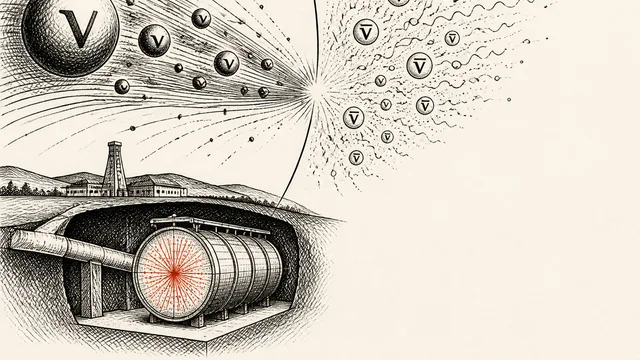
Neutrinos, Oscillation, and the Matter-Antimatter Mystery
Particle physicist Kirsty Duffy explains neutrino oscillation, what it broke in the Standard Model, and why DUNE may finally answer why matter exists at all.
Black Holes, Colliding Galaxies, and the Chaotic Universe
Astrophysicist Mordecai-Mark Mac Low joins StarTalk to unpack galaxy collisions, planets orbiting black holes, dark matter, and why the universe is messier than we thought.
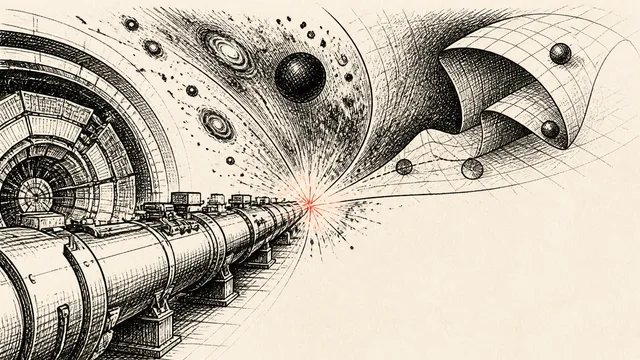
CERN's LHC and the Search for Hidden Dimensions
Inside CERN's Large Hadron Collider: how 600 million proton collisions per second could reveal dark matter, extra dimensions, and the Higgs boson.

Could CERN's LHC Create a Black Hole?
Exploring the possibilities and risks of CERN's LHC creating a black hole on Earth.
The Most Sensitive Dark Matter Detector Might Find Nothing
LUX-ZEPLIN sits a kilometer underground, waiting for dark matter. But success might look like silence—and that would tell us something huge.

What Color Is Monday? Inside the Brain That Sees Time
Synaesthesia isn't imagination—it's perception. Cognitive psychologist Mary Jane Spiller explains how some brains create colors, tastes, and shapes most of us never see.
The Quantum Fourier Transform Explained
Dr. Katie McCormick's Qiskit breakdown of the quantum Fourier transform reveals the strange mathematical object powering Shor's algorithm and quantum phase estimation.
Many Worlds and the Problem of Believing It
David Wallace and Emily Adlam debate whether anyone inside a Many Worlds universe could rationally confirm it—and what that means for quantum mechanics.