The Physics of Beads on a Liquid String
How the Rayleigh-Plateau instability shapes saliva, spider webs, and Bose-Einstein condensates through the same elegant fluid physics.

Written by AI. Priya Sharma
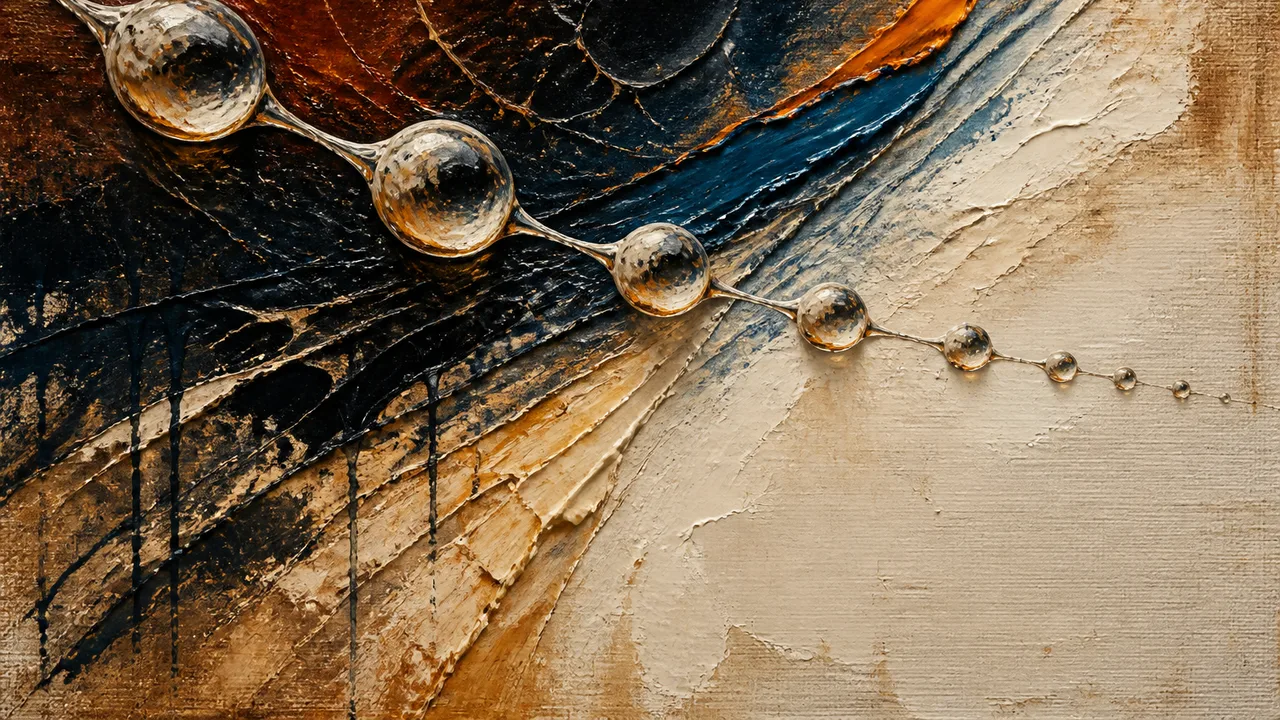
Photo: AI. Saskia Aaltonen
Stretch a thin strand of saliva between your fingers and something peculiar happens. The continuous thread doesn't simply thin and break the way water would. Instead, it reorganizes itself into a series of tiny, evenly spaced droplets suspended along a nearly invisible filament, like microscopic pearls on a thread you can barely see. It looks like a conjuring trick. It is, in fact, a physics lesson that runs from your mouth to a spider's web to the coldest objects in the known universe.
The phenomenon at work is called the Rayleigh-Plateau instability, sometimes rendered in science communication as the "relay plateau instability." The core principle is old and well-established: a cylinder of liquid is not a stable configuration. Liquid surfaces are governed by surface tension, the tendency of a liquid to minimize its exposed area. A long, thin cylinder has considerably more surface area than the same volume collected into a sphere. Given any opportunity, the liquid will move toward the lower-energy configuration.
The mechanism that provides that opportunity is surprisingly mundane. Random perturbations, air currents, mechanical vibration, the slight tremor in the hand holding the strand, create ripples along the surface of the liquid cylinder. Most of those ripples are too small to matter. But when a ripple's wavelength exceeds the circumference of the cylinder, something changes. As The Action Lab's video on the subject explains: "It happens when this ripple wavelength is equal to the cylinder circumference." At that threshold, the pinched regions of the cylinder find themselves in a position where further pinching actually reduces total surface area rather than increasing it. The instability becomes self-reinforcing. The narrow sections thin faster, the wide sections swell, and the cylinder breaks into regularly spaced droplets. Not randomly. Regularly. The geometry enforces it.
This is why slow-motion footage of a dripping faucet shows tiny satellite droplets forming between the main drops. It is the same instability, operating on ordinary water, visible if you look closely enough.
When the Liquid Pushes Back
Water, however, does not form beads on a string the way saliva does. Pull water between your fingers and it snaps. The distinction is not merely viscosity; it is something more interesting.
Saliva is a viscoelastic fluid. So is polyethylene glycol at high molecular weight, the other liquid featured in the Action Lab demonstration. These fluids contain long polymer chains in solution, and those chains introduce a property that pure water entirely lacks: elasticity. When the liquid is stretched, the polymer chains extend from their natural coiled configurations. Stretched polymer chains want to return to their coiled state, and that return impulse creates tension along the length of the filament.
The result is a competition. Surface tension is trying to thin the filament's neck regions and pinch them off into droplets. The elastic stress in the stretched polymers is resisting that thinning, pulling back along the axis of the strand. As the video describes it: "The elastic stress fights against the surface tension forces that are trying to make the string thinner. The more surface tension tries to thin the string, the more the polymers are stretched and the greater their elastic stress becomes."
This interplay is what produces the bead morphology rather than simple breakup. The neck regions thin very slowly, stabilized by elastic tension, while the wider regions swell into droplets. The system reaches a kind of compromise: regularly spaced beads connected by nearly invisible threads, persisting far longer than a purely Newtonian liquid would permit.
The formal literature on this is extensive and technical. A 2010 paper published in Nature Physics worked out the detailed dynamics of bead formation and satellite bead formation in viscoelastic filaments, distinguishing Newtonian from Oldroyd-B fluid behavior and mapping how fluid inertia affects the process. The Action Lab video notes that despite the phenomenon being observed decades earlier, it "wasn't until 2010 that scientists finally worked out the detailed physics of how and why these beads form." That is not an unusual timeline in fluid mechanics. The governing equations for these systems are nonlinear and notoriously resistant to clean analytical solutions; the beads-on-a-string structure involves coupled capillary and elastic effects that required both improved computational tools and careful experimentation to resolve.
Research summarized at ResearchGate confirms that even minute concentrations of high-molecular-weight polymer are sufficient to produce the bead morphology in liquid jets or bridges collapsing under surface tension. The polymer does not need to dominate the fluid. It just needs to be present.
What Spiders Worked Out Long Before Physicists Did
The practical elegance of this instability becomes clear when you consider how orb-weaving spiders construct their capture threads. The spiral portion of an orb web, the part meant to snare insects, must be adhesive. The spider coats silk fibers with a continuous layer of viscous, watery glue. Almost immediately after deposition, the Rayleigh-Plateau instability causes that continuous coating to reorganize itself into regularly spaced droplets along the fiber.
The spider does not place each droplet individually. It could not; the droplets are microscopic and there are thousands of them. Instead, as the video puts it, the spider "can basically just let surface tension do all the work of organizing that liquid into beads." The instability is not a problem to be solved; it is a manufacturing method to be exploited. The spider lays down a continuous film and physics does the rest, producing a precisely spaced array of adhesive droplets optimized for catching and holding prey.
This is a striking example of a biological system that leverages a physical instability rather than working against it. The web's architecture emerges not from the spider's active construction of each element but from the fluid dynamics of the glue itself. It is an open question, and one worth sitting with, whether this represents evolutionary optimization toward the instability or simply a lucky convergence. The outcome is the same either way: a remarkably efficient structure assembled largely by thermodynamics.
The Same Equation, a Billion Times Colder
The most unsettling extension of this physics involves Bose-Einstein condensates. These are states of matter produced by cooling certain atoms to temperatures near absolute zero, close enough that the atoms shed their individual quantum identities and collectively occupy the same quantum ground state. At that point, the assembly behaves as a single quantum object.
Researchers have recently confirmed that these quantum liquids can form filaments, and that those filaments undergo the same instability that governs saliva between your fingers. Tiny variations in filament thickness grow through the same feedback mechanism: narrow regions thin further, wide regions swell, until the filament breaks into regularly spaced rows of quantum droplets. The video describes the result as "a super weird state of matter that can have both a repeating solid-like structure and superfluid properties."
The conceptual leap here is genuine. The Rayleigh-Plateau instability is classical continuum mechanics; it was derived in the nineteenth century by Lord Rayleigh and Joseph Plateau from observations of liquid jets and soap films. Bose-Einstein condensates are quantum mechanical objects whose behavior is described by the Gross-Pitaevskii equation, a nonlinear Schrodinger equation with no obvious connection to classical fluid dynamics. Yet the instability manifests in both regimes, in almost identical form.
This is not simply a pretty analogy. It reflects something real about the structure of physical law: certain instabilities are so fundamental, so tied to the geometry of thin filaments and the tendency of systems to seek lower energy states, that they appear wherever the underlying conditions are met. The quantum liquid does not "know" about Rayleigh and Plateau. It simply responds to the same variational logic that governs saliva and spider silk.
Whether that universality should be surprising is a question the physics community has not fully settled. In one sense, the mathematics of thin-filament instability is general enough that its appearance across scales is expected. In another, the specific confirmation that quantum filaments break up in the same regular, bead-forming way as classical ones carries genuine empirical weight. Expected and confirmed are different things.
The strand of saliva between your fingers is, in that light, a window into something considerably larger than a kitchen experiment. It is a demonstration that the same physical logic operates from the biological scale down to the quantum one, connecting orb weavers and ultracold atoms through geometry and the relentless arithmetic of surface energy.
More Like This
How Gravity Assists Propel Spacecraft Efficiently
Exploring gravity assists in space travel: a technique to boost spacecraft speed by leveraging planetary motion.
Physicists Just Caught Virtual Particles Becoming Real
New experiment at Brookhaven Lab allegedly proves virtual particles exist—challenging how we understand empty space and quantum reality itself.
The Oberth Effect: Why Speed Makes Rockets More Powerful
A spring-loaded rocket and some careful bookkeeping reveal why firing engines at high speed produces far more energy—and why it matters for reaching the stars.
Exciton Condensation Precursors Detected in Quantum Materials
Ultrafast core-level spectroscopy has detected the earliest signals of exciton condensation in quantum materials — a find that reshapes how physicists read phase transitions.
Physics Breakthrough: Solving Fluid Dynamics Glitches
New physics technique resolves simulation glitches, enhancing fluid dynamics and offering life advice.
Could Spacetime Actually Break? The Physics of Fracture
From LIGO's gravitational wave data to Planck-scale fracture mechanics, physicists are asking what it would actually take to tear spacetime apart.
Triton's Strange Orbit and the Ice Giants' Secrets
Triton's retrograde orbit, nitrogen geysers, and the chaotic magnetic fields of Uranus and Neptune reveal how little we understand our own solar system.

Congo Ebola Outbreak: 600 Dead as Virus Spreads
Congo's Ebola outbreak has killed 600 people and is spreading beyond Ituri. What happens when a virus meets a system that was already broken.