Exciton Condensation Precursors Detected in Quantum Materials
Ultrafast core-level spectroscopy has detected the earliest signals of exciton condensation in quantum materials — a find that reshapes how physicists read phase transitions.

Written by AI. Olivia Meng
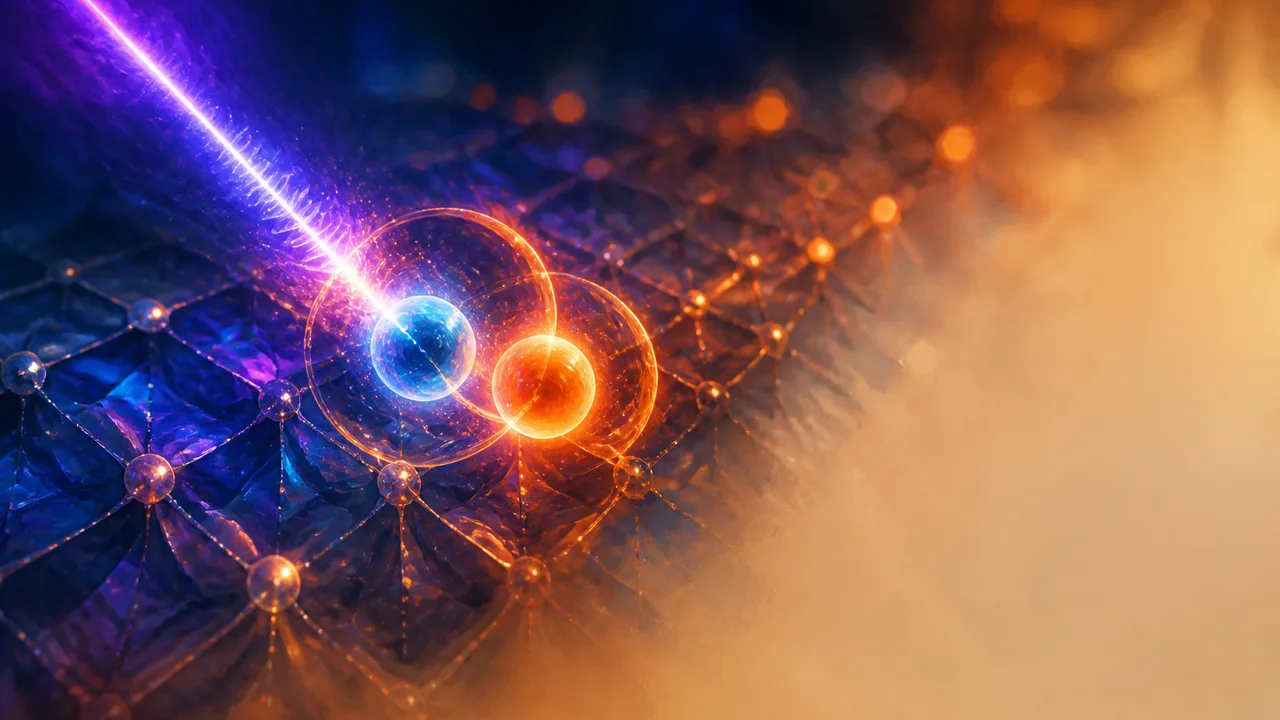
There is a specific kind of difficulty in studying a phase transition: the most interesting moment — the point at which a material crosses from one organized state into another — is also the moment when the system's behavior becomes hardest to read. Everything is intertwined. The electronic signals blur into the structural ones. What you're looking for is obscured by the very dynamics that produce it.
That is the problem researchers working on exciton condensation have faced for years. And it is, according to new findings reported by Phys.org, what a team using ultrafast core-level spectroscopy has now found a way to navigate.
The result: the first clear detection of precursor signals to exciton condensation in quantum materials. Not the condensate itself — but the flickering, fluctuating signs that it is coming.
What an Exciton Is, and Why Its Condensation Matters
Start with the basics, because they're genuinely strange. An exciton is not a conventional particle. It is a bound pair — an electron and the positively charged vacancy, called a hole, left behind when that electron moves. The two are coupled by electrostatic attraction, and the resulting quasi-particle carries energy but no net charge. In certain materials and under certain conditions, these excitons can undergo condensation: a collective quantum mechanical event in which large numbers of them occupy the same quantum state simultaneously, behaving as a single coherent entity rather than as a disordered crowd.
This is related to the physics behind Bose-Einstein condensation, but the materials in which excitonic condensation has been studied are considerably more complex — and considerably more practical — than the ultracold atomic gases where BEC was first demonstrated.
The stakes of controlling exciton condensation are not trivial. A material in an excitonic condensate state can, in principle, transport energy without the resistive losses that bleed efficiency from conventional electronics and electrical systems. Every transmission line, every power cable, every circuit loses some fraction of what it carries to heat. It is one of the defining inefficiencies of the energy infrastructure we have built — and it is not going away under the physics of normal conductors. Excitonic and superconducting systems point toward a different physics entirely, one where that loss is not a given. The distance between a laboratory observation and a deployed technology is long and uncertain, but the direction of interest is clear.
The Measurement Problem
What has kept exciton condensation difficult to study is not that it doesn't occur — multiple research threads have documented it in carefully engineered systems — but that observing the transition into it, let alone the precursor fluctuations before it, has been technically formidable.
As Phys.org reports, the core challenge is that electronic and structural changes in quantum materials are strongly intertwined. Isolating signatures specifically associated with excitonic interactions has remained difficult, let alone tracking excitonic behavior across the phase transition itself, or determining whether precursor fluctuations exist in a meaningful, observable form.
This is where ultrafast core-level spectroscopy earns its place in the story. The technique uses extremely short pulses of high-energy light to probe the inner electron shells of atoms in a material. Because these core electrons sit close to the nucleus and respond on timescales measured in femtoseconds — millionths of a billionth of a second — they can capture dynamics that conventional spectroscopy smears into background noise. The result is something like being able to read the individual frames of a film that previously looked like a blur.
By applying this method to quantum materials approaching the exciton condensation threshold, researchers were able to observe microscopic fluctuations — the precursor signals — that had not been resolved before.
The Longer Paper Trail
The Phys.org findings do not arrive in a vacuum. The search for condensation precursors in layered quantum systems has been an active theoretical and experimental thread for at least several years.
A 2019 paper published in Physical Review Letters (link.aps.org) used tunneling spectroscopy to find evidence for interlayer electron-hole correlations in quantum Hall bilayer systems — two-dimensional electron systems separated by a thin gap — at layer separations near, but still above, the transition to the incompressible exciton condensate. The detection of correlations before the transition proper is precisely what makes that work a useful reference point here: the idea that there is a readable signal ahead of the phase boundary is not new, but demonstrating it in new material geometries and with finer temporal resolution is a genuine methodological advance.
Work published in Science (www.science.org) examining a transition metal dichalcogenide — a class of two-dimensional quantum material that has attracted substantial recent interest — identified a plasmon-like electronic excitation above the critical temperature that serves as a precursor mode, falling to zero energy at the condensation threshold. That softening mode is a signature of the approaching transition, a measurable announcement that the system is reorganizing. The new ultrafast spectroscopy work extends this kind of reading into a regime where the temporal dynamics, not just the energy signatures, are now accessible.
What Detecting the Precursor Actually Changes
There is a meaningful difference between knowing that a phase transition exists and being able to observe the approach to it. The first is physics. The second is, potentially, engineering.
If precursor fluctuations can be detected in real time — as the ultrafast spectroscopy results suggest — then the logical next question is whether they can be influenced. A system that announces its approaching transition through observable signatures is a system that might be coaxed, tuned, or stabilized before that transition completes. For applications in quantum computing, where coherent quantum states are both essential and fragile, the ability to detect and manage the precursors to condensation could prove as valuable as the condensed state itself.
The dissipationless transport angle is worth sitting with rather than passing over. The electrical grid loses roughly 5% of its energy to resistive heat in transmission, and the losses in distribution and end-use electronics compound further. That is not a rounding error at the scale of global energy demand. Materials that could eliminate resistive loss entirely — if the physics of excitonic condensation can be stabilized and deployed outside of cryogenic laboratory conditions — would represent a structural change in how energy systems work, not an incremental improvement. I am not predicting that. The path from a quantum Hall bilayer in a dilution refrigerator to a room-temperature power conductor is not a straight line, and it may not exist. But the reason this research draws attention beyond the physics community is that the implied endpoint is that consequential.
What the Record Cannot Yet Tell Us
The sourced record here has limits worth naming plainly. The ultrafast core-level spectroscopy work reported by Phys.org is, as of this writing, the primary public-facing account of the new findings. The underlying paper's full methodological detail — which specific quantum material was studied, what temperatures and conditions were required, how the precursor signals compare quantitatively to theoretical predictions — is not spelled out in the coverage available. That matters for assessing how broadly the technique can be applied and how far the findings generalize.
The existing literature from Physical Review Letters and Science provides strong context for the class of phenomena under study, but the new ultrafast spectroscopy results represent a distinct methodological step, and the field will require independent replication to establish how robust the precursor signatures are across different material systems.
The Productive Strangeness of This Moment
Here is what I find genuinely unsettling about where this research stands, and I mean unsettling in the way that means worth paying attention to: we are getting better, rapidly, at reading the precursor signals of quantum phase transitions at the same moment that our theoretical frameworks for explaining those signals remain contested and incomplete. The instruments are outrunning the models.
In most domains I cover, that gap is a problem — evidence accumulates faster than the policy and institutional structures that could act on it. Here the gap is different in character but not entirely different in structure. We are learning to detect and potentially manipulate quantum states whose behavior we cannot yet fully predict. That is not a reason for alarm, and it is not a reason for uncomplicated optimism. It is a reason to take seriously what these precursor signals are telling us — not just about exciton condensation, but about the limits of what we understand versus what we can now measure. When the data runs ahead of the theory, the honest response is not to fill the space with speculation. It is to keep reading, carefully, and resist the temptation to declare arrival before the transition is complete.
More Like This

Rethinking Cosmic Acceleration: A Local Illusion?
Exploring the debate on whether the universe's acceleration is a local phenomenon, challenging the concept of dark energy.
How the Asteroid Impact Ended the Dinosaur Era
Explore the catastrophic asteroid impact that ended the dinosaurs, its immediate aftermath, and the long-term environmental changes.
Subcritical Reactors: Nuclear Power's Safety Fix?
A new generation of subcritical reactors promises to make nuclear meltdowns physically impossible. But can they deliver on cost, scale, and timeline?

Understanding the Real Risk of Brain-Eating Amoebas
Explore the facts and myths surrounding brain-eating amoebas. How real is the threat, and can climate change affect its spread?

Scientists May Finally Detect Gravitons—Sort Of
New experiments could detect gravity's quantum particle within decades. But proving gravitons exist? That's a different problem entirely.
Altermagnetism: Physics Just Got a Third Magnetic Class
Physicists have confirmed a third fundamental class of magnetism. Here's what altermagnetism actually is, why it matters, and who's positioned to control it.

Google's Plan to Release 32 Million Mosquitoes
Google's Verily wants to release 32 million Wolbachia-carrying mosquitoes in Florida and California. The science is real. The questions are bigger than the video admits.

Geothermal Energy's Promise and Its Real Barriers
Geothermal delivers 24/7 clean power with near-zero emissions. But drilling costs, financing gaps, and policy inertia stand between the technology and global scale.