Altermagnetism: Physics Just Got a Third Magnetic Class
Physicists have confirmed a third fundamental class of magnetism. Here's what altermagnetism actually is, why it matters, and who's positioned to control it.

Written by AI. Mei Zhang
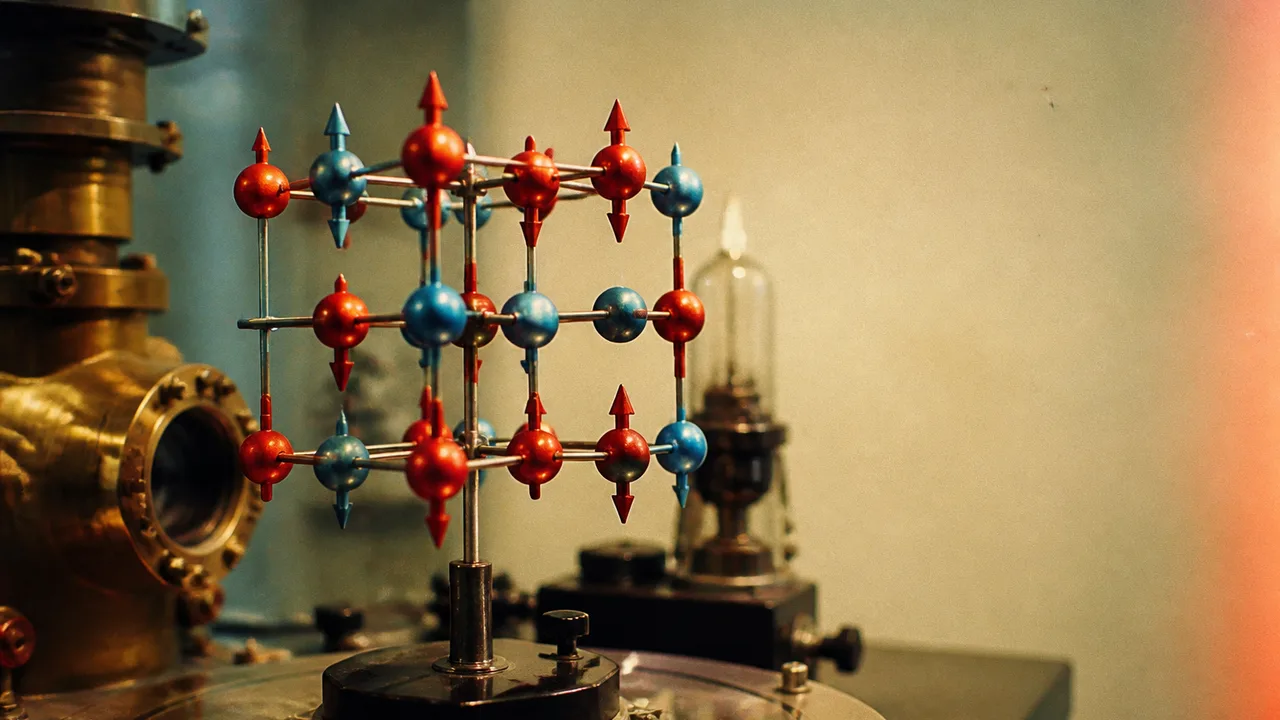
For about as long as physics has had a taxonomy of magnetism, it had two entries: ferromagnetism and antiferromagnetism. That's it. Two categories, split cleanly, each with its own properties and its own toolbox. Tidy. Settled.
Except: not settled anymore. 🧲
Physicists Jairo Sinova, Libor Šmejkal, and Tomas Jungwirth have established that nature was holding out on us — there's a third fundamental class of magnetism, and it's been sitting in plain sight in certain crystal structures this whole time. The work just earned them the 2026 Europhysics Prize, according to Phys.org. The prize, from the European Physical Society, doesn't go to science that might be interesting someday. It goes to work that has already demonstrably changed the field. That's the bar altermagnetism clears.
So what actually is it?
The two you knew, and the one you didn't
Quick orientation. Ferromagnetism is the one you grew up with — all the tiny magnetic moments in a material pointing the same direction, stacking up into a net field you can feel. Refrigerator magnets. Compass needles. Classic.
Antiferromagnetism is less intuitive: the magnetic moments alternate direction, so they cancel each other out. No net magnetic field. From the outside, an antiferromagnet looks magnetically boring — but internally, it has a beautifully ordered alternating structure. Physicists have known about this since the mid-20th century and have been trying to exploit it ever since.
Altermagnetism sits in between, but not in a vague, hand-wavy "sort of both" way. As The Hindu explains, you can think of it as a magnetic state in which rotating or mirror-flipping the crystal pattern matches sites in cancelling pairs, leaving no net magnetization — but unlike standard antiferromagnets, the cancellation isn't achieved by simple alternation. It emerges from the crystal's rotational symmetry itself. The geometry does the work.
The result: zero net magnetization (like an antiferromagnet) paired with momentum-dependent spin splitting of electrons (like a ferromagnet). 🔬 Two things that weren't supposed to coexist in the same material, coexisting. That's not a minor amendment to existing theory — it's a structural expansion of how we categorize magnetic order.
The taxonomy we'd been teaching wasn't wrong, exactly. Ferromagnetism and antiferromagnetism remain valid frameworks within their own domains. The taxonomy was just incomplete. There was a drawer in the cabinet that nobody had opened.
Why "not just one rare system" is the key sentence
A new physical phenomenon only matters at scale if it shows up in more than a handful of exotic lab materials. This is where the Šmejkal quote, surfaced by Science News, does the most work: "The bottom line is … it's not only one rare system" that hosts an altermagnet.
Read that again. Not one rare system.
That's the green light. Altermagnets aren't a curiosity found in one finicky compound under precisely controlled conditions. They appear across a meaningful class of materials. That reproducibility — across systems, not just within one — is what makes experimental confirmation genuinely significant and what makes the jump from physics prize to engineering conversation feel less like hype.
According to SciTechDaily, Professor Sinova called the recognition "a truly unique tribute to our work," noting that he and his team discovered and demonstrated the phenomenon. (SciTechDaily names Sinova as the speaker; the quote is attributed accordingly.) Altermagnetism was also named a top physics breakthrough of 2024 — so the Europhysics Prize in 2026 is something more like a ratification than a debut. Early experimental evidence had been circulating for a while before the field's institutions decided to formalize the recognition.
What spintronics actually needs from this
Here's where the physics starts bleeding into engineering — and into questions I find myself asking whenever a fundamental discovery gets this much attention.
Conventional electronics use electron charge to carry information. Spintronics uses electron spin — an intrinsic quantum property that behaves like a tiny magnet. The field has been working for decades on materials that can manipulate spin states cleanly, quickly, and without the heat dissipation that plagues charge-based devices.
Ferromagnets have been the primary material workhorse here. But they come with a problem: they generate stray magnetic fields that interfere with neighboring components. Antiferromagnets don't — their net magnetization is zero — but they're notoriously hard to read and write. You can't easily detect or set their magnetic state because the signal you'd normally look for isn't there.
Altermagnets offer something genuinely different: zero net magnetization (so no stray fields) and that momentum-dependent spin splitting that creates a detectable electronic signature. The combination is the reason researchers are paying attention. It's the specific technical shape of the problem that altermagnetism might solve — not some vague handoff from physics to applications, but a precise fit between what spintronics needs and what this material class provides.
Whether it actually works at device scale, under fabrication conditions, at room temperature — that's where we are in the research arc, not where we're going. The distance from "demonstrable phenomenon across multiple systems" to "manufacturable component" is where most materials science breakthroughs spend years, sometimes decades, negotiating with reality. The physics here is striking; the engineering is an open question.
The geography of this knowledge — and why it matters
This is the part I can't not notice: the three researchers who established altermagnetism are based at Johannes Gutenberg University Mainz (Šmejkal and Sinova) and the Czech Academy of Sciences (Jungwirth), according to idw-online.de. That's a tight institutional cluster — Central European condensed matter physics, which has historically been excellent and systematically underfunded relative to U.S. and East Asian labs.
I'm not suggesting anything nefarious. I'm asking the question I always ask in my beat: who controls what comes next?
Fundamental physics lives at universities and national labs. Applied spintronics and quantum materials research — the step where "interesting phenomenon" becomes "manufacturable component" — moves into industry, into patent portfolios, into the same semiconductor supply chains that are already concentrated in ways that have proven geopolitically and economically fraught. If altermagnets prove out for next-generation memory or quantum information hardware, the benefits of that discovery will travel through existing industrial infrastructure. That infrastructure has its own equity dynamics, its own gatekeeping, its own geography.
The researchers who found altermagnetism won't necessarily control who profits from it. That's not a knock on the science — it's just how the pipeline works, and it's worth naming.
The open questions that are actually interesting
Even with all the excitement, the record on applications is genuinely thin right now. Phys.org and the brief's sources gesture at quantum computing and advanced materials — and those are real avenues — but the field hasn't yet produced device demonstrations at scale. We're still in the phase where the materials properties are being mapped.
What I'd want to watch: which institutions file the early foundational patents on altermagnetic materials? Which governments designate this a strategic research priority? Does the concentration of early expertise in European universities translate into a European industrial advantage, or does it diffuse into global semiconductor supply chains the way most physics breakthroughs do?
Those questions don't have answers yet. But the fact that no one's loudly asking them while the physics celebration is underway — that's a pattern worth tracking. ⚗️
The textbooks probably do need updating. A third category in the most fundamental classification of magnetic order isn't a footnote addition. It's a structural revision. But revisions to how we understand nature and revisions to who benefits from that understanding are two different processes, running on two very different timelines.
More Like This

How Maxwell Unified Electricity and Magnetism
A compass needle twitched in 1820 and set off a chain of discoveries that now powers every wireless signal in your life. Here's the physics behind it.

Room-Temperature Quantum Materials Are Here
LSU physicists built a quantum material that works at room temperature. Here's what that actually means for quantum computing, and why it matters right now.

Microsoft Majorana 2: Bold Claims, Thin Evidence
Microsoft's Majorana 2 chip promises a 1,000x reliability leap and a 2029 quantum computer. Scientists say the paper doesn't back any of it up.
The Double Slit Experiment's Real Mystery
Physicist Sabine Hossenfelder dismantles common misconceptions about the double slit experiment—and reveals the one question nobody is actually asking.
The Neuroscience of Discipline: Automation Over Motivation
Explore how discipline evolves from motivation to neural automation, making actions automatic and emotions irrelevant.
When Basic Physics Secretly Rewrites the World
Don Lincoln explains how Maxwell's equations revealed the speed of light — and why what we ignore in physics today may determine our climate future.
How Origami Is Reshaping Modern Engineering
From medical stents to space telescopes, folding geometry is quietly rewriting how engineers think about structure, material, and design.

NASA Moves SunRISE Mission From Vulcan to Falcon Heavy
NASA switched its SunRISE solar weather mission from ULA's Vulcan Centaur to SpaceX's Falcon Heavy. Here's why that matters beyond the rocket swap.