The Double Slit Experiment's Real Mystery
Physicist Sabine Hossenfelder dismantles common misconceptions about the double slit experiment—and reveals the one question nobody is actually asking.

Written by AI. Amelia Nwofor
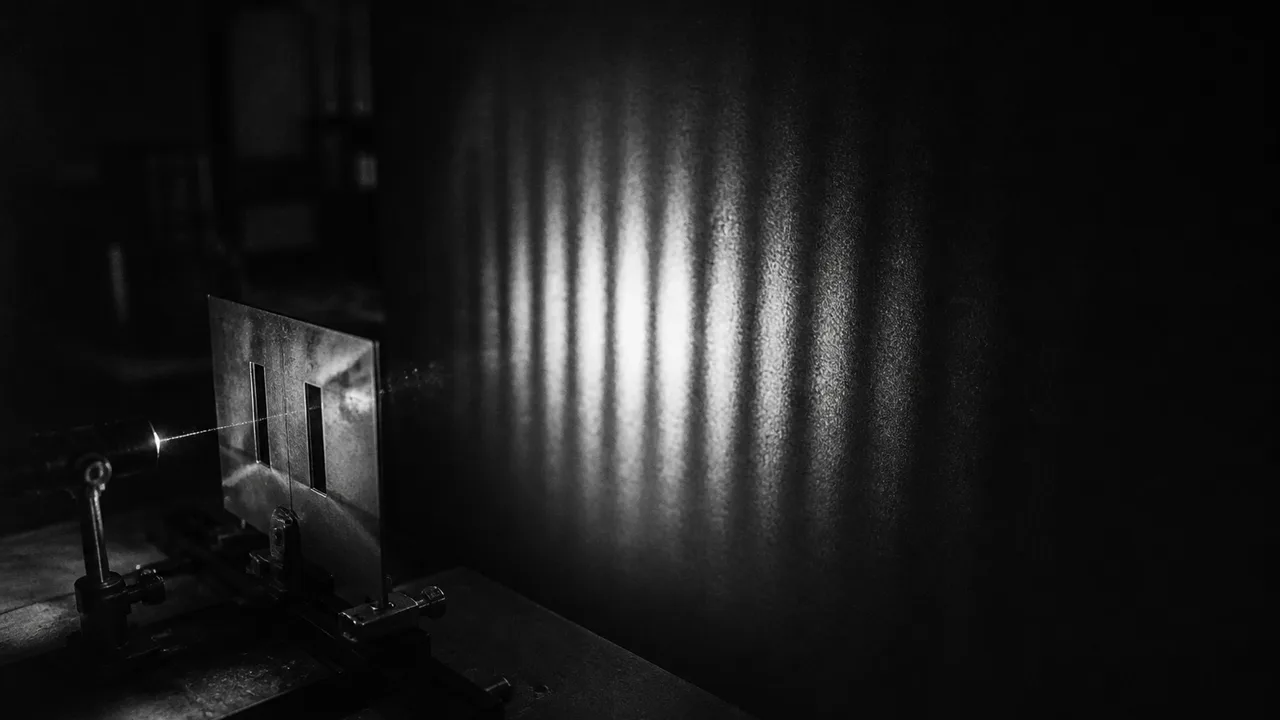
Photo: AI. Atticus Ferenczi
The double slit experiment has a strange reputation. It's the most taught experiment in quantum mechanics, the most cited in popular science books, and—according to physicist Sabine Hossenfelder—probably the most consistently misrepresented. In a recent video, Hossenfelder takes a methodical pass through the standard explanations and finds that several of them are not just oversimplified but actively wrong.
That's worth pausing on. Not "imprecise for a general audience" wrong. Wrong in ways that redirect attention from the experiment's actual puzzle toward a collection of philosophical tangents and pop-science theater.
Let's trace her argument carefully, because the correction is more interesting than the misconception.
What the Standard Account Gets Wrong
The familiar version goes like this: send particles through two slits and they form an interference pattern, like waves. But if you try to observe which slit a particle passed through, the interference pattern vanishes and you get two plain stripes instead. The particle, caught being watched, stops behaving like a wave. Consciousness, mystery, weirdness, done.
Hossenfelder's first correction lands hard: the two-stripe result doesn't happen. "The wrong part," she says, "is that the particles allegedly stop behaving like waves or form two stripes on the screen. This just never happens."
What actually occurs when you measure which slit a particle goes through is more subtle. The particle still behaves as a wave—it's just now a wave that passed through one slit. A single-slit wave produces a diffraction pattern, which is itself an interference effect. Measure at the right slit and you get a diffraction pattern from the right slit. Measure at the left and you get one from the left. Put both sets together, and you don't get two stripes—you get an overlap of two diffraction patterns.
The interference pattern from both slits together disappears, yes. But the reason has nothing to do with particles abandoning their wave nature. It's a straightforward consequence of the math: when you add two wave functions and then square the result, you get more than if you square them separately and add. That extra term is the interference. Remove your knowledge of which slit the particle used—collapse the two contributions into a single sum—and the extra term reappears.
The surprise, when the standard account dissolves, is that there's no deep observer effect lurking in the pattern on the screen. The screen is just arithmetic.
Where the Actual Weirdness Lives
Hossenfelder is precise about where to redirect the curiosity. The genuinely strange thing isn't what appears on the screen. It's when the detector gets switched on.
Imagine a particle in flight. It has already left its source. You haven't yet decided whether to measure which slit it uses. You switch the detector on after the particle is in transit. For the math to work—for the wave function to describe a particle that went through only one slit—the wave function has to update across both slits at once, instantaneously. Even the slit the particle didn't go through has to get the memo.
"You make a measurement at one slit and the wave function on the other slit changes immediately," Hossenfelder explains. "And note that this is the case even if the particle does not trigger the detector. If it doesn't go into the detector, you know it must have gone through the other slit. But if the particle went through the other slit, you never interacted with it. You didn't touch the particle. It just knew you were trying to."
That's not dramatization. That's the actual logical structure of the experiment. The particle that missed the detector still changed its behavior based on a measurement that didn't touch it.
Einstein called this sort of non-local updating "spooky action at a distance," and the double slit experiment is a clean instance of it. The alternatives don't get tidier. If you reject faster-than-light wave function updating, you're left with what Hossenfelder calls superdeterminism: the idea that the particle already "knew" whether you would measure it before you made that decision. The future was already settled when the particle left the source. Pick your discomfort.
Three Misconceptions Worth Naming
While she's at it, Hossenfelder dispenses with a few other recurring errors.
Consciousness. The measurement doesn't require a conscious observer. Any physical apparatus that records which slit the particle used will do. The consciousness framing has a long pop-science lineage, but it isn't in the physics.
Momentum conservation. When a particle hits the screen off-center, it looks like momentum wasn't conserved—the particle changed direction without anything pushing it. Hossenfelder clarifies that the particle actually becomes entangled with the slit apparatus itself. If the particle gets a momentum kick in one direction, the slit plate gets a corresponding kick in the other. Momentum is conserved in every single run. The kick to the plate is just unmeasurably small because the plate is vastly heavier than a particle. Shrink the slit to the size of individual atoms—which researchers have done—and you can detect that kick. When you can, the interference pattern degrades accordingly.
Elon Musk's simulation argument. Musk recently suggested the double slit experiment is "consistent with the simulation hypothesis," comparing it to video games that generate object positions only when observed. Hossenfelder's rebuttal has three prongs. First, the simulation hypothesis is compatible with everything, which is another way of saying it predicts nothing—what Wolfgang Pauli called "not even wrong." Second, video game rendering is typically pseudo-random (deterministic algorithms that look random), but if particles in the double slit were pseudo-random, that would directly contradict the standard interpretation of quantum mechanics. Third, measuring a particle doesn't give it a definite position—it gives certainty to whatever quantity you measured. Measure momentum and it's the momentum that sharpens, while position becomes more uncertain. Heisenberg wasn't decorative.
The Question Nobody Is Working On
Here's where Hossenfelder's frustration becomes analytically interesting rather than just characteristic. Her argument isn't just that people get the double slit wrong. It's that the popular misconceptions function as a kind of static, preventing attention from reaching the experiment's actual open problem.
The real problem is this: quantum mechanics requires instantaneous wave function updates—faster-than-light changes that propagate across any distance. Special relativity says nothing propagates faster than light. These two frameworks, both extraordinarily well-confirmed, appear to be in direct tension. How is the instantaneous wave function update compatible with Einstein's speed-of-light limit?
"This is a perfectly obvious research problem," Hossenfelder says, "that basically no one's working on despite the fact that it's the one topic that could actually return the foundations of physics to relevance."
That claim is itself worth scrutinizing. It's not strictly true that no one is working on quantum-relativistic reconciliation—quantum field theory, quantum gravity research, and various collapse theories all brush against this problem. But Hossenfelder's point is sharper than it first appears: the specific tension between nonlocal wave function updating and relativistic causality rarely gets treated as the central unsolved problem of quantum foundations. Instead, the discourse tends to recycle debates about interpretation—Copenhagen vs. Many Worlds vs. pilot wave—while leaving the measurement problem's relativistic edge largely unaddressed.
That might be a sociology-of-physics observation as much as a physics one. Foundations research is famously underfunded and institutionally peripheral. The double slit experiment, in its popular form, gets treated as an already-explained mystery rather than a doorway to an open one.
Whether you find Hossenfelder's framing of the research landscape entirely fair or somewhat overstated, her diagnostic of the misconceptions is solid. The interference pattern on the screen isn't the story. The decision-point—the moment when a particle's wave function has to "know" something before the experimenter does—is.
The screen is just where the evidence lands. The question lives somewhere in the gap between the source and the slit.
More Like This
How Maxwell Unified Electricity and Magnetism
A compass needle twitched in 1820 and set off a chain of discoveries that now powers every wireless signal in your life. Here's the physics behind it.
Exploring the Enigma of Antimatter at CERN
CERN's antimatter factory reveals mysteries of the universe's matter-antimatter asymmetry and the quest for new physics.
Exploring the Enigma of Negative Time in Quantum Physics
Dive into the perplexing world of negative time in quantum physics with insights from Prof. Aephraim Steinberg.
We've Been Teaching Heisenberg's Uncertainty Principle Wrong
The story we tell about Heisenberg's Uncertainty Principle is misleading. Professor Aephraim Steinberg explains what the textbooks got wrong—and what's right.
Can Quantum Physics Really Send Messages to the Past?
An MIT group published a paper in Physical Review Letters claiming messages can be sent to the past. The math works. The interpretation is where things get complicated.
A Black Hole Photon Ring Inspired a New Laser Design
Researchers built a laser using the light-trapping geometry of black hole photon spheres. Here's what the experiment actually shows—and what it doesn't.

Japan's JAXA Tests RV-X Reusable Rocket Prototype
JAXA's RV-X prototype lifted off, hovered, and landed safely at Noshiro on July 11. Here's what the test actually showed—and what it didn't.

Measuring the Sun's Temperature Without Touching It
How 19th-century physicists used spectroscopy and radiation laws to calculate the Sun's temperature from Earth—no probe, no contact, no vaporized instruments required.