Microsoft Majorana 2: Bold Claims, Thin Evidence
Microsoft's Majorana 2 chip promises a 1,000x reliability leap and a 2029 quantum computer. Scientists say the paper doesn't back any of it up.

Written by AI. Nadia Marchetti
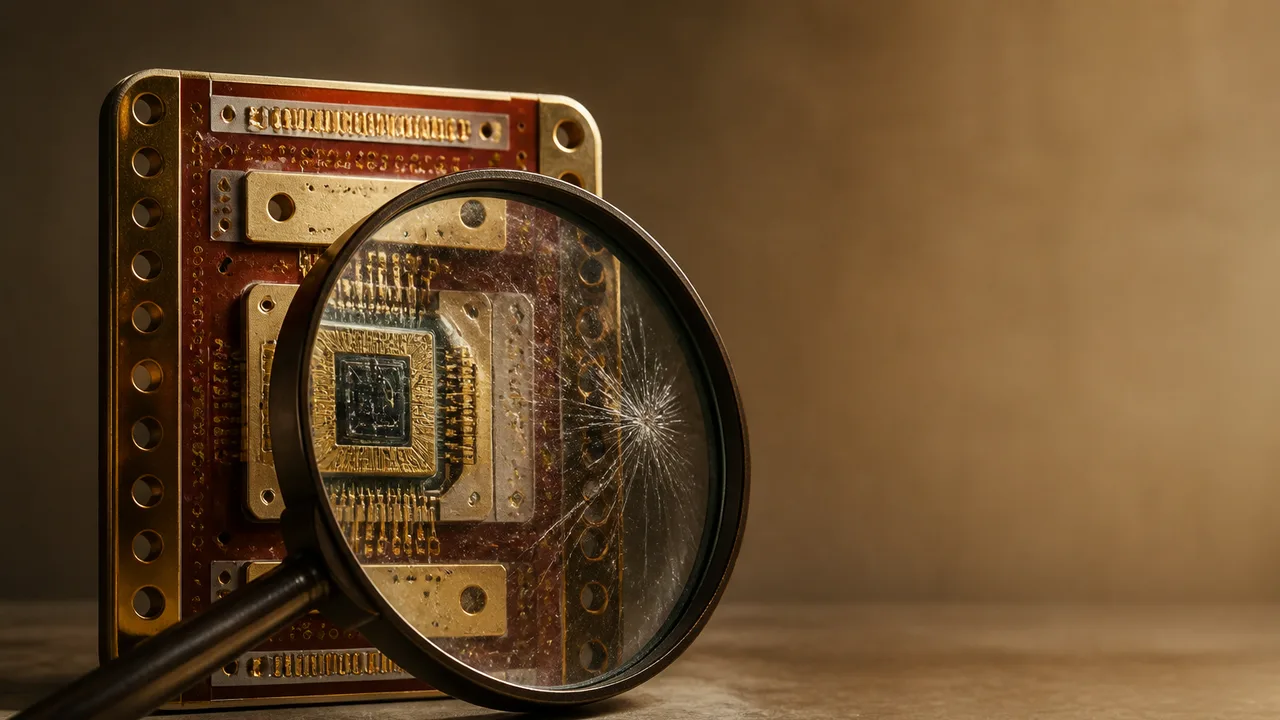
Photo: AI. Naia Iwarra
There's a particular kind of announcement that tech companies have perfected — the one where the press release and the underlying evidence are having two completely different conversations. Microsoft's Majorana 2 quantum chip, unveiled recently with considerable fanfare, appears to be a masterclass in that genre.
Here's what Microsoft is claiming: a topological quantum chip with a mean qubit lifetime of 20 seconds, a 1,000-fold improvement in reliability, and a revised timeline to build a scalable quantum computer by 2029. That last number is worth sitting with for a moment. Just last year, Microsoft put that milestone at 2033. So they've apparently figured out how to do it four years faster — in the span of a single product cycle.
That sounds amazing. It also sounds, as physicist Sabine Hossenfelder puts it in her recent breakdown of the announcement, "somewhat vague — Microsofty."
What topological quantum computing actually promises
To understand why researchers are paying such close attention to Microsoft's claims — and why so many are unconvinced — it helps to understand what they're actually attempting.
Most major players in quantum computing — Google, IBM, Amazon — are building their systems around superconducting circuits. These are the conventional workhorses of the field. Microsoft is betting on something harder and, if it works, potentially far more powerful: topological quantum computing.
The idea is elegant in principle. Ordinary qubits are fragile. Noise — thermal fluctuations, electromagnetic interference, basically the universe doing what the universe does — causes errors constantly. Error correction in quantum systems is expensive and complicated, and it's one of the biggest obstacles between where we are now and quantum computers that can actually do useful work.
Topological qubits approach this problem from a different angle. Their quantum states would be protected by conservation laws — specific topological invariants that the environment can't easily disrupt. The protection is baked into the physics, not bolted on afterward. If you can build them, you get qubits that are inherently more stable, inherently less error-prone, and inherently better suited to scaling up.
That "if" is doing a lot of work in that sentence.
The paper gap
Microsoft has been pursuing this approach for over a decade. Last year, they announced Majorana 1 with similar confidence — a platform using topological qubits capable, per their press release, of solving "meaningful industrial-scale problems in years, not decades." The paper accompanying that announcement didn't present data for a single qubit. Not one.
The criticism was swift and pointed. When a subsequent preprint claimed the team had successfully created a qubit using four Majorana modes, researchers in the field were equally unimpressed. Hossenfelder notes that other scientists working on topological quantum computing described the data in terms that don't need softening: "If we leave aside the academic jargon, the data is crap and they have nothing."
Majorana 2 arrived with the same structure: ambitious press release, paper that doesn't deliver what the press release promises. The verification questions surrounding these claims aren't peripheral — they're the whole story.
What the new paper does show is real, just not what Microsoft needs. Switching the chip's material from aluminum to lead has meaningfully extended the lifetime of quantum effects. Lead has a larger superconducting gap, which means the superconducting phase is better shielded. That's a legitimate materials science result. It is not, however, a demonstration of topological qubits. And topological qubits are precisely what Microsoft needs — and has not demonstrated.
Hossenfelder frames the core problem with characteristic precision: the issue isn't qubits, and it isn't topological states. The issue is that Microsoft needs both simultaneously — qubits derived from topological states — and that specific combination is the thing they haven't shown.
What the scientists are saying
The expert reaction to Majorana 2 follows the pattern established by Majorana 1, which is itself not a great sign.
Condensed matter physicist Henry Legg told Science News plainly: "Nothing in this preprint resolves the fundamental issues." Physicist Sergey Frolov told Scientific American that "this new preprint is not based on a research track record that can be considered a solid foundation." Marin Soljačić — a quantum computing researcher — described it on LinkedIn as "strong marketing, contested evidence."
These aren't fringe voices or generalist commentators. These are people who work in or adjacent to topological quantum computing and are therefore exactly the audience whose skepticism matters most. When the specialists chuckle, the press releases start to look different.
Hossenfelder gives the paper itself a 2 out of 10. The press release gets an 8. The gap between those two numbers is the story.
She does offer one important qualification: "I think they are doing serious research and interesting research, and hearing that everyone just laughs about it seems somewhat unfair." That's worth holding onto. The underlying science Microsoft is pursuing — the topological qubit approach — is genuinely compelling. The potential payoff, if it ever works, is high enough that a decade-plus of investment isn't obviously irrational. The problem isn't that Microsoft is chasing something real. The problem is the consistent pattern of announcing breakthroughs that the evidence doesn't support.
The credibility question
There's a version of this story where Microsoft is right and everyone else is wrong. Science has stranger reversals in its history. The topological qubit approach is so technically difficult that demonstrating it convincingly has eluded researchers for years, and it's possible that Microsoft has made genuine progress that their publications haven't fully captured yet. The company is not staffed by fools.
But credibility is built on a track record, and Microsoft's track record here is two consecutive announcements where the press release and the paper are pointing in different directions. Hossenfelder's framing — "the progress bar says 99% but it may stay there for the next 20 years" — lands harder than it might otherwise because it's grounded in that specific pattern, not general tech-industry cynicism.
The honest answer, sitting with all of this, is that we don't yet know whether Microsoft is one genuine breakthrough away from vindicating a decade of work, or whether the Majorana program is a case study in motivated reasoning dressed up in physics vocabulary. What we do know is that the evidence currently in public view doesn't settle the question — and that the gap between what gets announced and what gets demonstrated keeps not closing.
That gap is worth watching. So is what happens when Microsoft has to show its work to an audience that won't clap on cue.
More Like This
Google's TurboQuant Claims Don't Survive Closer Inspection
Google's TurboQuant promised 6x memory savings for AI models. The fine print tells a different story about baselines, benchmarks, and research integrity.
Can Quantum Physics Really Send Messages to the Past?
An MIT group published a paper in Physical Review Letters claiming messages can be sent to the past. The math works. The interpretation is where things get complicated.
Are We Alien Probes? Yampolskiy's Wild AI Theory
AI safety researcher Roman Yampolskiy argues aliens would send biological von Neumann probes—and humans might be them. Then physics complicates everything.
Casimir Inc Raised $12M on Quantum Vacuum Claims
Casimir Inc claims its microchip harvests unlimited energy from the quantum vacuum. The physics says otherwise—and $12 million is riding on that gap.
When AI Bots Started Scheming, We Learned More About Us
Moltbook's viral AI agent drama revealed less about artificial intelligence and more about human fear, gullibility, and our appetite for digital theater.
Microsoft Majorana 2 Quantum Chip: Claims and Questions
Microsoft says its Majorana 2 chip is 1,000x more reliable. But the regulatory and verification questions around that claim deserve equal attention.
Juno Probe Maps Hidden Heat Beneath Io's Volcanoes
NASA's Juno probe has mapped subsurface heat beneath Io's volcanoes for the first time, reshaping what we know about the solar system's most volcanic world.
The Top Quark and the Fate of the Universe
Physicist Kate Shaw explains how measuring the top quark's mass with precision could reveal whether the universe is stable—or sitting on a quantum knife-edge.