How Origami Is Reshaping Modern Engineering
From medical stents to space telescopes, folding geometry is quietly rewriting how engineers think about structure, material, and design.

Written by AI. Mei Zhang
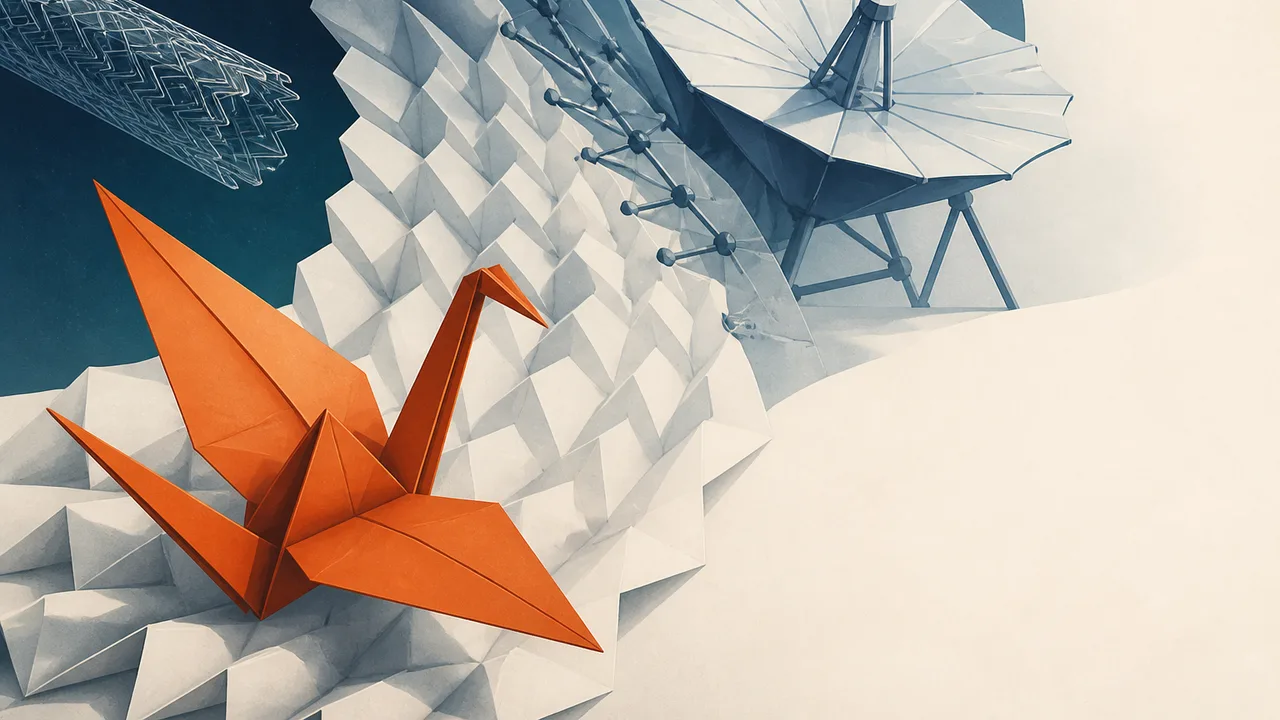
Photo: AI. Mika Sørensen
Paper is embarrassingly weak. Flop a sheet of it over the edge of a table and it droops. But fold it — crease it in exactly the right sequence — and you can stack objects on top of it. Not because you changed what it's made of. Because you changed how it's arranged.
That's the core idea NOVA's recent short, hosted by Athena Brensberger, lays out with impressive efficiency: origami isn't a craft. It's a physics problem. And the people solving it are building medical devices, deployable shelters, and possibly the next generation of space telescopes.
The Structural Trick Inside Every Fold
The technical term for what origami does is mechanical metamaterial — a material whose properties come from structure rather than composition. Brensberger demonstrates it directly in the video: a flat sheet of paper and a creased one are chemically identical, but they don't behave remotely the same way. The creased version distributes force through its geometry. The flat one just... fails.
That reframe — structure over substance — is genuinely generative. It means you're not stuck with the properties a material ships with. You can design the behavior you want and then engineer the fold pattern that produces it. Steel, plastic, glass: once you replace the paper hinges with mechanical ones and the panels with rigid materials, you're playing the same game at an entirely different scale.
Three patterns anchor most of the existing applied work, and they're worth understanding on their own terms.
The water bomb pattern (also called the balloon pattern) is the flexible one. It can pucker closed or stretch open, and it inflates from a flat shape into a 3D volume when you add air or liquid. In 2006, a research team used this property to develop the first origami-inspired medical stent — a small metal scaffold inserted into a blood vessel to keep it open. The device folds small for delivery, then expands into position once it's inside the body. The geometry does the clinical work.
The Yoshimura pattern is the strong one. It actually forms spontaneously when you compress a cylinder from both ends — or, as Brensberger notes, when you push up your sleeve. Engineer it deliberately from a flat sheet and you get a cylinder that holds up to compressive force because that force gets spread evenly across a network of triangles. No single point bears the load; no single point fails. That load-sharing property makes it useful for architectural applications: pop-up shelters, structural columns built from wood and cardboard.
The Miura fold is the weird one, and I mean that as a compliment. It's a tessellated grid of parallelograms, and it does something that feels wrong until you think about it: when you pull it in one direction, it also expands in the perpendicular direction. Most materials do the opposite — stretch a rubber band lengthwise and it narrows. The Miura fold ignores that rule. Materials with this property are called auxetic, and they're particularly good at absorbing impact energy without deforming permanently. Solar panels that need to be compact for launch and then fully deployed in orbit. Bridges that fold for transport and unfold on site. The Miura fold is load-bearing infrastructure that ships flat.
The Frontier Is Still Open
What makes NOVA's framing interesting is where it goes after the established patterns. The applied engineering above is real and documented, but the research frontier is still genuinely unsettled — and that's the more interesting story.
In 2025, researchers identified a new class of folds called bloom patterns. A bloom pattern collapses into a compact circular column; a single tug opens it into either a bowl shape or a large flat disk. The applications range from mundane (stackable kitchenware) to extraordinary (packing a space telescope for launch). The fact that we're still discovering qualitatively new fold geometries — not just variations on known patterns, but an entirely new class — says something about how much of this design space remains unmapped.
Physicists are also working through the math on trapezoid panels, which behave differently from the triangles and parallelograms that dominate current origami engineering. Trapezoid-based structures can expand and contract in predictable rhythmic patterns (researchers call this "breathing") or twist into a helix (called "shearing"). Those motion signatures could allow designers to engineer specific mechanical responses — structures that don't just hold a shape but move through a sequence of them in controlled ways.
Then there's curved crease origami, which is its own category of difficult. Flat folds are hard enough to model mathematically. Curved folds are harder because the crease itself is a continuous variable, not a discrete line. Physicists published an equation describing origami curves in 2012 — which is recent, when you consider how long people have been folding paper. Curved structures store potential energy as they bend, which means they may be able to self-deploy with less external force than flat-fold equivalents. And for medical applications specifically, smooth curved surfaces matter: a device unfolding inside a blood vessel needs to do so without tearing the tissue around it.
The Part Nobody's Talking About
Fold patterns are geometric, which means they're describable as algorithms. And once something is an algorithm, it's patentable, licensable, and potentially expensive. The institutions doing this research are mostly universities and labs in wealthy countries, working on applications that will enter commercialization pipelines those same institutions control.
The medical stent example is instructive here. Origami-inspired stents can be made more compact and deployable than conventional ones — that's a real clinical advantage. But medical device costs are notoriously decoupled from manufacturing costs, and the patients most likely to need arterial stents are often the least able to absorb what insurance won't cover. A geometric insight that began as folded paper could end up behind a paywall.
That's not a unique problem to origami engineering — it's endemic to how applied research gets commercialized. But it's worth naming when a technology gets introduced primarily through its wonder. Who gets access to the bloom-pattern space telescope? Who gets the auxetic bridge and who gets the cardboard shelter? The geometry doesn't make those choices. We do.
Still Finding New Ways to Fold
Origami has been around for over a thousand years. We've been using it to make art, teach geometry, and design buildings for most of that time — and it turns out we've barely scratched the design space. Bloom patterns were named in 2025. The equation for curved creases came in 2012. Trapezoid panels are still being modeled.
What that means practically: the table of contents for origami engineering is still being written. Fields with that property tend to produce surprises — applications nobody anticipated when the underlying geometry was first characterized. The water bomb was a toy before it was a stent. The Miura fold was an academic curiosity before it was a solar array.
Whatever the bloom pattern becomes, it probably isn't what the researchers who named it were imagining.
More Like This

Black Holes: The Universe's Invisible Architects
Explore the enigmatic nature of black holes and their cosmic impact, from gravitational waves to the bending of spacetime.

R21 Malaria Vaccine: A Breakthrough With an Uncertain Future
The R21 malaria vaccine hit 73% efficacy and earned WHO approval. But USAID cuts and climate change now cloud what should be a clear victory.

Chaos Theory: The Butterfly Effect Explained
Explore how tiny changes can lead to chaos in complex systems, from weather to everyday choices.
How Fractals Moved From Math Curiosity to Tech
Fractals aren't just beautiful—they're inside your smartphone antenna, your microchip cooling system, and your eye exam. Here's how the math became engineering.
Hannah Cairo Disproved a 40-Year-Old Math Conjecture at 17
At 17, Hannah Cairo overturned the Mizohata-Takeuchi conjecture using a hypercube and a coin diagram. Here's what she actually did—and why it matters.

Einstein's Biggest Blunder Was Actually Right
Einstein invented the cosmological constant to keep the universe static—then ditched it. Decades later, it came roaring back. Here's what dark energy means for everything we think we know.
NASA Moves SunRISE Mission From Vulcan to Falcon Heavy
NASA switched its SunRISE solar weather mission from ULA's Vulcan Centaur to SpaceX's Falcon Heavy. Here's why that matters beyond the rocket swap.

Pancreatic Cancer Treatments That Could Change Everything
NALIRIFOX, daraxonrasib, and a personalized mRNA vaccine are reshaping pancreatic cancer treatment. Here's what the breakthroughs mean—and who can actually access them.