Penguin Poop Is Shaping Antarctica's Climate
New research reveals penguin colonies release ammonia that seeds cloud formation over Antarctica—a feedback loop with real consequences for the continent's climate future.

Written by AI. Olivia Meng
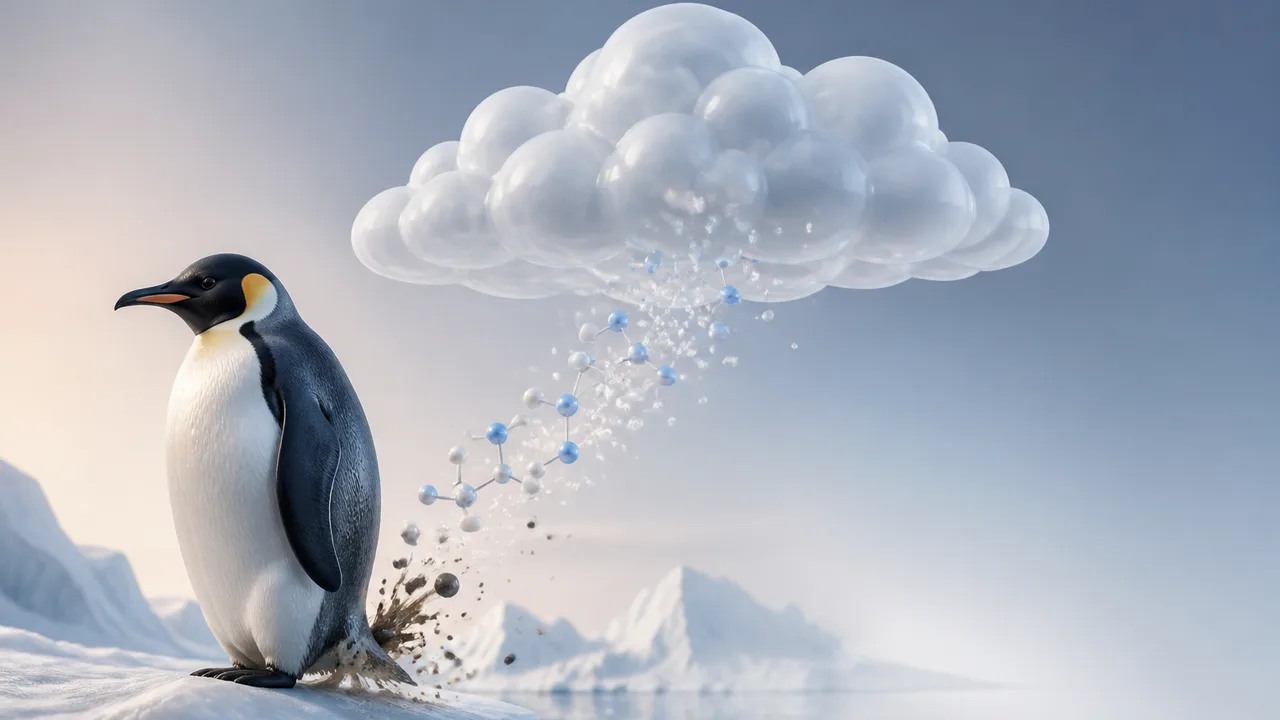
Photo: AI. Ren Takahashi
Antarctica is, technically, the world's largest desert. It receives almost no precipitation in its interior, hosts virtually no vegetation, and produces almost none of the atmospheric particulates—industrial emissions, decaying plant matter, windblown dust—that seed cloud formation elsewhere on Earth. What it does have, in extraordinary quantities, is penguins. And penguins, as a recent episode of SciShow lays out with commendable precision, produce an industrial quantity of waste.
That waste may be doing something genuinely remarkable.
The Mechanism: From Guano to Cloud
The chain of causation here is worth following slowly, because it's easy to hear "penguin poop makes clouds" and file it under charming science trivia. That would be a mistake.
Clouds don't form from water vapor alone. Water vapor needs something to condense onto—a particle, typically measured in nanometers, around which droplets can organize. These are called cloud condensation nuclei, and in most of the world they're supplied by the usual cast of atmospheric suspects: sea salt, dust, soot, organic compounds from vegetation. Antarctica, stripped of almost all of that, runs on a much narrower feedstock.
What Antarctica does have is phytoplankton in the surrounding ocean, which emit dimethyl sulfide. That compound reacts in the atmosphere to become sulfuric acid. On its own, sulfuric acid can initiate particle formation, but slowly. What accelerates the process is ammonia—and ammonia, in Antarctica, comes overwhelmingly from penguin guano.
As SciShow host Savannah Geary explains: "In Antarctica, many of the particles that go on to become cloud condensation nuclei are thought to start as clusters containing sulfuric acid and ammonia." The ammonia doesn't need to be abundant. The particles it helps create only need to reach a few dozen nanometers in diameter before water vapor can begin condensing on them—roughly one-thousandth the width of a human hair. Small cause, potentially large effect.
A 2025 study, cited in the video, put instruments near two penguin colonies at an Antarctic research station and tracked what happened when the wind shifted. When it blew in from the direction of the colonies, airborne ammonia concentrations rose—and new particle formation followed. When the wind came from elsewhere, neither occurred. The directionality isn't subtle. It implicates the penguins clearly enough that the researchers felt confident connecting the dots, even if the full atmospheric picture still requires more mapping.
The same study also detected dimethylamine, an amine compound that—in small quantities—accelerates the formation of ammonia-sulfuric acid particles. The researchers couldn't confirm its source, but the concentrations tracked the wind patterns from the colonies. Penguin guano is a known producer of amines. The inference isn't proven, but it isn't much of a leap.
The Persistence Problem—and the Reach
Here's where things get more interesting, and more complicated.
Ammonia itself is short-lived in the atmosphere. Once it's up there, it reacts and disperses relatively quickly. But the particles it helps create with sulfuric acid are sturdier. They persist. And because Antarctica is a continent with significant wind systems, those particles don't stay near the colony that produced them. A 2024 study cited in the video suggests that ammonia emissions from guano can spike during periods of freeze-thaw cycling—when temperatures oscillate above and below freezing across the course of a single day. As Antarctic temperatures become more variable under climate pressure, that dynamic becomes harder to predict.
The result: penguin colonies may be seeding cloud formation well beyond their immediate geography. As Geary puts it, "penguin poop could affect cloud cover far from their homes." This is not a local phenomenon. It's potentially a continental one.
What the researchers haven't fully resolved—and this is worth sitting with—is whether that cloud cover is a net thermal benefit. Clouds are not simple actors in the climate system. They reflect incoming solar radiation back into space, which cools the surface below. But they also trap outgoing longwave radiation, which warms it. The balance between those two effects depends on cloud type, altitude, thickness, and a dozen other variables. More cloud cover over Antarctica is not automatically more cooling. The science here is genuinely unsettled.
The Feedback Nobody Planned For
There is a feedback loop embedded in all of this that deserves more attention than it typically receives.
Climate change is already shrinking some Antarctic penguin populations. Species like the emperor penguin and several Adélie penguin colonies face habitat disruption tied directly to sea ice loss and shifting prey distributions. Fewer breeding pairs means smaller colonies. Smaller colonies mean less guano. Less guano means less ammonia. Less ammonia means fewer cloud condensation nuclei. Fewer cloud condensation nuclei could mean reduced cloud cover. And reduced cloud cover over Antarctica means more solar radiation reaching the surface—which accelerates the warming that shrank the penguin population in the first place.
This is what an ecological feedback loop looks like when it runs in reverse. The system that may have been providing a modest cooling buffer could, under sustained pressure, begin to erode that buffer in proportion to its own degradation. No single step in that chain is certain. The endpoint of the loop hasn't been modeled with enough precision to quantify. But the directionality—the general shape of what might happen—follows a coherent logic.
Geary frames the conservation argument plainly: "Fewer penguins means less penguin poop, which could then mean fewer clouds. Even though we don't understand their effects yet, this is a strong argument for protecting penguin populations. They might protect a whole continent in turn."
That's a significant claim, and the video is careful not to overstate it. The word "might" is doing real work there. The research linking penguin ammonia to particle formation to cloud formation to temperature regulation is a chain of plausible mechanisms, not a closed loop of confirmed effects. Each link has supporting evidence; the whole chain has not yet been validated end-to-end.
What the Research Does and Doesn't Establish
It's worth being precise about the state of knowledge here, because the story is genuinely interesting without being inflated.
What's established: penguin colonies produce substantial ammonia; that ammonia reaches the atmosphere; airborne ammonia levels rise when winds blow from colony directions; new particle formation correlates with those ammonia plumes; the particles produced are the right type and scale to become cloud condensation nuclei; ammonia contributions to cloud formation in Antarctica have been documented in scientific literature since at least 1998.
What's not yet established: the quantitative contribution of penguin-derived clouds to Antarctic albedo; whether that contribution meaningfully offsets warming at a continental scale; how the feedback loop would behave under specific emissions scenarios; and what the net cloud effect (cooling vs. warming) actually looks like when measured rather than modeled.
That gap—between what is plausible and what is demonstrated—is where a lot of important Antarctic climate science currently lives. It's not a gap that diminishes the finding. It's the honest frontier.
A Continent's Unexpected Stakeholders
Antarctica tends to appear in climate coverage as a place things happen to—ice sheets retreat, sea levels respond, the continent registers the consequences of decisions made everywhere else. The penguin-ammonia-cloud research complicates that framing, not by suggesting Antarctica is insulated from outside forces, but by revealing that the continent's own biology may be a non-trivial participant in its thermal regulation.
The implication for how we think about conservation is subtle but real. Protecting penguin populations has always had straightforward ecological justifications. They're a keystone species in the Southern Ocean food web. Their population health is an index of ecosystem integrity. Those arguments remain intact. What's now being added to the ledger is a potential climate service—diffuse, uncertain in magnitude, but mechanistically coherent.
Whether that service is large enough to register in the accounting of Antarctic climate dynamics is a question for the next several years of research. The 2025 study and the 2024 emissions work suggest the scientific community is starting to take the question seriously enough to instrument it properly.
The penguins, for their part, are unaware of the stakes. They are doing what they have always done: eating, breeding, and generating waste in prodigious quantities. The question is whether the systems downstream of that waste are as consequential as the emerging evidence suggests—and whether we'll have enough penguins left to find out.
More Like This
How the Asteroid Impact Ended the Dinosaur Era
Explore the catastrophic asteroid impact that ended the dinosaurs, its immediate aftermath, and the long-term environmental changes.
Understanding the Real Risk of Brain-Eating Amoebas
Explore the facts and myths surrounding brain-eating amoebas. How real is the threat, and can climate change affect its spread?

Amazon's Gas Plant Bet Clashes With Its Climate Pledge
Amazon confirmed it's backing a massive Texas gas power plant that could become the US's biggest climate polluter — while still promising net-zero by 2040.
Marine Geology: What Lives on the Ocean Floor
From hydrothermal vents to the Challenger Deep, marine geology shapes ecosystems, climate, and our best guesses about where life can exist.

The Bahia Emerald: A Geological Oddity and Legal Nightmare
The Bahia emerald weighs 340 kg and has at least 14 claimants. Its story spans geology, fraud, Hurricane Katrina, and a restraining order on the rock itself.
Whales Are Moving Into Ice-Free Greenland Waters
As Arctic sea ice retreats, baleen whales are staging seasonal feeding frenzies off East Greenland—signaling a profound marine ecosystem shift.
The Aurochs Is Gone. Should We Bring It Back?
The wild ancestor of cattle vanished in 1627. Now scientists are using back-breeding to resurrect it—and the ecological stakes extend across all of Europe.
Spain's 2026 Total Solar Eclipse: Best Cities to Watch
On August 12, 2026, a total solar eclipse crosses Spain. Here's which cities sit in the path of totality — and what it actually means to be there.