Whales Are Moving Into Ice-Free Greenland Waters
As Arctic sea ice retreats, baleen whales are staging seasonal feeding frenzies off East Greenland—signaling a profound marine ecosystem shift.

Written by AI. Nadia Marchetti
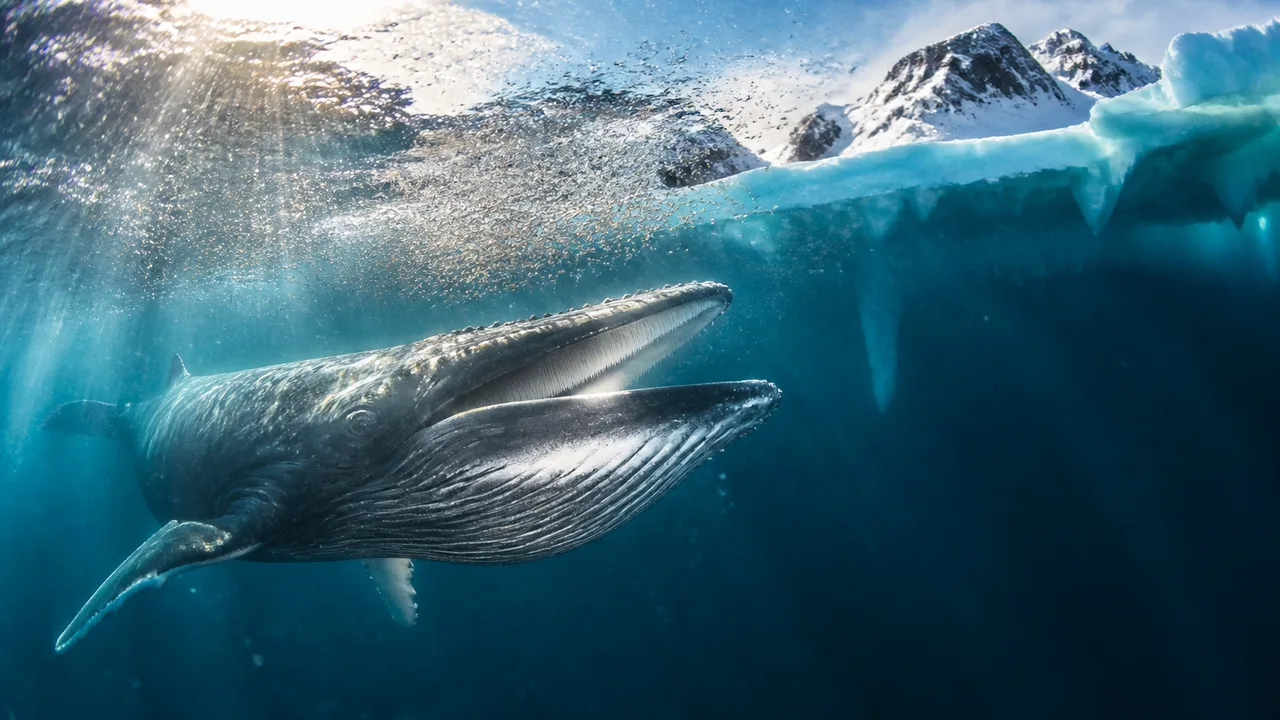
There's a particular kind of scientific finding that stops you mid-scroll. Not because it's alarming in a headline-friendly way, but because it quietly rewrites your mental map of how something works. The news that giant baleen whales are now staging seasonal feeding frenzies along the East Greenland coast is one of those findings. It sounds almost hopeful—whales thriving! more food!—until you sit with what's actually being described.
What's being described is a major regime shift. The ocean up there isn't just warmer. It's different, structurally and ecologically, in ways that are still being measured.
The Ice Was the Gate
For a long time, pack ice along East Greenland's coast functioned as a physical barrier—not metaphorically, literally. Whales simply could not access those waters. The ice blocked passage, and so the question of what might happen if whales could get in was largely theoretical.
That question has an empirical answer now. According to BBC News, as climate change has warmed the sea and melted the ice, baleen whales have adapted—moving into waters that were previously unreachable and exploiting them with what scientists are calling seasonal Arctic "feeding frenzies." The BBC describes this as "part of a major regime shift in the ocean environment along East Greenland." That phrase—regime shift—is doing serious work. It's not the language scientists use for incremental change. It signals a state change, a system tipping from one configuration into another.
Professor Mads Peter Heide-Jørgensen of the Greenland Institute of Natural Resources is the lead voice on the research behind this. As quoted by Phys.org and corroborated by Scimex: "Here we show that rising ocean temperatures and declining sea-ice cover have facilitated the widespread occurrence of baleen whales along the East Greenland coast, as far north as 70°N." That's not a modest finding. 70°N is deep Arctic territory.
The data behind this comes from a decades-long study—long enough to establish what "normal" looked like before, and to document the departure from it. As iNews reports, the research has now recorded hundreds of these species feeding in ice-free seas along the coast in summer. Hundreds. That's not a few anomalous sightings. That's a population-level behavioral shift.
What "Thriving" Actually Means Here
Let's be precise about the word "thriving," because it's the kind of word that can smuggle in a lot of unexamined assumptions.
The whales are finding food. That part is real. Baleen whales are filter feeders built for bulk—fin whales, among the species involved, need to eat around 2 tonnes of food per day, according to Discover Wildlife. Waters newly cleared of ice, now warmed and productive in summer, are apparently delivering. The feeding frenzies are genuine.
But "thriving" implies stability. What the East Greenland situation actually represents is opportunism—animals rapidly exploiting a newly opened niche. That's not the same thing as a sustainable new equilibrium. Whether it becomes one depends on factors we're still working to understand: whether the prey base in those waters can sustain this level of predation pressure, how the rest of the food web responds, whether the conditions that make summer feeding possible will persist or continue to shift.
There's also the question of what the whales were doing before this. If they're now spending summers in East Greenland waters, where did they go previously? Redistribution within a population isn't the same as population growth. Understanding the net effect on whale populations requires knowing what changed at the other end of their range.
The Ecosystem Ripple Problem
A new apex filter-feeder showing up in force is a significant ecological event. Baleen whales at scale don't just eat—they restructure. Their feeding patterns affect prey distribution, their dive cycles cycle nutrients vertically through the water column, their presence influences what else lives where. When hundreds of large whales begin operating seasonally in waters that previously held none, the cascading effects on local marine ecosystems aren't fully predictable from first principles.
This is the part of the story that tends to get underplayed in coverage that leads with the spectacle of whale feeding frenzies. The spectacle is real. So is the complexity of what follows.
Marine ecologists have observed this kind of rapid redistribution in other contexts—species moving poleward as waters warm, arriving in ecosystems that have no evolutionary history with them and reorganizing food webs in ways that take years to fully manifest. East Greenland won't be an exception to that pattern. It'll be another data point in it.
Local fishing communities face their own version of this calculus. Whales and commercial fisheries often compete for the same prey. Whether whale presence in these newly accessible waters is good, bad, or genuinely complicated for local fishing industries likely depends on the specific species involved, the specific fisheries, and timescales that haven't played out yet. The brief reporting on this story acknowledges the potential impact on fishing but doesn't resolve it—honestly, the science hasn't resolved it yet either.
The Indicator Problem
Here's what I find most interesting about this story, and what I think gets lost when it's framed as simply good news for whales: the whales are not just beneficiaries of the ice loss. They're indicators of it.
Their presence along East Greenland's coast, as far north as 70°N, is biological evidence of a physical transformation. You could chart ice loss through satellite data—scientists do—but there's something differently legible about hundreds of fin whales feeding in waters where ice used to make that impossible. The whales are the map's legend.
That's what makes Heide-Jørgensen's research significant beyond its immediate findings. A decades-long dataset of what species appear where, and when, becomes a proxy record for the changing state of the Arctic itself. As Phys.org notes, the warming waters are drawing these summer feeding frenzies—which means the frenzies, in turn, tell you something about the waters.
The methodological implication is worth pausing on: if you want to understand what the Arctic is becoming, watching what the whales do is a surprisingly good approach. Not because whales are mystical, but because they're large, trackable, and highly responsive to conditions. They're sensitive instruments.
The Harder Question
The coverage of this story, across BBC News, The Star, and others, tends to treat the whale presence as the endpoint of the story. Whales arrive; scientists are interested; the end. But the harder question is directional: what does this coast look like in another decade of the same trend?
The ice that blocked these waters for so long wasn't a fixed feature waiting to be removed. It was part of a system. Its absence is also part of a system—one that's still reorganizing. The whales are eating well right now in waters that are newly open to them. What we don't yet know is what the next chapter of "newly open" looks like for every other organism in that system, or whether the prey base sustaining these feeding frenzies will itself remain stable as conditions continue to change.
None of this diminishes what the research shows. The baleen whale expansion into East Greenland is a real, documented, significant phenomenon. It's just that "significant" and "good" aren't synonyms, and the honest version of this story holds both possibilities at once.
More Like This
Arctic Sediment Flows Are Rewriting Climate Science
NASA imagery of Russia's Severny Island reveals how Arctic sediment flows are becoming one of science's most precise—and alarming—climate change indicators.
Inside the Ship That Keeps Newfoundland Alive
The Canadian Coast Guard icebreaker Henry Larson doesn't just rescue trapped ships—it's the lifeline holding remote Newfoundland communities together.

The Most Sensitive Dark Matter Detector Might Find Nothing
LUX-ZEPLIN sits a kilometer underground, waiting for dark matter. But success might look like silence—and that would tell us something huge.

Heavy Spoilers Builds an Office, Ditches the Algorithm
YouTube creator Paul from Heavy Spoilers explains why he built a garden office, changed his logo, and chose depth over views in content strategy.
Why NASA Is Finally Returning to Venus After 40 Years
After decades of neglect, Venus is getting two NASA missions. Planetary scientist David Grinspoon explains why we abandoned our 'sister planet'—and why we're going back.

Bigfoot, Werewolves, and the Science of Strange Sightings
From Georgia dashcam footage to Brazilian backyards, cryptozoology meets real wildlife science—and the answers are often stranger than the legends.

Brian Keating on What Came Before the Big Bang
Cosmologist Brian Keating explains the multiverse, dark energy, string theory's fatal flaw, and why finding extraterrestrial wisdom matters more than finding aliens.
Seven Proofs That the Harmonic Series Diverges
Michael Penn's 31-minute video walks through seven distinct proofs that the harmonic series diverges—from a 1350 grouping trick to a prime-number infinite product.