Bigfoot, Werewolves, and the Science of Strange Sightings
From Georgia dashcam footage to Brazilian backyards, cryptozoology meets real wildlife science—and the answers are often stranger than the legends.

Written by AI. Priya Sharma
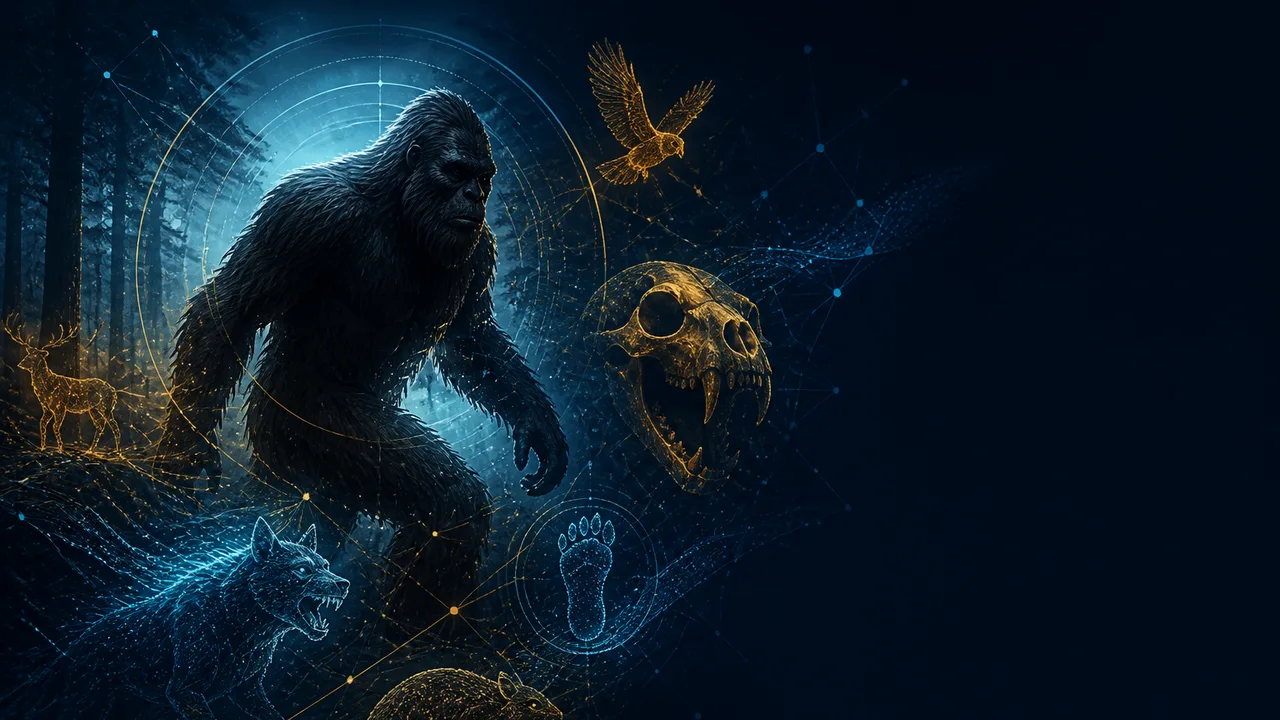
Photo: AI. Dante Nwosu
A cop's dashcam rolls on a dark stretch of highway in Georgia's Chattahoochee forest. Something large and dark crosses the road on what appears to be two legs, moving fast enough that it vanishes into the tree line before anyone can react. Deputy Sheriff TJ Alexander, who was behind the wheel, describes his reaction plainly: "I was kind of scared cuz I didn't know what I was dealing with."
That footage, and five others like it from around the world, form the spine of a recent Science Channel episode that does something slightly more interesting than the typical creature-feature format: it actually lets the experts disagree with each other.
The show's instinct—assemble investigators with real credentials, run the footage through actual analysis, test physical hypotheses—is sound. Its execution is uneven, in the way that all cryptozoology programming is uneven, because the subject matter is constitutionally resistant to resolution. What the episode does illuminate, somewhat accidentally, is how much the gap between "unknown" and "impossible" matters—and how often those two categories get collapsed.
What the Footage Actually Shows (and Doesn't)
The Georgia case is the cleanest example of the show's analytical approach, and also of its limitations. Investigator Joe Nickel slows the dashcam footage and reads the gait: the creature scrambles, rises almost upright, then drops back to all fours before disappearing. His conclusion is a bear. Explorer Matt Puit, who studies bears in the region, allows that black bears are common in the area but finds the stride length incompatible with a bipedal bear—the animal covers the road too quickly, in too few steps.
A gorilla is briefly floated. Historian Jeffrey Wells notes that there is a primate sanctuary near the area and a zoo in Atlanta, and that an escaped gorilla is, theoretically, not impossible. Puit checks incident records and finds no reported escapes. Then Puit tips his hand: he believes he once came face to face with Bigfoot at age 17, in a dense forest where he heard branches being ripped from trees and saw "two big almond-shaped reflective eyes." His analytical detachment curdles into advocacy at a certain point, which is worth noting when weighing his skepticism about the bear hypothesis.
The case resolves itself without the need for a cryptid. Sheriff Stacy Gerard returns to the scene, finds beer cans near the sighting location, and eventually locates students nearby with a large fur costume in their yard. "They had thought it was a fun gag," Gerard says, "and they had been doing it a few nights." No Bigfoot sightings in the area since.
The lesson here isn't that Bigfoot doesn't exist. It's that a solved case is a solved case, and the solution is usually mundane. That's not anticlimactic—it's actually how evidence works.
The Anatomy of a Werewolf
The Brazilian segment, filmed in a rural community north of Rio de Janeiro, is the episode's most methodologically interesting. A backyard security camera captures a shadowy figure with what appears to be an elongated snout, staying in the shadows as it moves. Local livestock have been turning up dead. The radio station is flooded with calls.
Zoologist Darren Naish does something the other experts don't: he takes measurements. Freezing the footage, he compares the figure's upper and lower arm lengths and finds a ratio of approximately 1:1—the characteristic proportion of Homo sapiens. "This footage basically has all the hallmarks of an elaborate prank," Naish concludes. But a prank isn't the only human explanation. Biologist Kelly Price raises hypertrichosis, a genetic condition sometimes called "werewolf syndrome" in which hair grows across the entire body, including the face and eyelids. Fewer than 100 cases have been recorded. A psychological condition called clinical lycanthropy—in which a person genuinely believes they have transformed into a wolf—is also raised, though notably it's harder to film yourself acting like a wolf if you actually believe you are one.
The counterargument to the human hypothesis is anatomical: if the figure is on all fours, its rear legs should show bent joints, and they don't appear to. The investigators land in the honest position that the footage alone is insufficient. "I don't think we're going to get to the bottom of whatever this creature is based on this footage alone," one expert admits. That's the correct conclusion. It's rarer than it should be in this genre.
The Alberta Log-Thrower
Alberta, 2015. Construction workers at a remote site film something in the morning mist that appears to hurl a large piece of timber a considerable distance through the air. Former NYPD image analyst Connor McCort runs enhancement software on the video and confirms the figure is real—no obvious cuts or digital effects—but cannot identify it. "Whatever that thing is is super strong," he says.
Hollywood ballistics expert Matt Kutcher sets up a physical experiment to test whether a human could produce that kind of throw, using a pneumatic car-flipping rig. By his own estimates—and these are his estimates, presented on screen, not independently verified figures—the force required to move the log the distance seen in the footage would be orders of magnitude beyond what a person could generate. Kutcher's conclusion: "There's got to be something we're missing in this video."
The episode cycles through candidates: a grizzly bear (strong enough, but wrong anatomy for an overhand throw), a silverback gorilla (dexterous and powerful, but not native to Alberta and none reported missing), an experimental exoskeleton suit being field-tested in a logging environment. Military historian Marty Morgan raises the Guardian XO suit—a real piece of technology under development for industrial use—as a plausible explanation for superhuman apparent strength in a remote work site.
None of these explanations is confirmed. The footage remains genuinely ambiguous, which is either the honest outcome or the production value, depending on your level of cynicism.
The Texas Hybrid and the DNA That Settled It
The most scientifically grounded segment involves a hairless, dog-like animal captured on a Texas deputy's dashcam in Duval County. The creature's appearance is striking enough that local legends about the chupacabra—a blood-draining predator deeply embedded in South Texas and Mexican folklore—are immediately invoked.
What makes this case different is that it eventually yields physical evidence. The animal is later struck by a vehicle and recovered. Dr. Phyllis Canyon, a local rancher who had lost 28 chickens to a predator draining their blood but leaving the meat, hires a taxidermist for reconstruction and submits a tissue sample to veterinary forensics experts at UC Davis. The results: coyote on the maternal side, Mexican wolf on the paternal side. No match to any single species in the DNA database.
This is the episode's most satisfying resolution, and also its most genuinely interesting science. The "chupacabra" of South Texas appears to be a coyote-wolf hybrid exhibiting unusual morphology—possibly from mange, possibly from in-utero chemical exposure given the agricultural density of the region, possibly from the hybridization itself. The creature is not mythological. It is a real, documented animal with a genetic profile that doesn't fit neatly into existing categories. Dr. Canyon's assessment: "It does not fit any animal that we have in our DNA bank." That's not a supernatural claim. It's a taxonomic puzzle that happens to wear a terrifying face.
When Wolves Stop Being Afraid of You
The episode's final segment is the one with the most immediate practical stakes. A man walking his dog near Stony Rapids, Saskatchewan films something large and aggressive moving through the trees, which then charges the dog. The animal appears to be a wolf.
What follows is less cryptozoology and more genuine wildlife science. The episode notes—supported by National Post reporting on wolf behavior in northern Saskatchewan—that the region has documented multiple wolf attacks on adult men over a twelve-year period, one of them fatal, a pattern starkly unusual against the backdrop of the rest of Canada, where lethal wolf attacks on humans have been essentially absent for decades. Researchers studying wolf behavior on Vancouver Island found, according to Hakai Magazine, 51 dangerous wolf encounters over a six-year period. The common thread is human encroachment: as logging, mining, and other industries push deeper into wilderness areas, wolves habituate to human presence and lose the wariness that normally keeps encounters rare.
"As wolves observe humans up close," one expert explains, "they lose their fear of us and see us instead as a feast."
This is not a cryptid problem. It is an ecological one. The direwolf hypothesis—these prehistoric canines were roughly 25% larger than modern grey wolves and are known from fossil records across North America—gets a brief airing before the show's own experts acknowledge that a 2021 study found direwolf DNA to be genetically distant from any living canid, making de-extinction essentially a non-starter with current technology. The Saskatchewan wolf is almost certainly a wolf. The disquieting part isn't what species it belongs to. It's why it no longer considers humans off-limits.
Across six cases and nearly an hour of footage analysis, the pattern that emerges is less about monsters and more about the widening frontier between human territory and everything beyond it. Most of the creatures in this episode have mundane explanations—costumes, hybrids, habituated predators, ambiguous shadows in bad light. The ones that don't have mundane explanations simply don't have any explanation yet, which is a different condition entirely. The wilderness hasn't run out of surprises. We've just gotten better at walking into it.
More Like This

Crafting Supercars: The Science Behind Speed and Style
Explore how supercars like Alfa Romeo 4C and Aston Martin Vanquish are meticulously crafted using cutting-edge materials and precision engineering.
Texas Chupacabra Sighting Explained by DNA Analysis
A Texas police dash cam captured a bizarre creature in 2008. DNA testing later revealed what it actually was — and the answer is stranger than fiction.
The Aurochs Is Gone. Should We Bring It Back?
The wild ancestor of cattle vanished in 1627. Now scientists are using back-breeding to resurrect it—and the ecological stakes extend across all of Europe.
Project X-Ray: The WWII Bat Bomb That Almost Worked
In WWII, the U.S. military spent $2 million strapping incendiary bombs to bats. The plan was absurd. It was also, frustratingly, not entirely wrong.

Mars, Enceladus, and the Search for Life
From Mars's vanishing water to Enceladus's hidden ocean, planetary science is reshaping our understanding of where life might exist.

Exploring Conspiracies and Wolves: Reality vs. Belief
Dive into conspiracy theories and the impact of reintroducing wolves, with insights from Joe Rogan and Andrew Wilson.

Fire Tornadoes on a Lake: The Bardstown Bourbon Disaster
In 2003, fire tornadoes erupted on a Kentucky lake. The cause wasn't paranormal—it was 800,000 gallons of burning bourbon and the right wind geometry.

The Maths Behind Palindrome Ages Explained
Mathematician Kat Phillips unpacks why some pairs of people have reversible ages—and the surprisingly elegant number theory that governs when it happens.