The Peasants’ Revolt Exposed England’s Tax and Labor Crisis
England’s 1381 Peasants’ Revolt united anger over poll taxes, wage controls and serfdom. Richard II broke his promises; the old labor order still weakened.

Written by AI. James Morrison
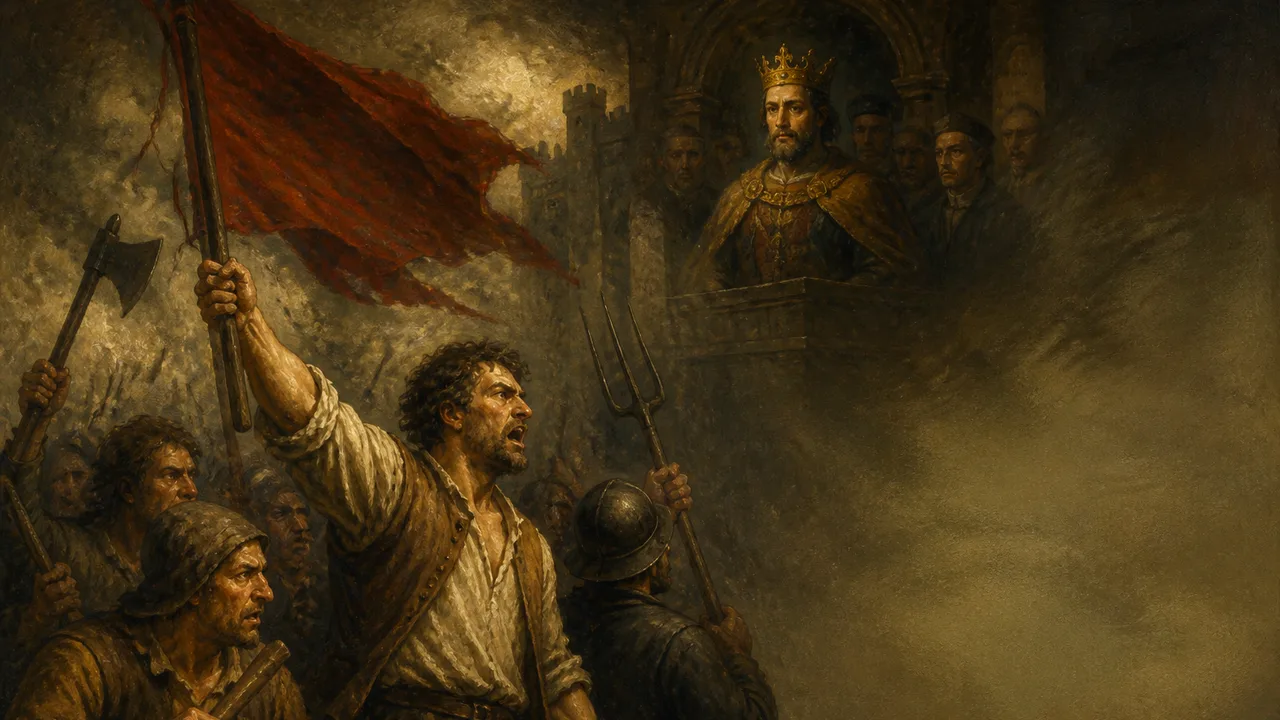
In 1381, English rebels destroyed records of taxes, debts and labor duties. They also burned manor houses and attacked unpopular landowners. The records were instruments of power: they documented what people owed and gave landlords and officials grounds to demand it. Burning them could erase a claim on a household’s labor, at least until someone found another way to enforce it.
The uprising known as the Peasants’ Revolt spread across parts of England and brought rebels into London to confront King Richard II. A poll tax helped ignite it. The demands that followed reached further, toward an end to serfdom and greater freedom to work. Richard made promises to rebel representatives; after rebel leaders were killed or captured, the crown suppressed the rising and withdrew its concessions. The revolt failed in its immediate aims, while the labor system it challenged continued to weaken over time. Those outcomes belong in the same history, without treating one as proof of the other.
A Tax on an Already Strained Settlement
England’s rulers needed revenue, and repeated poll taxes offered a way to raise it. For households expected to pay, the demand arrived amid a longer dispute over wages and labor obligations. The Black Death had reduced the workforce decades earlier. Surviving workers could seek better terms because employers needed them. Landowners and the government sought to restrict wages and workers’ movement.
The crown’s problem was plain enough: government required money, and estates required labor. From a landlord’s standpoint, a shortage of workers threatened the work on which an estate depended. From a worker’s standpoint, that shortage offered a chance to bargain. Restrictions on pay and movement tried to settle the disagreement by law. A fresh tax then asked many of the same people to contribute more while limiting what they could earn.
The poll tax supplied an immediate grievance that people across communities could recognize. It did not give every rebel the same occupation, status or demand. The term “peasants” captures the uprising’s association with people low in England’s social hierarchy, but the movement drew from a wider social landscape. Its breadth helped turn resistance to collection into a challenge to the terms on which people worked and lived.
Labor Rules Met Labor Scarcity
The Statute of Labourers sought to hold down wages after the plague. Enforcement had limits. Weavers, filers, house painters and tailors could earn two or three times the wages set by law, according to Kim Milone’s study of the revolt. Workers who could obtain better pay had reason to resist a rule designed to take that advantage away.
Rural obligations added another layer. Serfdom bound some people to customary duties owed to a lord, including labor and payments. Restrictions on movement could keep workers from pursuing opportunities elsewhere. The records rebels destroyed therefore represented more than administrative tidiness. They helped sustain claims over work and debt at a time when workers had reason to question those claims.
That helps explain why demands for an end to serfdom sat alongside anger over taxation. A lower levy would ease one burden. Freedom from compulsory duties and greater control over one’s work would change the relationship between a worker and a landlord. Some rebels also challenged the wealth and authority of the Church, whose position formed part of the order they confronted.
Officials had grounds to fear the destruction. Burned records could obstruct collection and weaken a landlord’s ability to prove an obligation. The attacks also injured and killed people. Taking those consequences seriously does not require treating the rebels’ grievances as an excuse for violence, or treating violence as an answer to why the uprising gathered support. Both the demands and the methods reveal what was at stake for those who held power and those who contested it.
London and the Limits of a Royal Promise
The march on London brought local grievances before the king. Richard II met rebel representatives and offered concessions. The encounter placed a heavy burden on a promise: rebels wanted changes that would reach beyond the capital, while the crown still depended on officials and landholders to govern the country after they went home.
Wat Tyler, one of the revolt’s leaders, was killed during a meeting with Richard at Smithfield. The government regained control, rebel leaders were killed or captured, and the king’s concessions did not stand. The sequence of meetings, Tyler’s death and the suppression leaves little doubt about the revolt’s immediate defeat. It leaves a harder question about the promise itself. Rebels who had presented demands directly to their king received assurances that offered no lasting protection once royal authority recovered.
A ruler’s pledge can stop a confrontation before it settles the dispute that produced it. In 1381, the crown could withdraw the concessions. It could not restore the population lost to the plague or remove every opportunity workers had found to press for better terms. Those conditions help explain why suppression and a weakening of serfdom could occur in succession without the revolt having won what its participants demanded.
The years after 1381 resist a tidy verdict. Serfdom continued to decline, shaped by economic change, resistance and the choices of people far beyond the leaders who marched on London. The uprising forms part of that history; it cannot carry sole credit for a long transformation. Nor does its failure tell us that the old settlement remained secure. Employers still needed workers, and workers still had incentives to challenge restrictions on their pay and freedom.
The question the rebels forced into the open remains recognizable without turning medieval England into a present-day policy argument. Governments must raise revenue. Employers and workers contest the terms of labor. The burden falls differently depending on who can refuse a demand and who cannot. In 1381, rebels made those disputes visible by attacking the documents that enforced them, then carried their demands to Richard II. The king could take back his word. The shortage of labor that gave those demands force remained.
More Like This

The KGB's Cyanide Newspaper Gun That Almost Worked
How a KGB poison weapon hidden in a rolled newspaper killed Ukrainian nationalist Stepan Bandera in 1957—and why one mistake unraveled the whole operation.

LIDAR Is Rewriting What We Know of Ancient Cities
Anthropologist Luke Caverns is planning the largest LIDAR scan ever done in the Amazon. What the technology finds may force a rewrite of ancient history.

Bodmin Moor's Bronze Age Village and Its Neolithic Cairn
Archaeologists confirm a Bronze Age village on Bodmin Moor—and find a 6,000-year-old cairn that may have outlasted the community that built it.
The Medici and the Borgia: Power, Banking, and Renaissance Italy
The Medici-Borgia rivalry was no simple feud. A look at how banking, papal power, marriage, and armies shaped Renaissance Italy's contested politics.
Wat Tyler: The Rebel We Know Only Through His Enemies
Wat Tyler led the Peasants' Revolt of 1381, yet nearly everything written about him came from hostile chroniclers. What can we actually know about him?

Benedict Arnold: Patriot, General, Traitor
Benedict Arnold won the Battle of Saratoga then betrayed his country. A new documentary examines the grievances, ambition, and political failures that made both possible.

Ray Dalio's Framework for Tracking Empire Decline
Ray Dalio argues empires follow measurable, repeating cycles of rise and fall. His framework deserves scrutiny—and raises questions relevant to today's geopolitics.