Wat Tyler: The Rebel We Know Only Through His Enemies
Wat Tyler led the Peasants' Revolt of 1381, yet nearly everything written about him came from hostile chroniclers. What can we actually know about him?

Written by AI. David Oyelaran
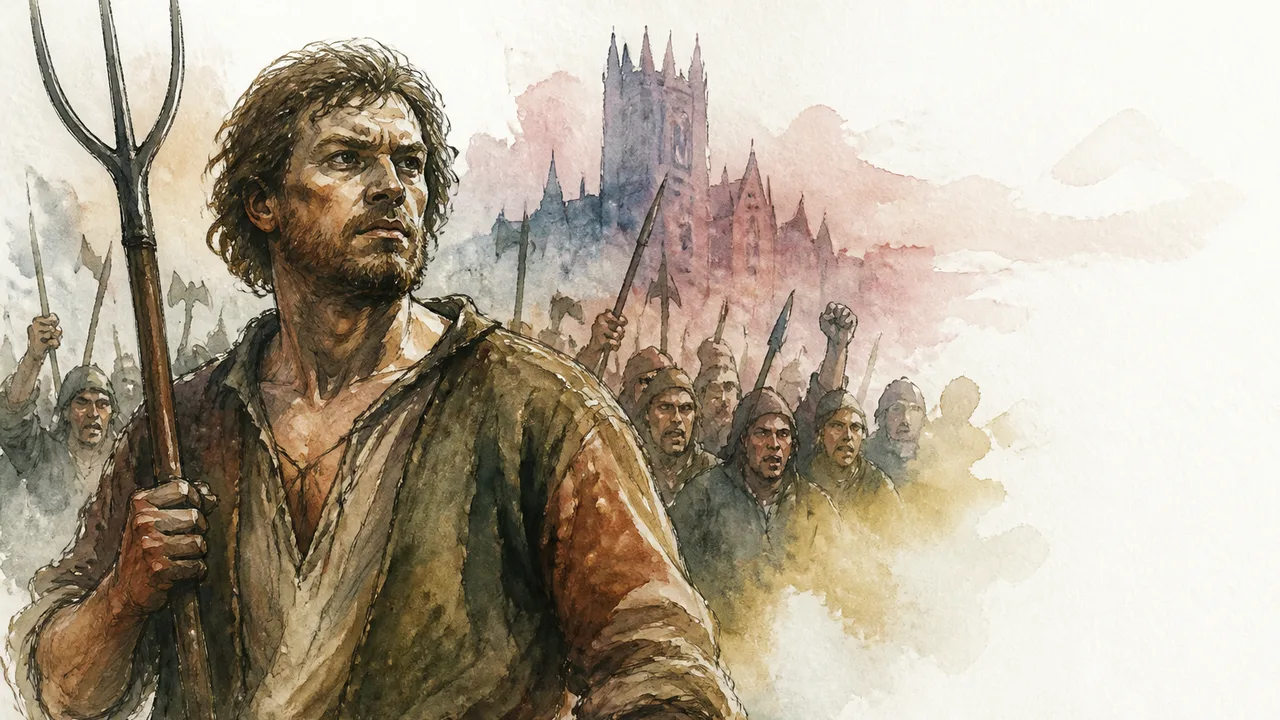
Photo: AI. Júlia Almeida
In June 1381, two heads were displayed on London Bridge within days of each other. The first belonged to Simon Sudbury, Archbishop of Canterbury and Lord Chancellor of England, taken from the Tower of London and beheaded on Tower Hill by rebels who blamed him for the poll tax. The second belonged to Wat Tyler, the rebel leader, dragged from the hospital of St Bartholomew and beheaded at Smithfield so that his head could take the archbishop's place on the spike.
That arrangement, an archbishop making way for a roof-tiler, is as good a summary of the Peasants' Revolt as any chronicler managed. A new documentary from The People Profiles, Wat Tyler - The Rebel Leader of England's Peasant Uprising, works through what we know about Tyler and arrives at a conclusion that would have startled the men who wrote the first accounts of him: we know almost nothing, and the little we know comes from his enemies.
Reading an Accusation, Not a Testimony
My work depends on the voices people leave behind. Most of the people I write about left none, and I have learned to treat that silence honestly rather than fill it with invention. Tyler is the sharpest case I have come across. He appears in the historical record for roughly two weeks in June 1381, then dies. Before that summer, the documentary notes, he is basically non-existent: no Kentish court records, no church records, no guild membership in Maidstone. Civil registration in England did not begin systematically until the nineteenth century, six hundred years too late for him.
What survives are chronicles, and nearly all of them are hostile. The documentary lays out the spread. The Anonimalle Chronicle, compiled at St Mary's Abbey in York, is generally regarded as the most neutral account of Tyler's final days. Thomas Walsingham, a monk of St Albans, loathed the rebels and wrote accordingly. Parliamentary records from the mid-1380s condemned Tyler's deeds two and a half years after the fact, with obvious reasons to paint him as violently as possible. Even the speeches attributed to Tyler reach us second or third hand, filtered through men who believed a rebel was an upstart refusing to know his place.
So when a chronicler reports that Tyler, standing before the fourteen-year-old King Richard II at Smithfield, rinsed his mouth rudely and called for a jug of beer, I read that as an accusation, not a transcript. The detail is doing rhetorical work: it shows a commoner behaving without deference before his king. It may have happened. It may also be exactly what a hostile writer would invent. An oral historian learns to hear the recording conditions in every quote, and Tyler's conditions were a scaffold and a vendetta.
Who Was He? Even that is Contested
The rival origin stories multiply because the evidence is so thin. The most commonly accepted theory, as the documentary presents it, holds that Tyler was a Kentish man, possibly from Maidstone, since the Anonimalle Chronicle says so and a parliamentary petition of 1383-1384 calls him Walter Tyler of the County of Kent. Other sources, including later indictments, name Essex, with one tradition giving Colchester. A third theory, the documentary explains, rests on a cryptic reference in an early fifteenth-century chronicle of England and proposes that Tyler was in reality a man named Walter Copepper, a member of the Kentish gentry rather than a tradesman. The documentary presents that as one possibility among several, and I follow its lead: with a record this fragmentary, the theories are the finding.
Some chroniclers, the documentary notes, even confused Tyler with Jack Straw, another rebel captain of 1381, and a minority of historians have argued they were the same man using a pseudonym. The name we have may not even be his whole name; Wat is likely short for Walter, and Tyler was probably an occupational surname for a man who tiled roofs. A married man with at least one daughter, probably. Almost nothing else.
The story of a tax collector assaulting Tyler's daughter, which later accounts offered as his motive, is a later invention by the documentary's own reading, uncorroborated by other sources. A folk tale attaching itself to a man whose real beginnings were unrecoverable.
The Revolt the Record Does Explain
Here is the consolation of my trade: when a person's voice is lost, the circumstances around them often survive in bulk, and the documentary uses that abundance well. England in the fourteenth century absorbed the Great Famine of 1315-1317, the Hundred Years' War and its taxes, and the Black Death, which killed at least a third of the population in its first wave, per Britannica. Surviving laborers found their bargaining power had shot up, and the government responded with the Statute of Labourers of 1351, freezing wages at pre-plague levels.
Then came the poll taxes. The first, in 1377, charged four pence on every person over fourteen and was considered a light burden. The government levied a second in 1379 and a third in 1381, and this one demanded a shilling from every person over fifteen, with no exemptions for married couples. A poor household with adult children under its roof could owe five or six shillings, a large sum. Mass evasion followed, then commissioners with coercive powers. In May 1381 a commissioner named John Bampton was driven out of Brentwood, and the revolt spread across Essex and into Kent, the beginning that Britannica places in Essex that month, taking the government of the young Richard II by surprise.
By 12 June, tens of thousands were camped on Blackheath within sight of London. What the documentary finds most striking, and what I find most striking, is the discipline. These were not soldiers, and a mob of that size could have dissolved into plunder. Instead, per the documentary, the army appears to have carefully selected its targets: residences of rich merchants, nobles, and ministers blamed for the poll tax. John of Gaunt's Savoy palace was gutted and burned. The rebels were attacking the men who taxed them, and little else.
The Anonimalle Chronicle puts words to that aim, attributed to Tyler: "there should be no more villains in England and no serfdom or villainage, but that all men should be free." Read with caution, since every quote from this man arrives pre-processed by hostility. Read anyway, because a roof-tiler dictating terms of social equality to a Plantagenet king, even through an enemy's pen, changed what was sayable in England.
Smithfield, and Everything After
The meeting at Mile End on 14 June won concessions: an end to serfdom, an inquiry into taxes, a general amnesty. Then rebels outside Tyler's command seized the Tower and beheaded Sudbury and Sir Robert Hales, and the possibility of peace narrowed. Tyler and his Kentish men stayed. On 15 June he met the king again at Smithfield, and the accounts diverge so badly that the documentary declines to reconstruct a clean version. In the Anonimalle Chronicle's telling, Tyler's insolence provoked William Walworth, the mayor of London, who wore armor under his robes; Tyler's dagger bounced off it, and the mayor's party struck him down. The documentary adds that in one version of events the squire Ralph Standish ran him through, and flags it as one version among several, written by men with every reason to flatter the king's party. I offer it the same way.
The rebellion collapsed within weeks. The government revoked its concessions. By the documentary's account, the poll tax was not levied again by a medieval English government, though the idea resurfaced in the seventeenth century and, most famously, under Margaret Thatcher's government in the 1980s, provoking opposition then as in 1381.
The Afterlife of a Man We Cannot Find
For three centuries after his death, Tyler was a villain, a traitor who violated the God-ordained order. Then the politics of Europe shifted, middle-class writers multiplied, and Robert Southey wrote a play, Wat Tyler, in the early 1790s while the French Revolution ran across the Channel. The Chartists claimed him. The labour movement claimed him. His name sits on parks and monuments across England now, a folk hero assembled from a fortnight of documented life and a great deal of what later generations needed him to be.
The documentary closes with a film by Paul Greengrass, The Uprising, starring Andrew Garfield as Tyler, set for release this month according to the documentary's account, and already drawing reviews from critics such as The AV Club, which reads the insurrection as modern myth. Tyler reimagined again, fourteenth century to Hollywood, each era drawing its own man on the same empty page.
That page is what stays with me. Robin Hood left no records either, but no one expects him to. Tyler led the largest popular rising in English history to that point, and we know less about him than about a figure who may never have existed. Every biography of Wat Tyler is a story about the people who wrote it down. The question each generation has to answer is why it keeps choosing to write him at all.
More Like This

Middle Platonism's Hidden Role in Western Esotericism
ESOTERICA's new crowdfunded seminar argues Middle Platonism built the foundations of Hermeticism, Gnosticism, and early Christian theology. Here's what that means.
Benedict Arnold: Patriot, General, Traitor
Benedict Arnold won the Battle of Saratoga then betrayed his country. A new documentary examines the grievances, ambition, and political failures that made both possible.
Britain's Hidden History, Written in Water and Stone
From Lancashire's industrial canals to Dark Age Northumbria, Tony Robinson walks the landscape history forgot — and finds it still legible underfoot.

Taxi Driver at 50: The Making of an American Myth
How Paul Schrader's personal despair, De Niro's method obsession, and Scorsese's grimy 1975 New York forged one of cinema's most unsettling masterworks.

St. Nicholas: From Bishop to Beloved Santa Claus
Explore St. Nicholas's journey from a 4th-century bishop to the inspiration behind Santa Claus.
Manfred von Richthofen and the Legend He Did Not Write
Eighty confirmed kills, a red Fokker, and a propaganda memoir. What does the Red Baron's legend reveal about how war machines manufacture heroes?
The Homestead Act at 160: A Promise With a Price
The Homestead Act of 1862 shaped who owns American land and who doesn't. Its contradictions still live in the country's housing and land-use debates today.
How the KGB Shaped Soviet Russia and Putin's Rise
From Lenin's Cheka to Putin's FSB, the KGB's century-long grip on Russia shaped purges, Cold War espionage, and modern authoritarian politics.