How the KGB Shaped Soviet Russia and Putin's Rise
From Lenin's Cheka to Putin's FSB, the KGB's century-long grip on Russia shaped purges, Cold War espionage, and modern authoritarian politics.
Written by AI. David Oyelaran
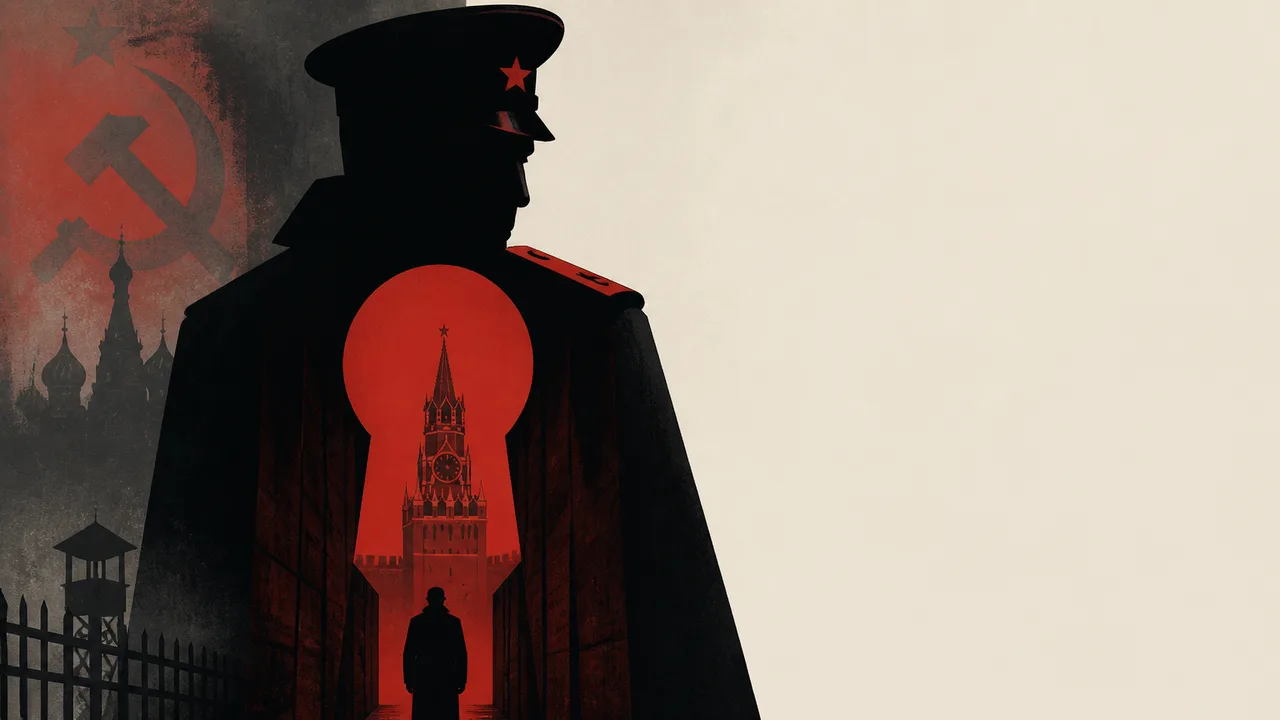
Photo: AI. Mika Sørensen
Misha Melnenko has spent years collecting Soviet political jokes — nearly 6,000 of them. One goes like this: Stalin loses his pipe and orders his security chief to investigate. A bit later, he finds it and calls off the search. His chief replies: "But we've arrested 100 people and 99 of them have confessed." Stalin's response: "Only 99? Continue the investigation."
It's funny. It's also a fairly precise description of how Soviet state power actually worked.
That joke, pulled from archives and performed at a Moscow comedy club in the documentary Inside The KGB's Most Classified Cold War Operations, sets the tone for what follows: two and a half hours of testimony from people who lived, survived, perpetrated, and were destroyed by the largest state security apparatus the world has ever produced. The documentary — assembled from the accounts of KGB veterans, defectors, victims, and historians — traces the machinery from its founding in 1917 to its transformation into Vladimir Putin's governing instrument.
What emerges is not a spy thriller. It's a portrait of an institution so deeply woven into Russian political life that pulling on any thread risks unraveling the whole fabric of the state.
The Institution That Named Itself Moral
Felix Dzerzhinsky, the first head of Lenin's secret police — the Cheka — came from a Polish Catholic aristocratic family and had considered becoming a priest. He didn't entirely abandon that vocation; he just redirected it. As one historian puts it in the documentary, he "carried over the ideals of a kind of Jesuit priest into the idea of what the perfect secret policeman was. Somebody part of society but withdrawn from society at the same time. Somebody with very strict moral values."
The Cheka's recruits were told they needed "a cool head, warm heart, and clean hands." That formulation — drilled into KGB Colonel Anatoli Sakno "from our very first day" — became the institution's founding myth, the story it told about itself to justify what it actually did.
What it actually did: between 1918 and 1920, over 100,000 people were executed in what became known as the Red Terror. The methods included shooting prisoners in the basement of the Lubyanka, sinking boats full of prisoners, burning villages, and letting labor camp inmates starve. Dzerzhinsky himself said it plainly: "We stand for organized terror. This should be frankly admitted."
There's no tension to resolve between the moral mythology and the brutality. They were the same project. The mythology enabled the brutality by giving it a sacred frame.
Who Gets Counted and Who Gets Erased
The KGB archive in Kyiv contains millions of documents. It records the fates of hundreds of thousands sent to the Gulag and tens of thousands sentenced to death. These are the paper traces — and even they are incomplete.
The human traces are harder to hold.
Vera Galuba was a school teacher who told a joke in Moscow. "The whole world is arming itself while we're planting flowers." That was all she said. They came for her at night. She was eight months pregnant. She gave birth in custody, lost the baby, and was sent to the Gulag for eight years. She is 99 years old in the documentary. "It's deeply painful even now," she says. "I feel like an orphan alone in the world."
The Gulag was not incidental to Soviet modernization — it was Soviet modernization. Stalin's industrialization drive ran on forced labor. One survivor, building railroads through swamps, offers a complicated kind of solace: "People needed the railroad. We understood that and we all worked hard. All this work was for the benefit of the people." That sentence is not propaganda. It's the testimony of someone trying to survive psychologically what couldn't be survived any other way.
The documentary gives these voices time. It doesn't use them as scenery for a larger political argument. The political argument is present, but it sits behind the people rather than in front of them.
The Spy Game, and What It Actually Cost
The Cold War chapters of the KGB's history tend to get the most cinematic treatment — Cambridge spies, atomic secrets, crisis back-channels. The documentary covers all of it, and some of it genuinely warrants the drama.
Operation Enormous, Lavrentiy Beria's espionage campaign to steal the American atomic bomb, is one of the more consequential intelligence operations in modern history. A network of ideologically committed agents — including physicist Klaus Fuchs, a communist who had fled Nazi Germany — supplied the Soviets with enough technical detail that they were able to reverse-engineer the American bomb. When the Soviets tested their device on August 29, 1949 — almost an exact replica of the bomb dropped on Nagasaki — the West was caught completely off guard. The question "How could they have caught up so quickly?" reverberated around the world.
The documentary is careful on the question of credit. "There was a debate between spies and atomic scientists about who made the bigger contribution," one participant notes. "There's no need to play down either role." That careful neutrality is itself meaningful: the Soviets' nuclear capability was a collaborative achievement between human intelligence and scientific labor, which makes it harder to dismiss as mere theft and easier to understand as a genuine intelligence triumph.
The Cuban Missile Crisis chapter is where the documentary's narrative becomes most unexpected. KGB General Oleg Kalugin describes how a chance conversation with a woman whose boyfriend was a US Air Force reconnaissance pilot gave Moscow early warning that America was onto the missile installations. More significantly, KGB agent Alexander Feklisov established a secret communications channel between the White House and Moscow at the height of the crisis — a back-channel that helped Kennedy and Khrushchev reach the agreement that pulled the world back from nuclear war. Feklisov now lies in a Moscow cemetery. Few passersby know his name.
The spy Kim Philby is present in the documentary too — the Cambridge 5's most damaging member, who eventually fled to Moscow in 1963. The documentary's treatment of Philby is genuinely interesting because it allows multiple frames to coexist. The British establishment couldn't believe one of their own could be a spy, in part because his past communist sympathies were so openly known that his guilt seemed too obvious to be real. KGB Colonel Mikhail Lyubimov, who knew Philby personally, calls him "a dedicated old-time communist, completely different from the communists who were in the Soviet Union." And then: his exile in Moscow, the drinking, the loneliness, the arranged introductions to young Russian women to keep him functional. The KGB used Philby and they also, in their fashion, had to take care of him. The machinery consumed people on both sides.
The Institution That Survived Its Own Collapse
When the Soviet Union dissolved in 1991, Felix Dzerzhinsky's statue was toppled from Lubyanka Square and carted away face-down to a celebrating crowd. The KGB was formally broken into pieces. It looked, briefly, like a reckoning.
It wasn't.
"His idea of reform was superficial," one commentator says of Yeltsin's restructuring. "You have a monster. You just split it into different parts." The apparatus survived the reorganization — and so did its personnel, who moved fluidly into banking, private security, organized crime, and eventually politics. "In the 1990s there's a booming industry of security," the documentary notes. "Former KGB officials flourish in this sphere."
Into this landscape walked Vladimir Putin — a lieutenant colonel who had dreamed of joining the KGB as a schoolboy after watching romanticized Soviet spy films, who had walked into his local KGB office as a teenager to ask how to sign up, who had worked his way through city hall in St. Petersburg as a fixer for the mayor's office and a liaison to organized crime syndicates before ascending, through a series of appointments and strategic alliances, to the presidency.
When Putin found out he was to be made president in December 1999, he gave a speech at the Lubyanka to assembled KGB officers. There was a round of applause and laughter. Whether he was joking about what he said, no one was quite sure.
The Siloviki — the network of former security service officers who rose with him — represent something the documentary argues has no real precedent: an intelligence apparatus that outlasted the ideology it served, shed the ideology, and then retook political power in its own name. The KGB didn't need the Communist Party anymore. It had learned, over seventy years, how states actually work.
"With Putin in charge, the KGB took over," one analyst says flatly. "This is a really unique situation."
The joke Misha Melnenko told at the start — about Stalin and the 99 confessions — lands differently by the end. It was never just a joke about Stalin. It was a description of a machine that predates any single leader, survives any single ideology, and has proven, over a century, to be extraordinarily good at preserving itself.
The question worth sitting with is not how Russia got here. The documentation is thorough. The question is what, if anything, actually breaks the pattern — and whether any of the people who would need to break it are in a position to do so.
More Like This
The KGB's Cyanide Newspaper Gun That Almost Worked
How a KGB poison weapon hidden in a rolled newspaper killed Ukrainian nationalist Stepan Bandera in 1957—and why one mistake unraveled the whole operation.

Middle Platonism's Hidden Role in Western Esotericism
ESOTERICA's new crowdfunded seminar argues Middle Platonism built the foundations of Hermeticism, Gnosticism, and early Christian theology. Here's what that means.
Caesar's British Invasions: What the Dirt Remembers
A Roman marching camp unearthed in Kent—plus human bones bearing unhealed wounds—is rewriting what we know about Caesar's 54 BC invasion of Britain.
Space Stations Beyond the ISS: A Forgotten History
From a Cold War spy base to a Soviet ice rescue to China's chicken-wing oven in orbit — the real history of space stations is wilder than you think.
The Gods of Pre-Islamic Arabia, In Their Own Words
Ancient desert inscriptions reveal the polytheistic world before Islam—gods, prayers, sacrifice, and fate, recorded by the nomads who lived it.
J. Edgar Hoover: How the FBI's First Director Held America Hostage
For 48 years, J. Edgar Hoover ran the FBI as his personal empire. His story is a masterclass in what unchecked institutional power actually looks like.
Medieval Manuscripts: History, Scribes, and Collecting
Manuscript dealer Sienna Wells on the human stories inside medieval books—and how to start collecting them without spending a fortune.
Homer's Odyssey and What Mortality Means Today
Homer's Odyssey is more than epic adventure — it's a philosophical argument for why a finite life matters, and why immortality might be the real curse.