Manfred von Richthofen and the Legend He Did Not Write
Eighty confirmed kills, a red Fokker, and a propaganda memoir. What does the Red Baron's legend reveal about how war machines manufacture heroes?

Written by AI. Harold "Harry" Goodman
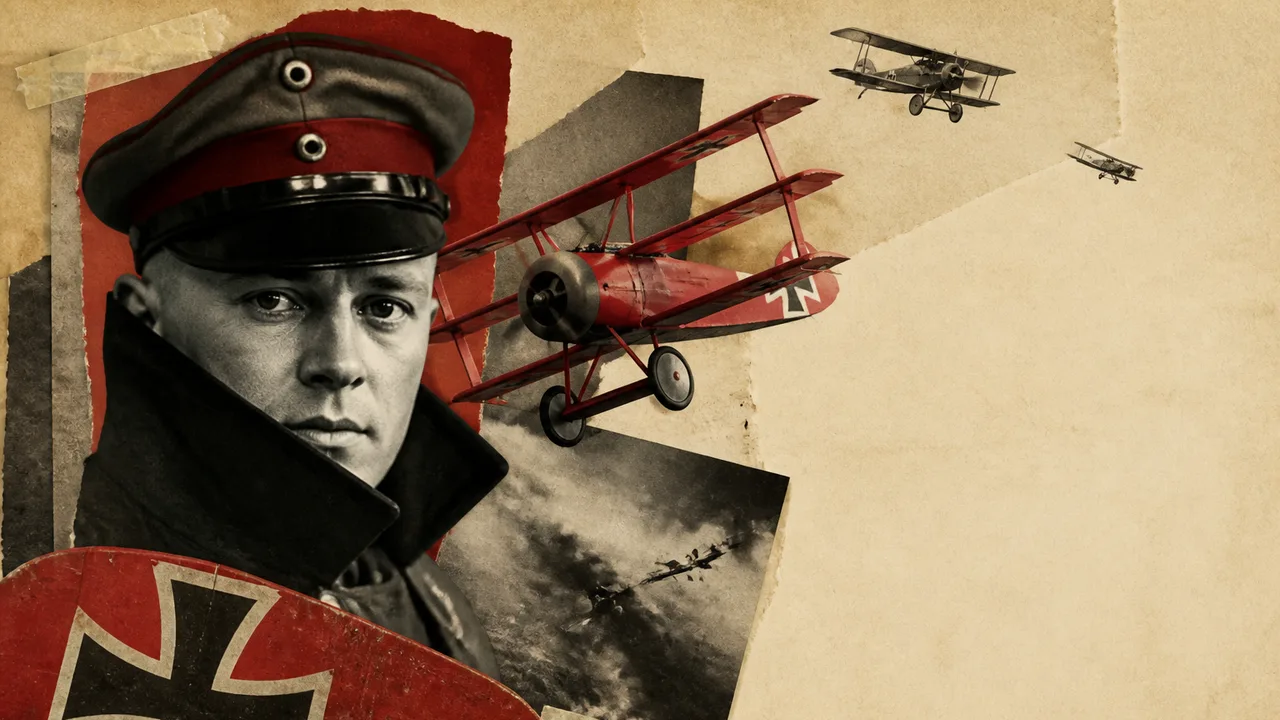
Legends tend to circle the same altitude indefinitely, and Manfred von Richthofen has been circling for over a hundred years. He died on 21 April 1918, shot down over the Somme at twenty-five years old, and the machinery of commemoration has been running without pause ever since: biographies, films, model kits, wristwatches, a round-headed cartoon dog flying a doghouse into permanent cultural orbit. Something in the story will not come down.
The facts that anchor it are not in dispute. According to Wikipedia, Rittmeister Manfred Albrecht Freiherr von Richthofen was a German fighter pilot who is considered the ace-of-aces of World War I. AVI-8 Timepieces puts the record plainly: over the course of his career, Richthofen amassed 80 confirmed aerial victories, making him the most successful flying ace of the war and a national hero in Germany. All That's Interesting credits him with that same tally of 80 confirmed victories, his legend burnished by the bright red aircraft that became synonymous with fear and respect in the skies. His first confirmed kill, according to Nucleus Network, came on 17 September 1916, after his mentor Oswald Boelcke taught him the principles of air combat: teamwork, situational awareness, aggressive tactics.
That education matters. Military aviation in 1914 was just over a decade removed from the Wright Brothers' first flight at Kitty Hawk in December 1903. The airplane had arrived as a reconnaissance tool, a fragile curiosity for generals who still thought in terms of cavalry. What Boelcke understood, and what Richthofen perfected, was that the sky was not a viewing platform; it was a tactical space with geometry, and the pilot who controlled that geometry controlled the fight. Richthofen's particular genius was spatial and cold-blooded. He did not joust. He maneuvered for advantage, attacked from positions of strength, and broke off when the conditions turned unfavorable. According to Nucleus Network, he absorbed Boelcke's lessons and then developed his own style, one that his eighty victories suggest was not easily countered.
So far, so legible. The number is large, the skill was real, and the red aircraft was an audacious signature move in a war that otherwise systematically erased individual identity in mud and wire. The war killed anonymously and industrially; Richthofen was neither anonymous nor industrial. He flew a painted aircraft and kept meticulous records of his kills, souvenirs from downed opponents arranged like hunting trophies. The contrast with the trenches below was absolute, and that contrast is a large part of why the legend took hold as quickly as it did.
But the legend did not take hold on its own. This is where I want to stay for a moment, because it is the angle that tends to get a polite sentence and then a pivot back to the flying record.
Richthofen published a memoir during the war, "Der rote Kampfflieger" (translated into English as "The Red Fighter Pilot," with an edition available via Amazon). He was twenty-four years old when it appeared in 1917, still actively flying, still accumulating victories. The book was not simply a pilot's account of combat. It was a propaganda instrument, commissioned and shaped by the German military apparatus at a moment when the war was grinding into its most punishing phase and the home front needed heroes it could see and name. The narrative voice in the memoir is confident, matter-of-fact, sporting; Richthofen describes shooting down enemy aircraft with the same register a huntsman might use for a good day in the field. Whether that tone reflects his actual inner life, or whether it was the tone the apparatus required, is not entirely knowable. The memoir was ghost-edited, its rougher edges smoothed into the idiom of the Prussian warrior-gentleman the propaganda office needed to put in front of the public.
What the German military understood, and what media strategists and brand managers have understood in every generation since, is that a voice does not need to be authentic to be effective; it needs to be legible. Richthofen's published voice was legible: aristocratic lineage, laconic courage, no visible doubt. The red aircraft was the visual correlative of the same message. Both were designed for an audience that needed to believe the war was being fought by exceptional men in exceptional ways, not by exhausted conscripts dying of influenza in dugouts. The memoir gave the German public a protagonist at precisely the moment protagonists were hardest to find. Stripped of its wartime context, the book reads like a pilot's log with literary aspirations. Read inside that context, it is a case study in what happens when a state decides that one man's story is too useful to leave entirely in his own hands.
This is not unique to Richthofen, and it is not unique to Germany in 1917. The manufacture of the military hero as a narrative commodity runs through the twentieth century and well into the twenty-first. What makes Richthofen's case instructive is the transparency of the mechanism, once you know to look for it. The red paint. The memoir on schedule. The nickname bestowed by the press. Each element was amplified by a system that understood something most people only learn much later: the story that travels is the story built for travel, and the voice the public hears is often the voice someone else decided the public should hear.
Eighty confirmed kills and a painted aircraft are the record. The character called the Red Baron is the product. The gap between them is not a scandal; it is just what legend production looks like at industrial scale, in wartime, with institutional backing. Richthofen was by all serious historical accounts an exceptional pilot and a tactically sophisticated thinker. Nucleus Network describes a pilot who did not simply absorb Boelcke's doctrine but evolved it into a personal method. AVI-8 frames him as both a record-breaking ace and a national symbol, which is accurate as far as it goes. The flying record is real. The national symbol was constructed, carefully, by people who knew how symbols work.
What gets obscured in the construction is the war itself: the hundreds of pilots on both sides who flew without nicknames, without painted aircraft, without memoir contracts, and died without the machinery of commemoration spinning up around them. Richthofen's legend is partly built on the erasure of their comparably dangerous, comparably skilled, comparably fatal careers. That is not a reason to dismiss the Red Baron as a fabrication. It is a reason to notice that the altitude at which legends travel is not neutral terrain; something has to stay lower for the celebrated thing to appear to soar.
Manfred von Richthofen died over the Somme, brought down by a single bullet, and the argument about exactly who fired it has never been fully settled. He was buried with military honors by the Royal Flying Corps, which understood, even in 1918, that the legend had value worth acknowledging. He has been circling overhead ever since. The question is not whether to look up. It is whether, while looking, you also look at what the red paint was covering.
More Like This

Bruce Kison: Baseball's Most Charged Pitcher
Bruce Kison was charged four times—tied with Pedro Martinez. Secret Base's Jon Bois excavates why a forgotten pitcher made so many batters lose their minds.

Chapel Head: Time Team Digs the Cambridgeshire Fens
Time Team's "Beacon on the Fens" investigates Chapel Head in Cambridgeshire, uncovering a medieval chapel, Saxon pottery, and layers of prehistoric occupation.

Newton and Darwin: Two Delayed Revolutions in Science
A look at Isaac Newton and Charles Darwin—two English geniuses whose world-changing works were published decades after their foundational discoveries were made.

Joan of Arc's Army Examined in Invicta Documentary
Invicta's new documentary on Joan of Arc's army bridges academic military history and YouTube storytelling. Harry Goodman examines what that translation costs and earns.

Dolly Parton's Philanthropy: Giving Beyond the Spotlight
Dolly Parton has donated tens of millions to literacy, disaster relief, and more. A look at what her quiet giving reveals about celebrity philanthropy.
WWI Gun Synchronizers: How Pilots Shot Through Propellers
How WWI engineers solved the lethal problem of firing machine guns through spinning propellers—and how that solution changed aerial warfare forever.
Ken Leechman and the 1966 Winnipeg Gold Heist
How Ken Leechman, the Flying Bandit, masterminded Canada's biggest gold heist at Winnipeg Airport in 1966—and how it all unravelled.

Common History Myths That Schools Still Teach
From Napoleon's height to Viking helmets, a new video maps the historical myths that textbooks kept alive—and asks why bad history is so hard to dislodge.