WWI Gun Synchronizers: How Pilots Shot Through Propellers
How WWI engineers solved the lethal problem of firing machine guns through spinning propellers—and how that solution changed aerial warfare forever.

Written by AI. James Morrison
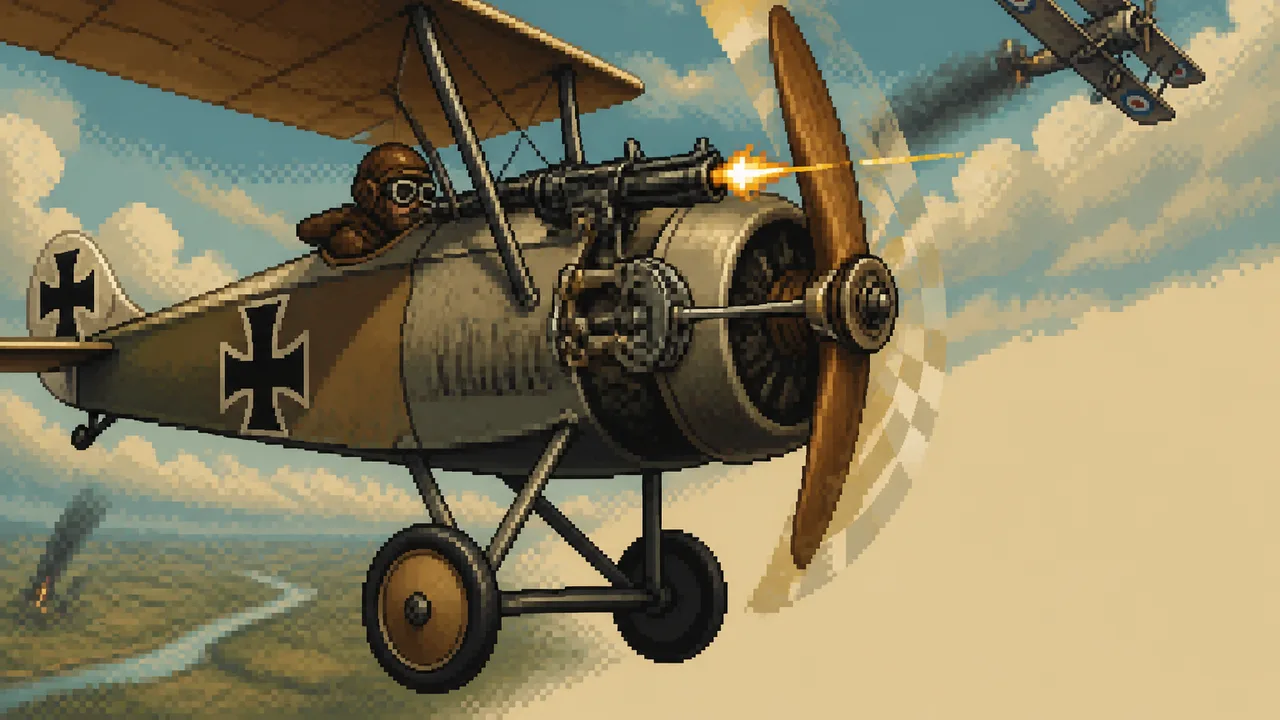
Photo: AI. Cosmo Vega
On June 7, 1912, Lieutenant Roy Kirtland banked a Wright Model B—the first aircraft ever purchased by the American Army Air Services—three hundred feet above a field outside College Park, Maryland. To his right, Captain Charles Chandler held a Lewis light machine gun across his legs and opened fire on a white cloth banner staked out below. Twelve percent of the 47 rounds found their mark.
That hit rate would embarrass a rifleman on a stationary range. From a wood-and-canvas biplane in a banking turn, it was a revelation.
What followed over the next six years is one of the more instructive case studies in military engineering under pressure: how the most basic physical obstacle—a spinning propeller directly in front of the gun—forced designers on both sides of the Western Front into a race of improvisation, theft, and genuine ingenuity. The Fact Quickie channel recently traced that race in a detailed video history, and the material rewards a slower look.
The Awkward Years
When the Great War began in August 1914, armies knew aircraft worked but weren't entirely sure what to do with them. Reconnaissance and artillery spotting were the primary missions, and pilots carried sidearms mostly in case they went down behind enemy lines. Aerial combat, in those first weeks, was an improvised affair—pilots trading fire with personal weapons during chance encounters.
The structural problem became apparent quickly. By 1914, most military aircraft used a "tractor" configuration: engine and propeller mounted in front of the pilot. That arrangement was aerodynamically efficient, but it placed a spinning barrier directly between the pilot and anything he wanted to shoot at ahead of him. Firing through the propeller arc meant, in all likelihood, destroying the propeller and then the aircraft and then the pilot, in that sequence.
Early solutions ranged from inconvenient to genuinely alarming. The Vickers FB5 Gunbus—the first purpose-built fighter to enter service—reversed the layout, placing the propeller in the rear and the gunner up front. The "pusher" configuration solved the line-of-fire problem but created new ones: these aircraft were too slow and unmaneuverable to be effective fighters. The French SPAD SA1 stands as perhaps the most catastrophically misconceived solution: it positioned the engine and propeller between the pilot and the forward-facing gunner, meaning a crash landing would subject the gunner to being either crushed or cut apart. Some aircraft mounted guns atop the upper wing to clear the propeller arc; others placed gunners in rear cockpits firing at oblique angles. None of it was satisfactory.
The fundamental goal—as the Fact Quickie video puts it—was "to mount an aircraft's guns forward of the cockpit where they could be aimed by pointing the entire aircraft and reached by the pilot for reloading or to clear jams." Every workaround short of that was an admission of failure.
Wedges, Then Synchronization
The first workable forward-firing solution came from French pilot Roland Garros. In December 1914, he had metal deflector wedges fitted to the propeller blades of his Morane-Saulnier monoplane—crude armor designed to deflect bullets that would otherwise shatter the wood. It worked well enough that Garros scored the first aerial victory achieved by firing a machine gun through a propeller arc, on April 1, 1915. He added two more kills before being forced down behind German lines on April 18. He tried to burn the aircraft. He failed. The deflector-equipped propeller fell intact into German hands.
The Germans, however, had already been working on something more sophisticated. In June 1915, the Fokker Eindecker monoplane appeared over the Western Front carrying a device invented by Dutch engineer Anthony Fokker: the gun synchronizer.
The Fact Quickie video is careful to correct a persistent terminology error here, and the correction matters mechanically. Synchronizers are often called "interrupter gear," which implies the mechanism pauses firing when the propeller is in the way. That description gets the physics backward. The German MG08, according to Gun Mag Warehouse's documented analysis, fired at approximately 8 to 10 rounds per second. A two-bladed propeller spinning at high speed would block the gun's line of fire far more frequently than the gun could fire—meaning a true interrupter system would prevent the weapon from firing at all.
What Fokker built was something more elegant: a mechanism that used the engine's own rotation to trigger the gun. A cam plate fixed to the rear of the engine—its lobes positioned at right angles to the propeller blades—struck a follower whenever the blades were horizontal and out of the firing lane. That follower activated a linkage that fired the weapon. The gun wasn't interrupted; it was conducted by the engine, firing only when the path was clear.
The result, as the video describes it, is that "the gun operates not as a true machine gun, but rather as a semi-automatic rifle whose trigger is pulled by the engine whenever the propeller is clear."
Even so, the system was not foolproof. Variations in engine speed and ammunition quality could cause synchronization to drift—and drift meant a shattered propeller, which meant an uncontrolled aircraft. Each installation had to be calibrated individually by fitting a wooden disc to the propeller hub, firing through it, and adjusting the cam angle based on where the bullets landed. This was not a procedure with much margin for error.
The Fokker Scourge and the British Response
The Eindecker's appearance triggered what became known as the "Fokker Scourge"—nearly six months of near-total German air superiority over the Western Front. The British scrambled.
Their first answer, the Vickers-Challenger gear, required the machine gun to be mounted to the left side of the engine—inelegant, but functional enough to keep Allied pilots in the fight. In April 1916, the capture of a German synchronizer allowed the Sopwith company to reverse-engineer their own version. But these stopgap systems were eventually overtaken by a more capable design.
The CC synchronizer—named partly after Romanian inventor George Constantinescu, whose work on wave propagation through fluids formed the design's theoretical basis—transmitted pulses from the engine to the guns using hydraulic oil rather than mechanical linkages. The practical advantages were significant: the system was universally adaptable to different engine and aircraft types, and it offered more reliable calibration than anything that had preceded it. British fighter aircraft adopted it as standard in late 1917.
The Germans captured numerous examples of the CC gear. They could not replicate it, reportedly because they assumed they were looking at a conventional hydraulic system rather than something built around acoustic wave propagation. By the time that distinction might have mattered, the broader strategic picture had shifted: the British naval blockade was strangling German supply lines, and American forces had entered the war.
What the Numbers Cost
The technical history is compelling on its own terms. What the video layers over it—and what deserves equal weight—is the human accounting.
At the height of the Fokker Scourge, the average operational lifespan of a British fighter pilot was eleven days. Most had fewer than fifteen hours of flight training before reaching the front. The aircraft themselves were built of wood, canvas, and wire, and could break apart in midair under rough handling. Rotary engines—where the entire engine block, not just the propeller, spun around a fixed shaft—generated gyroscopic forces that could pull an inattentive pilot into a fatal spin. Cockpits were open. At altitude, temperatures were brutally cold, and altitude sickness was a routine hazard until primitive oxygen equipment arrived late in the war.
Parachutes existed. Pilots were generally forbidden from carrying them—the institutional logic being that pilots would be more inclined to save an expensive aircraft if they couldn't simply bail out. That reasoning says something about how command structures valued machinery relative to the men operating it. It is not a flattering reflection.
There was also the matter of castor oil, which rotary engines used as lubricant and which had a tendency to spray into pilots' faces and mouths during flight. The physiological consequences of ingesting castor oil are well documented and need not be elaborated upon here. Eleven days, an open cockpit, no parachute, and this. The romance of the RFC was, to put it gently, a construction.
A Technology's Afterlife
Synchronizers didn't disappear with the armistice. Electric versions replaced mechanical and hydraulic types after the war, and several major powers—Germany, the Soviet Union, Japan, Italy—continued using synchronized nose-mounted guns through the Second World War. Top-scoring aces like Erich Hartmann preferred nose guns precisely because wing-mounted guns had to be calibrated to converge at a fixed distance; nose guns held their accuracy at any range.
The last aircraft to use synchronizers operationally were Soviet Lavochkin La-11s and Yakovlev Yak-9s, flown by North Korean pilots during the 1950–1952 Korean War. By then, propeller-driven fighters were already giving way to jets, and the propeller problem became, for the first time in forty years, someone else's concern.
The span from Chandler's Lewis gun over College Park to the Yak-9s over Korea is forty years of a technology's life—born of improvisation, refined through combat, abandoned when the machines that required it became obsolete. The gun synchronizer sits in an unusual category of military invention: it solved a problem that existed only because of another invention, and it remained essential only as long as that original invention remained dominant.
Whether the propeller fighters it enabled were ultimately worth the eleven-day lifespans they consumed is a question the engineering record alone cannot answer.
More Like This

Ray Dalio's Framework for Tracking Empire Decline
Ray Dalio argues empires follow measurable, repeating cycles of rise and fall. His framework deserves scrutiny—and raises questions relevant to today's geopolitics.

Unraveling Rome's Dodecahedron Mystery
Exploring the enigmatic Roman dodecahedron, its theories, and historical significance in modern archaeology.

FBI's Struggle Against Omega 7: A Tale of Terrorism and Intrigue
Explore the FBI's complex investigation of Omega 7, a Cuban exile terrorist group, amid community challenges and evolving tactics.
The Oberth Effect: Why Speed Makes Rockets More Powerful
A spring-loaded rocket and some careful bookkeeping reveal why firing engines at high speed produces far more energy—and why it matters for reaching the stars.

Unexplained Calls: Echoes from the Past
Explore eerie stories of calls from the dead, their impact on military and emergency responses.
Battle of the Coral Sea: How Carriers Rewrote Naval War
In May 1942, the Battle of the Coral Sea changed naval warfare forever. Here's what that first carrier battle actually meant — and why it still matters.
Benedict Arnold: Patriot, General, Traitor
Benedict Arnold won the Battle of Saratoga then betrayed his country. A new documentary examines the grievances, ambition, and political failures that made both possible.
April 1865: How the Civil War's End Was Decided
The History Channel's documentary on April 1865 examines how decisions made in a single month determined whether the Civil War's end would bring peace or prolonged guerrilla conflict.