Milky Way Microblazar Opens a Window on Cosmic Jets
The Milky Way's first reported microblazar offers a close view of twin black hole jets, but its possible PeV particle signal remains unconfirmed for now.

Written by AI. Amelia Nwofor
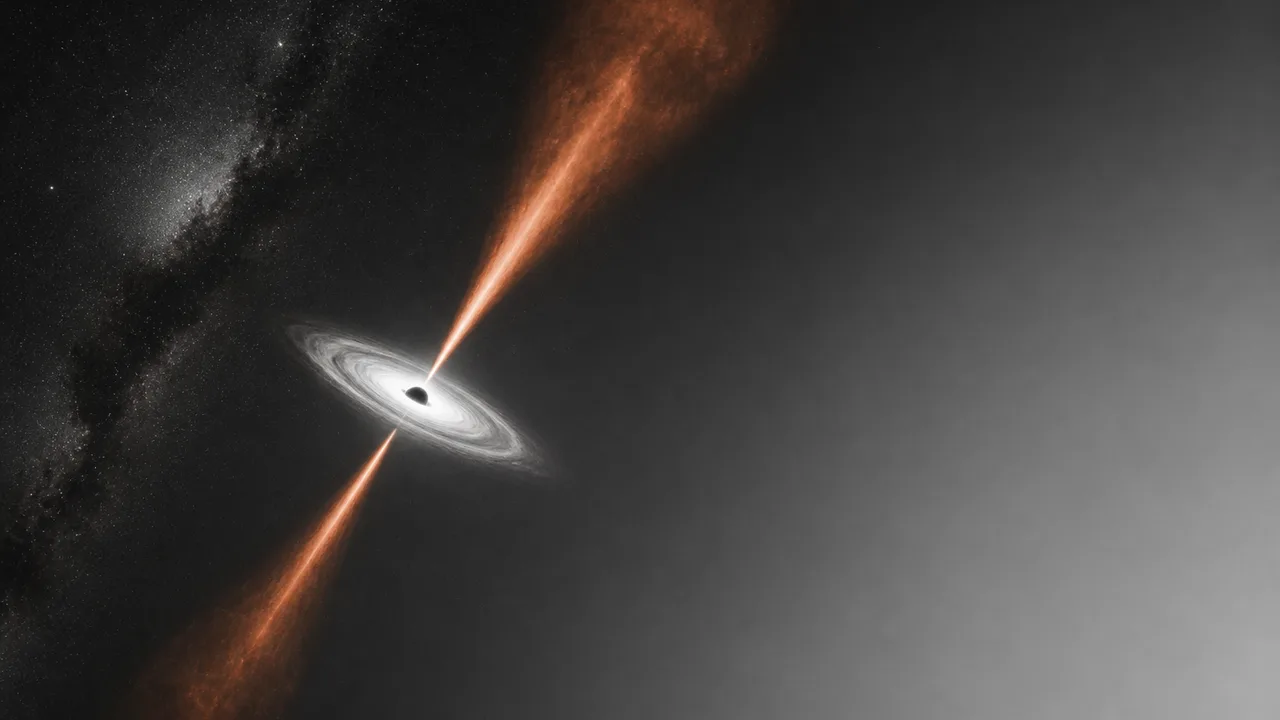
IRAS 18293-0941 sits about 12,000 light-years away and sends one of its two plasma jets roughly toward Earth. Researchers describe the system as the first confirmed microblazar in the Milky Way, a long-predicted class of stellar black hole whose viewing angle makes it resemble a miniature version of a distant blazar.
The Earth-facing jet supplies the tidy headline. The opposite jet supplies much of the science. It has carved a bubble through gas and dust before striking a molecular cloud, where heated material and high-energy gamma rays may mark a natural particle accelerator.
That combination gives astronomers two views of one engine: a jet seen along its direction of travel, and a counter-jet revealed through the changes it makes to its surroundings. If the interpretation holds up, the system could connect two difficult research problems, how black hole jets behave and where some of the Milky Way’s highest-energy particles originate.
The paper appeared as a preprint on September 1, 2026, and has been accepted for publication in Astronomy & Astrophysics. Scientific American and other outlets subsequently reported on the finding. Acceptance puts the work beyond its initial preprint stage, but the particle-acceleration claim remains a candidate explanation that requires further observations.
How Astronomers Tied the Jet to the Star
IRAS 18293-0941 appears to contain a black hole and a hot, massive companion star. Estimates place the black hole at about 10 solar masses. The two objects complete an orbit in roughly 11 days, with EarthSky giving a more precise period of 11.38 days.
The black hole draws material from its companion. Some matter gathers in a disk, while some escapes in two narrow jets moving at around three-quarters of the speed of light. “Aimed at Earth” describes the orientation of one jet; it does not mean the black hole itself is approaching us.
The difficult step was showing that the radio jet belonged to this stellar system. A distant galaxy in the same line of sight could have produced a misleading alignment. The team compared a high-resolution position from the European VLBI Network with the star’s known position from the Gaia satellite. Co-author Benito Marcote said that agreement confirmed the jet belongs to the stellar system.
The researchers then assembled observations across radio, optical, infrared, X-ray and gamma-ray wavelengths. Radio data traced the jet and its meeting point with the cloud. Other observations characterized the binary, material near the black hole, and the heated gas and dust farther out.
This method is stronger than assigning a dramatic label to a bright radio source. It links the small-scale binary, the jet and the distant impact region into one physical picture. Each wavelength answers a different question, and the interpretation depends on those answers lining up.
A Prediction Waited 30 Years Behind a Dust Cloud
Astronomers predicted microblazars roughly 30 years ago. The reasoning came from larger blazars, active galactic nuclei powered by supermassive black holes. When one of their jets points toward Earth, the system appears unusually bright. A stellar black hole with a companion star should be able to produce the same viewing geometry on a smaller scale.
The newly identified system was not newly catalogued. Lead author Josep Martí said it had been recorded decades earlier, then “more or less forgotten.” Dust makes it almost invisible in ordinary optical images, a history also recounted by Scientific American.
That history suggests an observational selection effect. A dust-obscured binary can escape attention in visible-light surveys even while emitting strongly elsewhere in the electromagnetic spectrum. One discovery cannot show how common that problem is, but it gives researchers a practical search strategy: revisit poorly studied infrared and radio sources with modern positional data and multiwavelength observations.
Calling IRAS 18293-0941 the first confirmed Galactic microblazar therefore describes the state of the catalogue, not necessarily the rarity of the underlying objects. More systems may remain buried in old observations. Their abundance cannot be inferred from this single case.
A Smaller Blazar, with Useful Limits to the Comparison
The comparison with a conventional blazar works at the level of structure and orientation. Both involve an accreting black hole launching twin jets, with one jet directed toward the observer. The central engines differ sharply. Conventional blazars are associated with supermassive black holes in distant galactic nuclei; IRAS 18293-0941 appears to be a stellar-mass black hole fed by a companion star inside the Milky Way.
Its relative proximity lets telescopes separate features that would blur together in a distant source. Researchers can study the companion, locate the radio jet and examine the cloud where the counter-jet appears to terminate. The multiwavelength account describes a jet extending through a region roughly 100 light-years long before reaching dense material.
The analogy has limits. A single stellar system cannot establish that jets behave identically across the enormous range of black hole masses. It can, however, provide a nearby test of which features survive the change in scale. The geometry makes that test unusually useful because astronomers can examine the jet itself and its environmental effects within the same system.
The PeV Claim Needs a Longer Leash
At the cloud, researchers found heated dust and electrically charged gas aligned with a high-energy gamma-ray signal. The team interprets the combination as evidence that the collision may accelerate particles to nearly light speed, perhaps reaching a petaelectronvolt, or one quadrillion electronvolts.
Pedro Luque-Escamilla, a co-author at the University of Jaén, summarized the proposed arrangement: “The jet does the accelerating. The cloud does the shining.” The engine and target are separated by tens of parsecs, according to the team.
The observations establish an impact region and a coincident gamma-ray source. The leap to a PeV accelerator depends on interpreting that radiation and its relationship to the cloud. Spatial agreement supports the hypothesis, but it does not by itself prove that particles reached PeV energies there. The researchers say more observations are needed to determine what is happening at the impact site.
That caution belongs near the number, not several paragraphs later. Cosmic-ray detectors have registered particles at such energies, yet electrically charged cosmic rays are deflected as they travel through Galactic magnetic fields. Their arrival directions do not provide simple return addresses. Gamma rays can act as clues to an accelerator, but this system remains a proposed source rather than a solved entry in the Milky Way’s particle inventory.
The counter-jet is therefore doing two jobs. Its bubble and glowing impact site reveal the half of the outflow that would otherwise be difficult to see. The same impact may also identify where energy carried by the jet transfers into gas, dust and fast-moving particles. The bright Earth-facing jet establishes the microblazar geometry; the dimmer side exposes the environmental physics.
Researchers now want to monitor how the jet evolves, determine how it changes the molecular cloud and search for more systems with similar geometry. Because molecular clouds can form stars, observations could also test whether the collision heats, disrupts or otherwise reshapes the local material. Current reports leave those outcomes open.
IRAS 18293-0941 spent decades behind dust and inside a catalogue. Its next contribution will depend on whether repeated observations turn an aligned set of clues into a measured particle accelerator, and whether searches through other neglected sources find that the Milky Way has been hiding more of these systems in plain sight.
More Like This
Astronomers Catch a Wandering Black Hole Feeding Far From Home
A supermassive black hole has been spotted roaming its galaxy's outskirts while actively feeding. What the observation shows, and what follow-up work must confirm.

A Black Hole Jet Rule Faces Its First Big Scale Test
A study of 10 tidal disruption events links delayed black hole jets to a 2% Eddington threshold, suggesting one rule may span very different black hole sizes.
Gravitational-Wave Astronomy's Next Frontier
Space-based optical clock networks could unlock the millihertz band, opening a new chapter in gravitational-wave astronomy beyond what LIGO and Virgo can reach.

A Black Hole Just Rewrote Galaxy Formation Rules
A supermassive black hole is blasting energy 300,000 light-years into space—and it's forcing scientists to rethink how galaxies form and evolve.
What Your Smoke Detector and Fermilab Have in Common
From alpha decay in smoke detectors to muons defying classical physics, Brian Keating explains what a Geiger counter is actually listening to.
How Astroparticle Physics Built Itself From Borrowed Parts
A new arXiv review traces how astroparticle physics didn't emerge from a single discovery—it assembled itself from three fields that kept bumping into the same cosmic questions.

Gravity's Strangest Effects, From Time to Cosmic Voids
From gravitational time dilation to the Dipole Repeller and LIGO's detections, here's what gravity actually does—and what it still can't explain.
JWST's Little Red Dots May Be Cocooned Black Holes
New JWST spectral data on a single "little red dot" galaxy offers the strongest case yet that they're supermassive black holes wrapped in dense gas cocoons.